

In the Octagon ‘‘Robbie’’ Burns had evidently roused himself to enter into the spirit of the occasion, his head surmounted by a white top hat, conspicuous garters round his legs and the familiar sign of the three balls suspended in front of his nose. One of the big city churches had the usual sign on its noticeboard replaced by one assuring passers-by that ‘‘It pays to advertise.’’
These and similar conspicuous pranks made it impossible for anyone to forget the occasion.
Large numbers even went as far as the University to watch the spectacle assemble and start off. The day was fine, but an easterly wind bit shrewdly, and the most daring dancers in the scantiness of their attire must have envied their fellows who came disguised as woolly gollywog sheep.
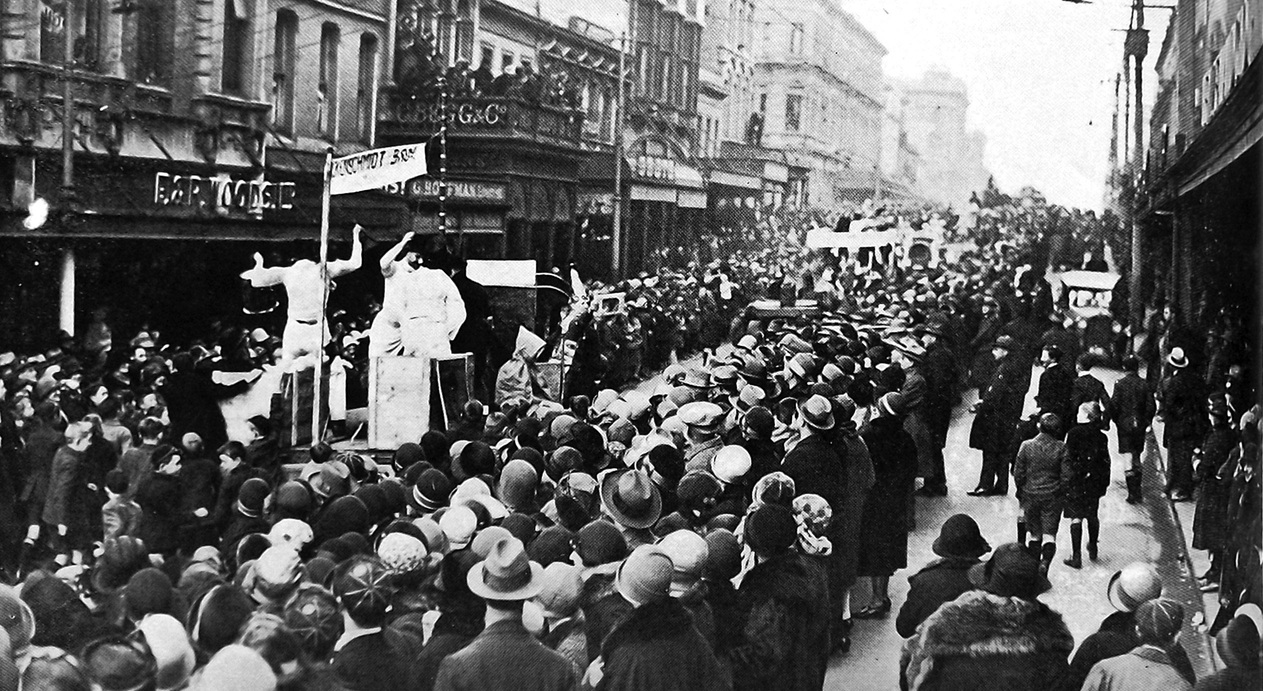
The costumes, as a whole, were probably as gay, as varied, as ingenious and as numerous as any that have been got together in previous years. Many, of course, elected to appear as girls, and they jostled and frolicked about with pierrots, dancers, Indians red and otherwise, Chinamen, swaggers, devils, Russians, negroes, policemen, Ku Klux Klansmen, nurse girls, school girls, girl guides, burglars, soldiers, mounted policemen, and dozens of others. The numerous lorries and tableaux that made up the procession appeared to be quite up to standard. Naturally the Exhibition provided most of the material for banter and satire.
The ‘‘doomed corsets’’ or ‘‘Coarse Sex’’ was the title given a tableau meant to recall the Russian singers who have just completed their season here, while a famous dancer was easily recognisable by the name of ‘‘Palm Olivova .’’ The Indian hockey team, the ‘‘Quick Munch’’ at the Exhibition, roll-downs, silk stocking show (‘‘Licensed by the Council of Churches’’), the reopening of the hotels at Waihi after the 17 years’ drought, the discovery of illicit stills in Southland, children’s playgrounds, a singing teacher and his pupils, and the methods of several well-known business firms each formed the topic for an exuberant and more or less successful tableau. Several most decrepit motor cars added to the gaiety of the scene, and one was ingeniously transformed to represent the Passchendaele locomotive. One of the most ambitious of the devices was in the form of an aeroplane and bore legends about Amundsen’s flight to the North Pole. Another illustrated Zane Grey’s fishing exploits.
Right from the beginning of the procession at the University all along the route the way was thickly lined with laughing spectators of all ages craning their necks and pushing to get the closest view of all that was passing. Many police were kept busy making a way through the crowds. The trams nosed their way along foot by foot for a long while, till finally they were brought to a complete standstill by the density of the crowds. — ODT, 15.7.1926


