

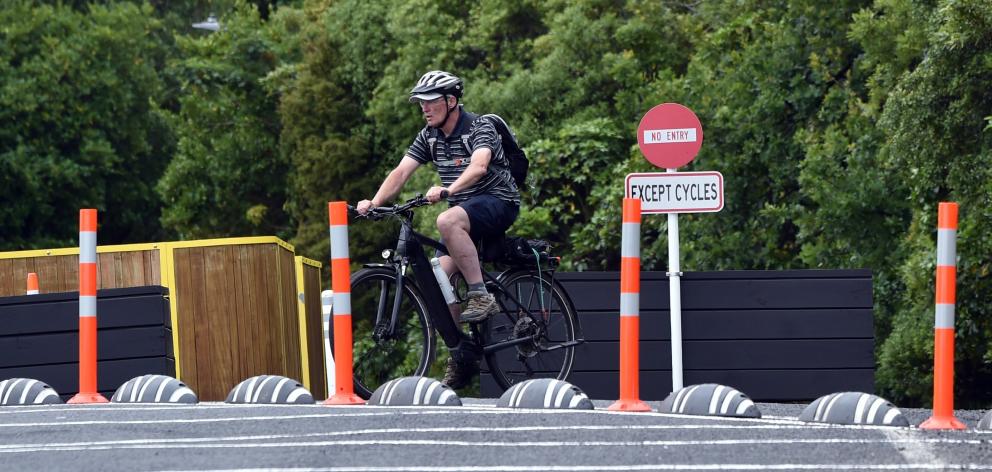
Oh me of too much faith in the new DCC
I had held a forlorn hope that the recently elected Dunedin City Council were going to show more restraint and more sense in their decisions regarding the running of this city.
The partial closure of the Town Belt demonstrates that nothing has changed. There have been a number of absolutely idiotic and money-wasting decisions over the years, sitting areas on disused bus stops to give the city an “English Village” style (until a vehicle ran into one), coloured dots on the roadway and half-a-million-dollar see-saws in George St.
Now we have a partial closure of the Town Belt to add to the list. Yoga and table tennis? The road is undulating, who in their right mind is going to travel to the area to play table tennis when the ball will likely run off into the bush or soggy drainage ditch when it misses the table?
Only last year the council chose to cut back on services to save money, e.g. cutting grass verges, killing weeds on footpaths. The whole city needs a good tidy-up and the council needs to stick to its knitting and provide core services.
I walked through the area last Monday with a walking group: we were all astounded and bewildered by the absurdity of it all.
Who is being paid to come up with this stupidity? Stop this nonsense and waste of ratepayers’ money.
Dianne Avey
Dunedin
[Abridged — length. Editor.]
'Trial' pointless
In an effort to broker a solution to the fracas over the use of the Town Belt roadway, may I suggest that the councillors consider the following double-pronged solution: move the problematic seesaws from George St to the Town Belt for the convenience of fitness-inclined ratepayers.
This would negate the need for an unnecessary, expensive cycle track, and (wait for it), the seesaws would arguably get even less use than they do now, saving money on their frequent and expensive repairs: a win-win for ratepayers. I also contend that my tongue-in-cheek suggestion has more honest credibility than the $15,000 ‘‘trial period’’ foisted on ratepayers to give what they clearly intend to do regardless, a semblance of credibility.
The trial period is an insulting, pointless exercise, deliberately set up to fail. Ratepayers deserve better.
Brendan Murphy
Ravensbourne
Three things
Josie Vidal (Opinion ODT 26.1.26) overlooks three important facts about mining companies. As eruditely elaborated by Tim Hazledine (21.1.26), 65% of the profits of the Santana mine would be exported to enrich our transtasman neighbour. The gold mined already globally vastly exceeds what is deployable, so the unmined gold may as well remain underground rather than in bank vaults. And, as Otago has a low 2.8% rate of unemployment, it doesn’t need more jobs, especially in an area in need of more housing.
Ian Breeze
Broad Bay
Cyanide and goldmining
Behind Macetown a number of sites were mined in the late 19th century. Most visible evidence is gone, either souvenired or reduced by time.
One of the most difficult sites to access are the mines in Sawyers Gully, but that has meant those sites are largely intact, with evidence of the mining strewn across the gully.
This includes coils of wire rope, a stamping battery, and circular cyanide pits, each about 5m in diameter. The wooden walls of these are still largely intact, despite being abandoned more than 120 years ago. Around the pits, nothing grows.
Greg Sligo
Macandrew Bay

Gutted over disembowelling of local services
How easily we seem to have accepted the gutting of services in towns far and wide.
For a long time the likes of banks and post offices and corner stores were part of the fabric of every town and we took for granted their presence and necessity.
It appears, in lieu of having to meet investors’ expectations of ever-increasing dividends the simple solution is to downsize services, lay people off and make it so much more difficult for people to actually do their everyday business, whether large or small.
I appreciate that these institutions may have faced fluctuating financial pressures over the years, but their sense of responsibility to communities now appears long gone, replaced solely on the dollar.
When did you ever see a bank going broke?
When I see the huge amount banks make I wonder why something isn't done to curtail these modern-day money lenders at the temple.
It appears, much like supermarket monopolies, no government is willing or has the courage to take them head on for fear of losing, despite the credibility they would gain from the great unwashed if they did.
Graham Bulman
Roslyn
What you need to be competent
A basic competence test for anyone asking for our vote in the upcoming election: do you accept that storm-related flood, landslide, and wind damage in New Zealand is increasing; that storms are becoming more destructive; that this is driven by warming oceans; that the oceans are warming because the atmosphere is heating; that this heating is caused by rapidly rising atmospheric CO2; and that the primary source of that CO2 is combustion of fossil fuels by humans?
If you answer yes to all of the above, what are going to do about it if elected? If you reject any part of the above, state clearly which link you deny and what evidence you rely on.
If you cannot or will not do that, explain why voters should trust you with evidence-based decision-making at all.
Mike Palin
Belleknowes
Mike Palin is a former senior lecturer in geography, University of Otago.
It’s our fault
Your correspondent (Letters ODT 22.1.26) may pontificate all he likes about human-induced climate change, but three points need to be made clear.
In the first place, the Earth has always had temperature ups and downs. It is after all a living being in its own right.
Secondly, the media hype up any and all catastrophes as ominous proof of climate change. The reality is catastrophes are perceived to be growing in magnitude primarily because there are more people likely to be affected by them.
This brings us to the third, and most important, consideration. The single largest contributor to climate-related disasters is us, human beings, and our insatiable need to travel everywhere, build, consume, and buy the latest gadgets.
There are about 8 billion of us on this planet when there should only be 1 billion. Simply put, there are too many of us and overpopulation is exacerbating a natural earthly phenomenon, not causing it.
Pat Duffy
Opoho
Address Letters to the Editor to: Otago Daily Times, PO Box 517, 52-56 Lower Stuart St, Dunedin. Email: letters@odt.co.nz


