The latest New Zealand honours list was published on December 31.
Reactions to such lists usually involve comment on those mentioned (or overlooked) or calls for the abolition of the honours system but seldom, if ever, is anything said about the litany of aberrations and anomalies that have bedevilled the system for many decades.
New Zealanders were for many years improperly awarded United Kingdom honours
The first honours awarded in connection with New Zealand were conferred in 1846. They were of course honours of the Crown of the United Kingdom, as New Zealand was part of the British Empire.
UK honours — the dignity of knight bachelor, gallantry decorations, appointment in the various classes of the orders of the Bath, St Michael and St George, and the British Empire, and some other awards — continued until 1995. That was despite constitutional evolution and legislation which meant that in that time New Zealand progressed to become fully independent of the United Kingdom and that the Crown of New Zealand was separated from the Crown of the UK (with their only link being a personal one): two countries, two crowns, and thus two different "founts of honour" with exclusive rights to award honours in each realm.
The implications of this fundamental distinction appear to have gone unnoticed in both Wellington and London and warrants of appointment of New Zealanders to UK orders were for many years issued in the name of the Queen of New Zealand, although in that role she was not the sovereign of those orders. The validity of the appointments concerned is questionable.
Anomalous medal designs
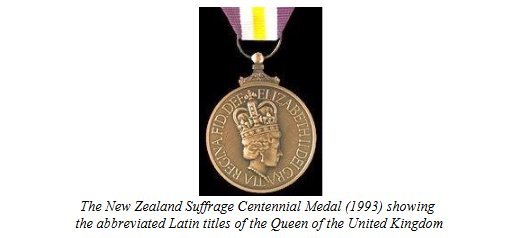
A failure to recognise the distinction between the two crowns is also seen in the physical designs of no fewer than 13 New Zealand medals.
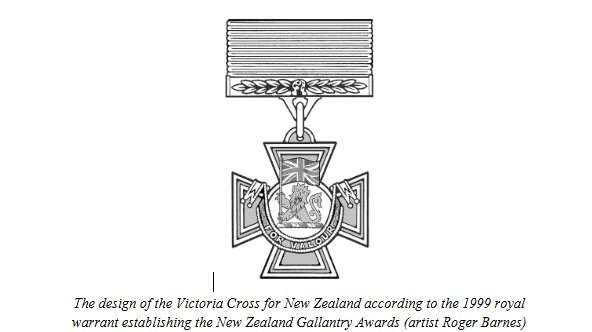
An even more remarkable error occurred with the design of the Victoria Cross for New Zealand, instituted in 1999 and awarded for the first (and so far only) time in 2007.
According to its founding warrant, the Victoria Cross for New Zealand should bear "Our Royal Crest" (ie the crest of the sovereign of New Zealand).
However, the medal presented to Willie Apiata is identical to the British VC instituted in 1856 and bears not only the royal crest of England of the sovereign of the UK (a crowned lion standing on a royal crown) but tiny roses, thistles and shamrocks, the plant badges of England, Scotland and Ireland. None of those emblems has any connection with New Zealand.
The royal crest of New Zealand, defined in 1911 but now anachronistic and seldom used since 1956, is actually a demi-lion supporting a Union Jack. The medal is plainly not in accord with the warrant, but this anomaly is not unique in our honours.
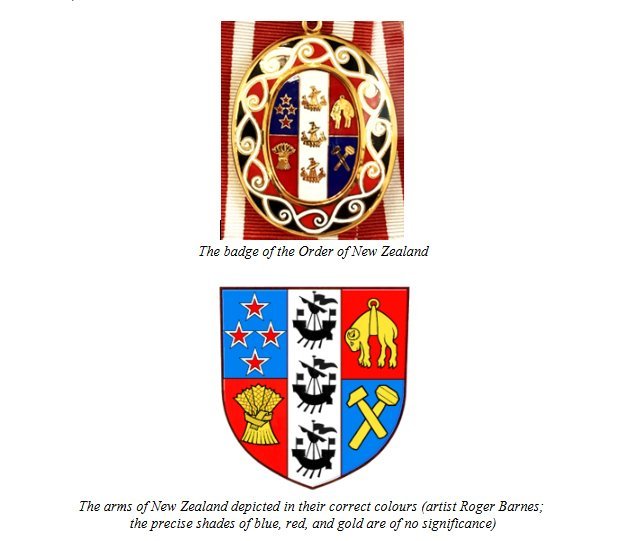
As part of the somewhat haphazard evolution of a patriated honours system for New Zealand, the Order of New Zealand was established in 1987 and the New Zealand Order of Merit (NZOM) in 1996. According to their statutes, the badge for members of the Order of New Zealand and the badges and stars for members of the three highest levels of the NZOM are meant to include the design of the shield from the New Zealand coat of arms.
On the physical insignia for both orders, however, the New Zealand coat of arms is erroneously depicted, with the three central lymphads (heraldic ships) and the borders of the stars in the first (top left) quarter depicted in silver-gilt (gold) rather than black (for the lymphads) or white/silver (for the stars). The colours of a coat of arms are not mere optional suggestions and cannot be varied any more than the colours of the various parts of the design of the New Zealand flag can be altered.
There are further errors in the design of the collar of the NZOM, worn by only the sovereign and the chancellor (the governor-general of New Zealand).
Forfeiture of knighthoods
Brierley’s knighthood was evidently an award of the sovereign of the United Kingdom: notices in The London Gazette announced the award and authorised the governor-general to confer the accolade upon him, the badge he was invested with was defined by the sovereign of the UK and not New Zealand in 1974. The 1995 report of the prime minister’s honours advisory committee asserted that "knight bachelorhoods are not ours to change", and no knight bachelorhoods have been awarded since 1996.
In the UK, knighthood can be rescinded only by letters patent under the Great Seal of the UK. No such document has been issued concerning Brierley and it is not clear how the sovereign of New Zealand could deprive anyone of a UK honour.
James Wallace was dubbed a knight immediately before being invested as a KCNZ in 2011. The statutes of the NZOM authorise, but do not require, the governor-general to "confer the accolade of knighthood" on men about to be invested as knights in the order. Knighthood thus appears to be an honour that is additional to and separate from membership of the order and so expulsion from the order does not in itself rescind the status of being a knight.
The forfeiture of Wallace’s KNZM was gazetted in 2023 but the notice did not mention his knighthood and no action has yet been taken to cancel it.
The future
Although in many cases it would be logistically impractical, and possibly prohibitively expensive, can any of the various errors and anomalies mentioned be corrected? Or will public funds continue to be spent on flawed medals and insignia and convicted criminals be allowed to remain knights?
Our honours system was reviewed in the 1970s and the 1990s.
It is time for a third review — it would be an opportunity to get things right at last.
• Gregor Macaulay is a retired Dunedin university administrator with a long-standing interest in heraldry and honours.