

There were 52 of them in the photo and they are our future leaders, apart, sadly, from the many who will end up overseas. But it wasn’t simply the sight of those smiling faces which excited me — it was the caption.

In 50 years, the grandchildren of the Class Act recipients can pull out the clipping and immediately identify granddad when he had hair.
Which leads us to the theme of this morning’s sermon. Caption your photos.
I recently hauled down the shoebox of old photos with a view to cobbling together a sort of album of my past. There I was in standard 4 (year something or other today) with about 20 other boys with whom I spent 10 years or so at primary and secondary school.
The photo had no caption but, given the length of time I’d spent with those characters, I was able by diligently studying them row by row to put a name to all but two.
Not bad going for a bloke who can never remember who he was talking to in the pub last week.
Of course, with names established, memories came back and I wondered what had happened to my old schoolmates in later years.
In most cases, I’ll never find out, but when I see the names in the court news I’ll know about at least some of them.
I’ll bet you have the same problem. Piles of old family photos with no captions. That could be Auntie Freda before she had her nose job. Or is it cousin Norma? She had big ears, didn’t she?
If you get involved in historical research the problem looms larger. About 30 years ago George Griffiths (font of all knowledge about Otago/Southland history) and I were shown a huge collection of photos which had been donated to the Hocken Collections by the ODT.
Many were uncaptioned and the idea was that we might go through them and recognise people and events. As it happened, we were both busy with other matters and had no time to spare. Perhaps by now the job has been done.
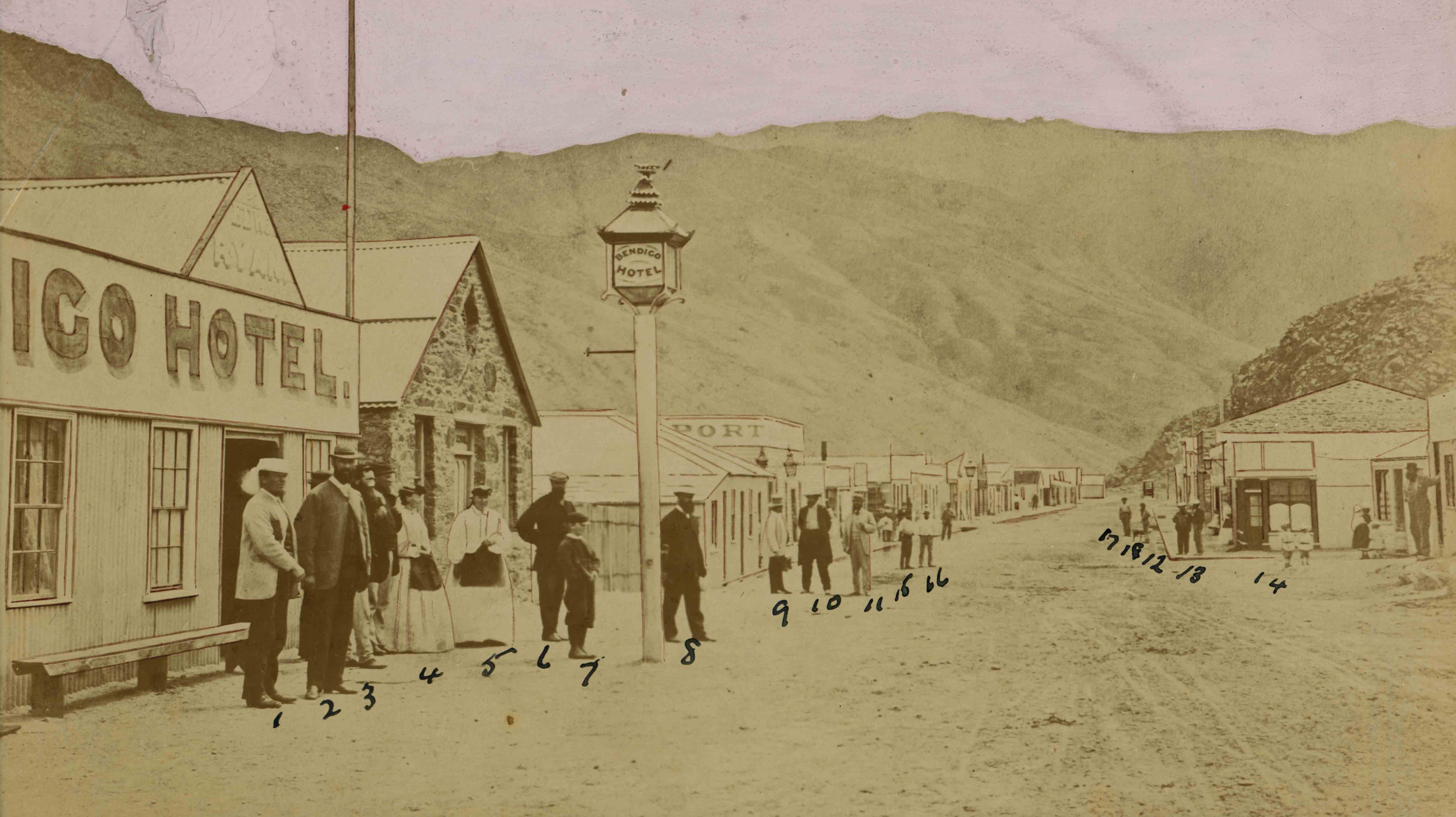
All this was brought home to me last week when a friend who’s writing a biography of goldfield’s legend Vincent Pyke showed me a photo the Toitu Otago Settlers Museum had found for him. It showed Clyde’s main street in 1868 with locals posing patiently while the photographer did his thing.
He did a bit of touching up with signs and building outlines later. A great streetscape, but what about the people?
Unlike many other historical photos this one had a typewritten caption added many years later, probably after the photo appeared on the Otago Witness in the 1930s and an old-timer offered to put names to faces he’d known 60 years earlier.
He named and numbered the characters and with a bit of sleuthing in Papers Past my author friend was able to flesh out the story of the characters.
1. John Grindley owned the Victorian butchery — "a cart delivers meat daily throughout the district".
2. James Samson was a draper in Alexandra.
3., 4. and 7. John Ryan, his wife and son.
5. and 12. Sophia and Gilbert Fowler who ran a grocery store and bakery opposite the Bendigo Hotel.
6. Schoolmaster Samuel Clark.
8. Thomas George, surveyor.
9. Vincent Pyke.
10. John Armstrong, a Dunedin dentist who travelled the goldfields, "improving or extracting those most necessary but sometimes troublesome ivory appendages known as teeth".
11. Anthony Brough, a Clyde lawyer who also practised in Dunedin.
13. and 14. Donald Macpherson, who ran the first ferry-punt at Clyde, and his daughters. About 1881 Macpherson returned to Scotland for the benefit of his health but in 1882 was run over by a train and died from his injuries.
15. Johnny Cox was the landlord of the Port Philip Hotel at the centre left of the picture.
16. Martin Marshall, a bookseller, secretary of the Dunstan Jockey Club and acting town clerk.
17. Three-fingered-Jack, whose real name has not been found.
18. A roadman called Walker, possibly James Walker.
"The photograph may have been taken by Robert Barlow or Charles Goodwin who had a jewellery shop and photographic gallery in Clyde."
I was fascinated by all that extra information. It told me much more about early Clyde than a picture of a street with unnamed people.
Will you now caption your photos? Your grandchildren will thank you for it.
— Jim Sullivan is a Patearoa writer.


