

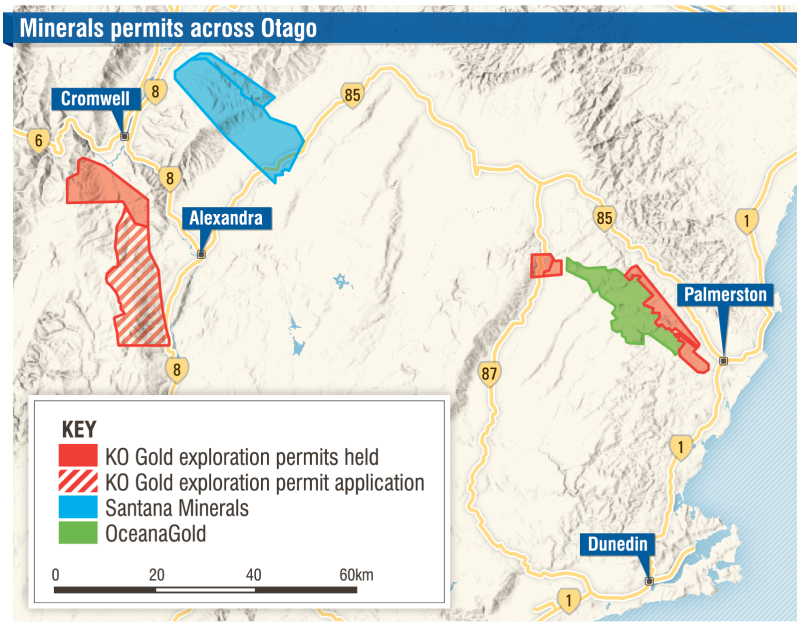
One has recently launched the first phase of a four-site drilling campaign starting near Palmerston, which it hopes to complete by the year’s end.
But an environmental group has warned the expanding gold rush could bring with it ‘‘cumulative adverse impacts’’.
KO Gold announced this week it had commenced drilling on its Smylers exploration permit, near Palmerston, earlier this month.

Speaking to the Otago Daily Times from Nova Scotia on Friday, KO Gold chief executive Greg Isenor said the drilling marked a ‘‘huge’’ milestone.
‘‘We’re at the early stage of something like Santana.
‘‘We’re quite confident on what we’re going to achieve.’’
The company described it as the first phase of ‘‘an expanded 2026 drilling campaign’’ that would subsequently extend to the company’s Hyde, Glenpark and Carrick exploration permits.
KO Gold had only ever drilled in Otago on its Smylers site.
It completed drilling there in 2021 that returned ‘‘impressive gold intersections’’.
The new drilling at Smylers would step out from its older holes and probably take a month and a-half to complete, he said.
It planned to be drilling at Carrick within a couple of months, the rest of the sites completed by the end of the year.
Asked about the prospect of starting its own large-scale gold mine, Mr Isenor said: ‘‘That’s certainly in the future. I’m not going to predict something like that.’’
Any one of the other companies exploring the area could find a very economic gold mine, he said.
‘‘All of the Otago gold belt has great potential.
‘‘It’s a great economic opportunity for New Zealand, I believe.
‘‘We’re all in the industry and we’re all hoping any one of our competitors makes a discovery.’’
KO Gold is not the only international company drilling in Otago.
New Age Exploration announced in late April phase two drilling was under way for its Lammerlaw Gold and Antimony Project.
The Australian company owns two exploration permits, Lammerlaw and Waipouri, west of Dunedin.
Eight holes covering 554m had already been completed out of a planned 1000m-1200m drilling programme, the company said.
And in March, Critical Resources announced it had received New Zealand Petroleum and Minerals’ approval for the acquisition of five ‘‘highly prospective’’ prospecting permits.
It had also received the Department of Conservation’s approval to start minimum impact activities across four of those permits — three of which are in Otago.
An initial phased drill programme for its Cap Burn exploration permit was completed in December.
Environmental Defence Society (EDS) chief executive Gary Taylor said KO Gold’s drilling programme was clearly incentivised by the high price of gold and the encouragement of mineral extraction by the government.
‘‘We are interested to be briefed by the company at some stage if it decides to proceed [with mining].
‘‘We are not opposed to mining: it’s a question of the environmental and other effects and whether it’s ultimately underground or open pit.’’
Concerns included landscape, freshwater ecology, groundwater contamination and terrestrial ecology.
There was also concern about the potential use of the Fast-track Approvals Act, which Mr Taylor said was too fast and demanding for all participants.
The number of companies applying for permits across Otago growing, so the potential for ‘‘cumulative adverse impacts across that swathe of mineralisation’’ needed to be considered.


