
PHOTO

Anyone who has ever stood on the sideline of an Otago school sports match knows the feeling, the hum of excitement, the nerves out played by the cheers from the sideline and the smiles of young people who know they are part of something bigger than themselves.
This year’s Otago School Sport Census reinforces what our communities see every week.
School sport remains a huge part of life for our rangatahi.
Despite the pressures of modern life, they continue to lace up, turn up and get involved.
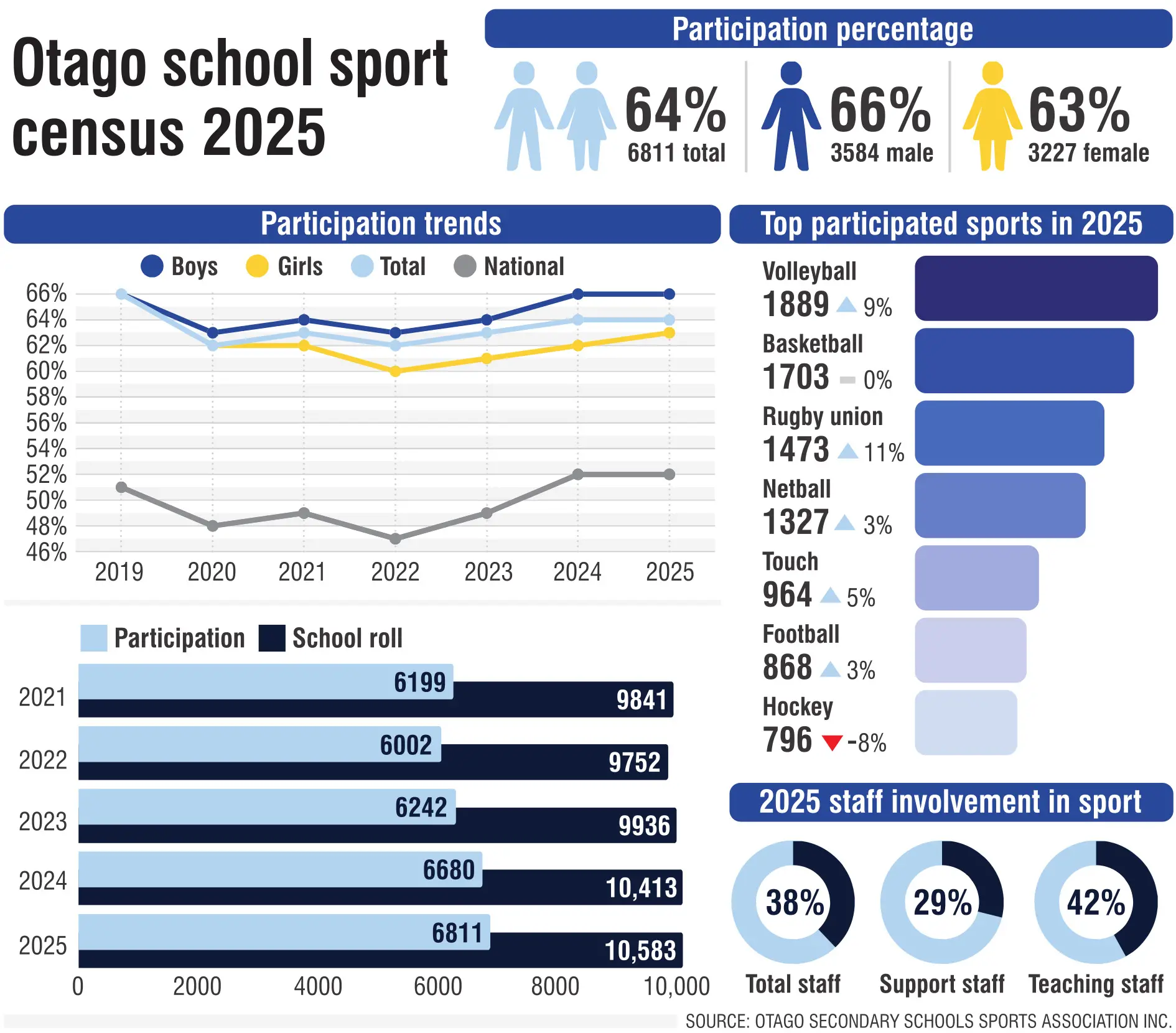
In 2025, 6811 secondary students across Otago took part in organised school sport, an impressive 64% of all students.
Boys’ participation sits at 66%,and girls’ at 63%, both well ahead of the national averages of 55% for boys and 48% for girls and total participation of 52%.
What makes this even more encouraging is that participation is still growing, even as school rolls rise.
Our region increased from 9936 students in 2023 to 10,583 in 2025, and yet schools are continuing to engage more students than ever.
That speaks to the dedication and passion of school sport staff who work tirelessly, often with limited resources, to welcome new students while keeping retention high.
Among the wide range of sporting opportunities on offer, a few continue to lead the way. In 2025, the top six sports in Otago were:
• Volleyball 1889 participants (up 9%)
• Basketball 1703 (steady)
• Rugby 1473 (up 11%)
• Netball 1327 (up 3%)
• Touch 964 (up 5%)
• Football 868 (up 3%)
While these numbers reflect strong and growing interest, they also come with challenges.
Indoor facilities across the region are at capacity as sports shorten game durations or shift games into already heavily utilised school gyms, putting extra demands on schools and sports trying to resource multiple venues.
But if you ask students what matters most, they will talk about the long bus rides, the team-mates who become lifelong friends, the pride of pulling on a school jersey, the coach who got the best out of them or the moment they surprised themselves with what they could do. Those stories show the real value of school sport.
The census also highlights the people behind the scenes who make sport happen.
Staff involvement in school sport in Otago sits at 38%, 9% above the national average, a reflection of how strongly Otago teachers, whānau, and community coaches value the opportunities sport provides.
School sport simply does not exist without these volunteers who give their time so rangatahi can experience opportunities.
In a world where young people have more demands on their time and more digital distractions than ever, showing up to play still matters.
It matters for wellbeing, for friendships, for confidence and for the memories that last long after the final whistle and long after school itself.
School sport is not just another extracurricular activity. It is a place where young people build character, learn commitment, develop courage, practise teamwork and grow resilience and skills that strengthen their classroom learning and stay with them well into adulthood.
Otago should be proud. Our young people are engaged, our communities are committed and the impact of school sport continues to reach far beyond the field.