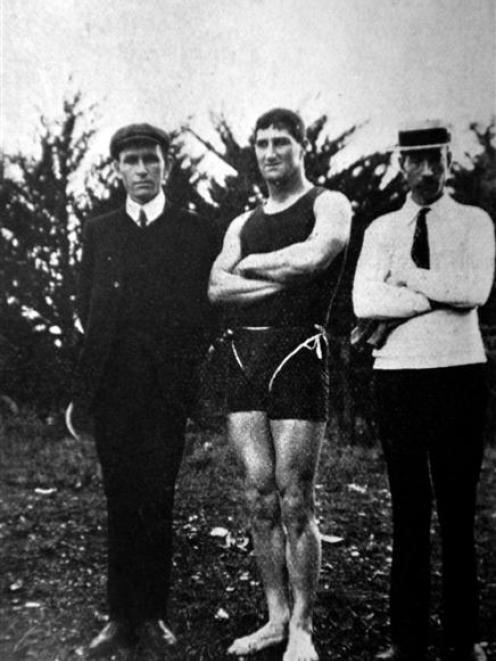
A couple of weeks before the Olympic Games open in London, a few people may pause to think of the first New Zealander to win an Olympic gold medal. Not too many, because not too many would have heard of Malcolm Champion and even fewer would know what he did, and where, when and with whom he did it.
New Zealanders competed as part of Australasia at the 1908 and 1912 games in London and Stockholm.
Champion was a swimmer and was a member of the Australasian relay team (one New Zealander, three Australians) that won the 4x200m in world-record time, beating the American team that included much-publicised Hawaiian Duke Kahanamoku.
That much is known. That much is true. But there is much that is not known about Champion, perhaps because he was seldom interviewed; perhaps because he left no letters, notes or diaries; perhaps because the record-keeping of swimming, like most other sports, was haphazard to poor in the early years of the 20th century.
Basic life details are shadowy.
He used to say he was born in Auckland; practically all other sources give his birthplace as Norfolk Island. His mother was Sarah, whose maiden name was Quintal, a descendant of one of the Bounty mutineers. Three or four different birth dates have been given. Neither New Zealand nor New South Wales nor Norfolk Island official sources hold a birth record.
For all his achievements, Champion has not often been written about. Any number of books supposedly chronicling the sporting past ignore him.
A retired Auckland schoolteacher, Neville McMillan, wrote a book in the early 1990s about some of his favourite sports people, and one of them was Champion. In his brief piece, he made this startling revelation: "For reasons which have defied research, Champion was disqualified from amateur swimming for life in 1902."
Disqualified for life? For what?
And how come he later swam at an Olympics - not just swam, but won a gold medal at the very Olympics from which another well-publicised American, Jim Thorpe, was deprived of his medals because he had taken a pittance for playing minor league baseball?
McMillan, who died in 1997, seems to have found a reference in Wellington weekly the Free Lance, in the late summer of 1908, which said: "It will be remembered that in 1902 Champion was disqualified by the Wellington centre for life."
Later writers took this up and added he was banned for offending against amateur regulations. The internet has ensured this has been perpetuated, often using the same wording, in any number of websites.
Earlier writers, including reporters in Auckland and Wellington who would have been alive at the same time as Champion and been able to check with him, did not mention any ban for life. None was mentioned in either of his newspaper obituaries in Auckland in 1939.
Wallie Ingram, an indefatigable sports scribbler and broadcaster, mentioned Champion several times in stories and talks, but never said anything about a life ban. Teddy Isaacs, well loved and remembered on both Dunedin daily newspapers, was the Mr Swimming of the South and there was no mention of any Champion ban among his papers in the Hocken.
So what was it all about?
It's a long story and would take about as long to retell as it did to unravel.
Champion was a great swimmer, easily the best in New Zealand in his day and not surpassed until Danyon Loader. Just one indication of his prowess was that from 39 starts at national championships, he won 32 titles and had five seconds, one third and one withdrawal.
While he was preparing for the 1902 nationals, his sudden withdrawal from a carnival in Auckland took most people by surprise. The crowd booed its displeasure. A reporter for The Press in Christchurch wrote: "I understand he was debarred from competing at the last minute, through the representations of the Wellington centre of the association."
Champion had first swum for Wellington because the Auckland club to which he originally belonged was not a member of the national association, which was then split in two. When Auckland's differences seemed to have been sorted, at least temporarily, Champion transferred his allegiance back to Auckland.
He seemed to have become caught in the crossfire of internecine warfare between the administrators of Auckland, Christchurch and Wellington. A writer in the Evening Post in Wellington said Champion was under suspension and the reason was well known. So well known, apparently, the Post chose not to tell its readers what it was.
It seems most likely Champion was banned for nothing more than being what at the time was called a defaulter, that is, someone who had not paid his membership fee and therefore was not licensed to swim.
About a year into his ban, Champion lodged an appeal with the national association in Christchurch (although he lived within the jurisdiction of the other national association in Auckland).
The Post's swimming man reported: "The [Wellington] committee decided to forward to the New Zealand association all particulars of matters which led up to Champion being posted as a defaulter and the question will now be left for the New Zealand association to adjudicate on."
The argument that Champion somehow breached amateur regulations by accepting money for swimming is difficult, if not impossible, to sustain. There is no evidence that he did. None that he did not, either.
But if he did, if he was slipped a few bob for competing and was caught, why didn't anyone say so publicly?
More significantly, why did Champion not go ahead and race as a professional anyway, as he could so easily have done?
Some of the contemporary Australians, such as the stunning Cavill brothers and Annette Kellerman, had already done so and had shown they could make a fair living competing in Europe and the United States.
Champion, with his strength and his keenness to have a go at any distance, would have been ideal for such a life. Yet it was a life he did not choose.
Instead, he joined the police and was posted to Dunedin. It was a brief career in blue serge.
He met the woman with whom he would spend the rest of his life, Rose de Maus (daughter of the Port Chalmers photographer and sometime mayor) and they decided to marry on Thursday, October 9, 1902.
The following day, he was out of a job - dismissed by the police because he was supposed to have been on duty when he got married and because serving police officers needed permission to marry, which Champion did not have.
The newlyweds moved to Auckland and there they remained. Eventually, swimming administrators rubbed out the Mason-Dixon line separating them and declared peace and Champion in 1907 was allowed to swim again.
He was then 25 but still practically unbeatable in New Zealand, whether in the sea or in saltwater or freshwater pools. He was sent to the Festival of Empire in London in 1911, at which the Empire showed off its diversity and industry to mark King George V's coronation.
He competed in the mile but pulled out with about 150 yards (137m) to go. As some compensation, he won the English three miles (4.8km) championship.
Champion did enough in 1911, and again won all the national titles in 1912, to show he deserved selection for Stockholm.
And the Australians, who dominated the team and had the final say on the relay team make-up, agreed.
Champion swam the second leg in the final and created such a gap over the Americans and Brits that the third and fourth Australians had only to maintain it.