
PHOTO
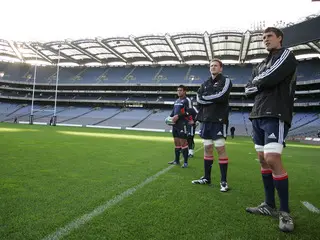
Croke Park is not just another grassy rectangle for All Blacks with an appreciation of history, nor just another rugby ground on which to test themselves against the Irish.
The test squad to play Ireland tomorrow gained an early appreciation of the unique occasion they will be part of when venturing on to the Gaelic Athletic Association's (GAA) hallowed turf for a light captain's run.
For some it appeared an almost sombre experience as they contemplate what is likely to be the All Blacks only invite to this Irish citadel, a cauldron normally reserved for Gaelic football, hurling and camogie.
The GAA, despite reservations from some hard-line republicans, has allowed the Irish Rugby Union to use this imposing 82,000-seat stadium until the sport's traditional home at Lansdowne Road is rebuilt.
It was a goodwill gesture on a grand scale considering the GAA was established in 1884 as a Gaelic movement to promote Irish sport, culture and language while emphasising separation from all things British, rugby included.
The stadium, in Dublin's working class northern suburbs, is inextricably linked to Ireland's War of Independence. Rubble left after a British artillery bombardment of Dublin's main thoroughfare -- today's O'Connell St -- in 1916 was used when the ground was built.
A section retains the name Hill 16 and although the original terrace was demolished in the 1980s, remnants of rubble are embedded in the new foundations.
All Blacks head coach Graham Henry walked on the Hill today, to gain some perspective on the passion his side will be up against come kick-off.
"There's always edge in a rugby test match, but I think there's more edge in this one because of the significance of the game," he said.
"We're playing in a venue that is very historic. I think it's quite emotional and we need to control those emotions.
"I did walk up the terraces and I think that's hugely significant .... you need to think about the history .... it's a privilege for the All Blacks to play there."
The Hogan Stand is another link with Ireland's turbulent past -- and the ground's tragic legacy. On November 21, 1920 as Dublin were playing Tipperary, British soldiers swarmed into the ground and opened fire in retaliation for an attack earlier that day -- 13 spectators and Tipperary captain Michael Hogan were killed.
Those events made the fiercely patriotic GAA's decision to grant access to rugby even more contentious, given England were scheduled to visit in February 2007. It was an emotionally charged occasion as God Save The Queen was played by the Irish Army Band --a previously unthinkable scenario.
Ireland's fervent support helped inspire them to a cathartic 43-13 victory. Naturally tomorrow's match does not involve the political connotations associated with the English -- but Irish management today said a capacity of crowd of 82,000 was crucial as the team strive for their first win over the All Blacks in the 22nd test of a rivalry that began in 1905.
"It's an incredible place to be, it's steeped in history. It has that aura about it," said centre Brian O'Driscoll on the eve of his 50th test as captain.
"It's great it's a 5.15 kick-off. I'm sure a few of the watering holes will be packed from 2 o'clock. People tend to be a little more vocal when they've a couple inside them.
"Hopefully we'll give them something to roar about."
New Irish head coach Declan Kidney, who started his tenure with a 55-0 defeat of Canada last week, said it was imperative to get the crowd enthused early.
"We have to watch in that first five or 10 minutes we're not out of the game. As they say you can't win a game in the first 10 minutes, but you can lose it."
Meanwhile, McCaw said the All Blacks could not afford to be distracted by their own proud history against the Irish.
"I think everyone is aware of it but if we start thinking 'Oh, we don't want to be the first to lose', that won't help us."
McCaw was among the All Blacks appearing to appreciate their surroundings today, though Irish history was not the only motivation.
"We had a brief word about some of the history of it but to be honest the guys are pretty focused too. This is a big challenge, there's a bit of an edge to the team."