



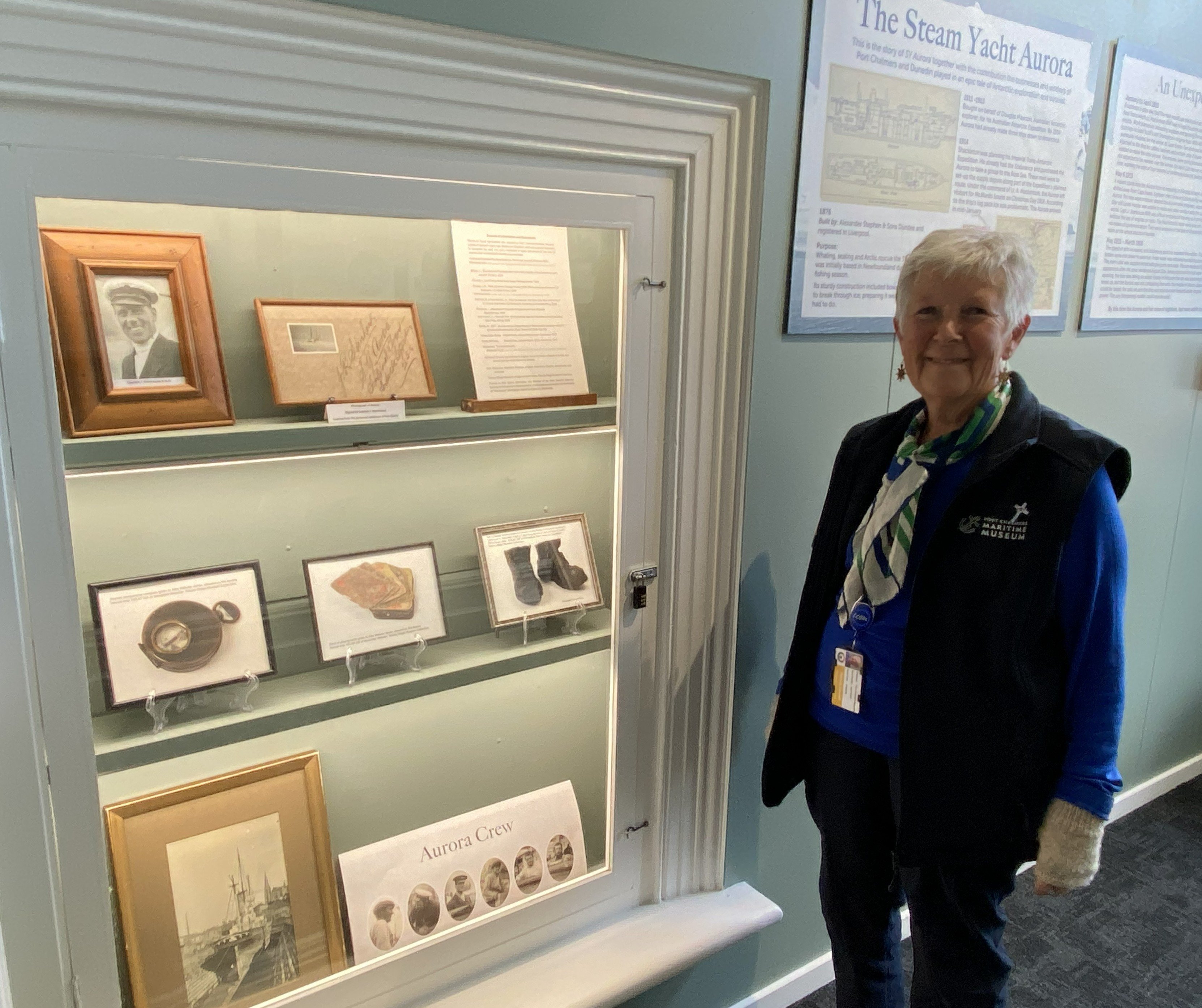
Museum volunteer Pat Caswell spent months researching the remarkable history of the Antarctic exploration vessel SY Aurora, which spent 312 days adrift in sea ice during Ernest Shackleton’s ill-fated Imperial Trans-Antarctic Expedition of 1914-1917.
The vessel, which was extensively damaged, was repaired in the ship yards at Port Chalmers in 1916, before returning to Cape Evans in Antarctica to rescue the survivors of the stranded Ross Sea shore party.
Mrs Caswell said the project started off with a donation from Christchurch-based Antarctic historian Dr David Harrowfield of copies of the SY Aurora log books, company correspondence and paper work around the repairs that the ship underwent in Port Chalmers in 1916.
"I really enjoyed doing the research around the SY Aurora from these original sources, it is such an amazing story," she said.
Mrs Caswell created a display at Port Chalmers Maritime Museum, telling the story of the SY Aurora and including photographs of an array of artefacts held at Otago Museum. The exhibition continues until the end of this month.
The SY Aurora — a 580 tonne steam yacht — was built in Dundee, in 1876, with a reinforced hull so that it could be sailed into Arctic sea ice.
Brought south in 1910 by Australian explorer Douglas Mawson, SY Aurora was eventually acquired by Ernest Shackleton for his Imperial Trans-Antarctic Expedition of 1914 — which aimed to trek right across Antarctica. The men aboard were to create supply depots for the main expedition party.
The recently-refitted SY Aurora sailed under captain Aeneas Mackintosh to McMurdo Sound to drop off a Ross Sea supply party — arriving on January 15, 1915.
Mackintosh took command of the supply party, leaving SY Aurora under first officer Joseph Stenhouse to find a safe winter berth.
On May 6, a violent storm broke SY Aurora from its moorings at Cape Evans, leaving it stuck in the ice pack and drifting, with 18 men aboard ship — surviving on penguins and seals, and 10 men left stranded in huts on the ice.
By the time the ice finally broke up, in mid-March, 1916, the SY Aurora had drifted for 312 days, covering 3000km.
In the meantime, Shackleton had his own problems, as his ship Endurance became trapped in pack ice and finally sank in the Antarctic Weddell Sea on November 21, 1915.

The SY Aurora finally made contact with the outside world, when 18 year-old apprentice wireless operator Lionel Hooke rigged up a radio and reached Bluff station.
Prompted by New Zealand Prime Minister William Massey, Port Chalmers Harbour Board sent the tug Dunedin to help — it made contact with SY Aurora at Snares Island.
The badly damaged SY Aurora arrived in Otago Harbour on April 15, 1916, was surveyed and repairs commenced, under a joint committee of British, Australian and NZ Government representatives.
Mrs Caswell said the repairs involved many Dunedin and Port Chalmers firms, led by agent John Mill & Co, and including John Edmonds Ltd, Whitcomb & Tombs, NZ Railway Department, Cook & Stevenson, and more.
The firms are represented in a one-off Port Chalmers Maritime Newspaper page, created in conjunction with local company Digiart and Design.
"Looking at the final bills that were submitted, we can see that the repairs took five months and cost £20,233 — the equivalent today of a whopping $5,181,000," Mrs Caswell said.
"There was quite a ‘brouhaha’ around it all.
"Shackleton had returned after rescuing the Endurance crew, but wasn’t the preferred captain of the Ross Sea party rescue expedition. Although he went as the shore party leader."
The SY Aurora departed Port Chalmers in December, 1916, under Captain T.K. Davis, arriving in mid-January at Cape Evans in McMurdo Sound.
Of the Ross Sea supply party, three had died — Aneas Mackintosh, Victor Hayward, and the Rev Arnold Spencer-Smith, who had connections to All Saints Church in North Dunedin.
Once SY Aurora completed the rescue of the seven survivors and returned to Wellington, Shackleton resumed ownership and sold it to a coal shipping company.
Aurora was last seen in July, 1917, when it departed Australia bound for Chile with a cargo of coal. It was believed the ship was sunk by a mine — a casualty of World War 1.


