
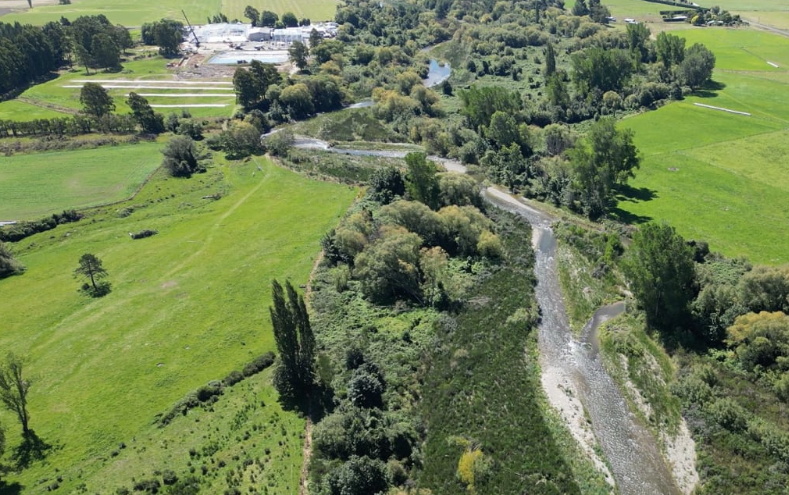
The Geraldine processor owned by French multi-international Andros Group has invested in a $60 million expansion including a new factory eventually doubling capacity to 28,000 tonnes of fruit and vegetables a year.
It wants to run a three-site discharge of factory wastewater in the interim until the storage ponds are emptied and then phase into a two-site system.
To do this it has applied again for a short concession from the Department of Conservation (Doc) to discharge on to six hectares at Hae Hae Te Moana River Conservation Reserve after this was not renewed.
Existing resource consents allow wastewater to be irrigated from the ponds on parts of its main farm and the reserve, but Doc approval is needed to carry this out on reserve land.
Barker’s had to store factory wastewater in the ponds after the concession lapsed last year, leading to the odour problem.
The contents are also being emptied by truck off site, but this is being dismissed as too lengthy and costly an option.
Barker’s also has a new consent issued by Environment Canterbury (ECan) to put wastewater on 14.5ha of neighbouring land at Pleasant Valley.
A new irrigation system to be completed soon will irrigate fruit and vegetable pulp, juice spillage and wash water directly from the processing factory on the new land without going through the ponds.
Chief executive Agnes Baekelandt said Barker’s had invested heavily in environmental compliance and to stay and grow in South Canterbury.
She said there had been complaints from a few neighbours and minimising any impact on neighbours and the environment was "paramount".
To suggest waste was being dumped on the reserve was incorrect as Barker’s had previously held a concession to irrigate on Doc land under resource consent with controls and monitoring, she said.
"We are sorry for the circumstances that have led to the odour issue, but this was all avoidable if our original concession had not been revoked, or had been worked collaboratively through a transition."
She said Barker’s wanted to discharge wastewater from the ponds on Doc land as it could only irrigate on about 3ha on the main farm.
Weather conditions and truck movement restrictions had prevented the ponds from being quickly emptied
"We are working through a chain reaction of events which has created pressure for us to buy more land and to apply for a new consent, which takes time and has impacted our ability to empty our ponds. Irrigating on our new property land is the long-term solution that doesn’t rely on a concession from Doc, but is still subject to ECan oversight."
Ms Baekelandt said the previous decision to not renew the reserve concession was based on incorrect assumptions, neighbour pressure, and did not take into account environmental impact reports from a consultant recommended by Doc.
The company estimated it would take 50 to 60 irrigation days to empty the ponds on the main farm and reserve.
"The main farm land will still receive water from the pond, as we may need to temporarily store water in case of a high rain event. But it will not have time to become aerobic."
Doc said it was assessing the concession application for the reserve.
Barker’s previous attempt was declined last July partly because sodium hydroxide in the wastewater was causing a salt buildup in the soil, resource consent non-compliance and the activity being at odds with the reserve’s conservation values.
Ms Baekelandt said Barker’s had replaced sodium hydroxide with magnesium hydroxide after advice from ECan and planned to add gypsum to reduce residual sodium in the soil.
She said the company had worked with ECan and Doc to identify suitable areas for irrigation and meet Doc’s requirements and consent conditions.
ECan regulatory implementation general manager Paul Hulse said ECan was satisfied Barker’s was fulfilling its conditions for consents to discharge wastewater since an unauthorised discharge breach was investigated and resolved last April.
Two abatement notices issued two weeks before the incident were for discharging caustic soda in the wastewater and for a discharge on Doc land. They were withdrawn when Barker’s stopped both activities.
Mr Hulse said all but one of 22 complaints received from neighbours were about odour.
He said Barker’s request to dispose of wastewater was on Doc land of low ecological value and an interim solution until new irrigation was in place.
Ms Baekelandt said scientific soil assessments showed good soil health after 15 years of irrigating on Doc land.
"It is also important to note that this new concession is short term and limited to the volume of water currently in the ponds. It is a one-time concession to enable us to empty the ponds and it will expire once they are empty."


