
PHOTO
A group of Canterbury University engineering students may have built one of the world’s fastest Rubik’s Cube-solving robots, with their machine completing a 4x4 puzzle in just 9.806 seconds.
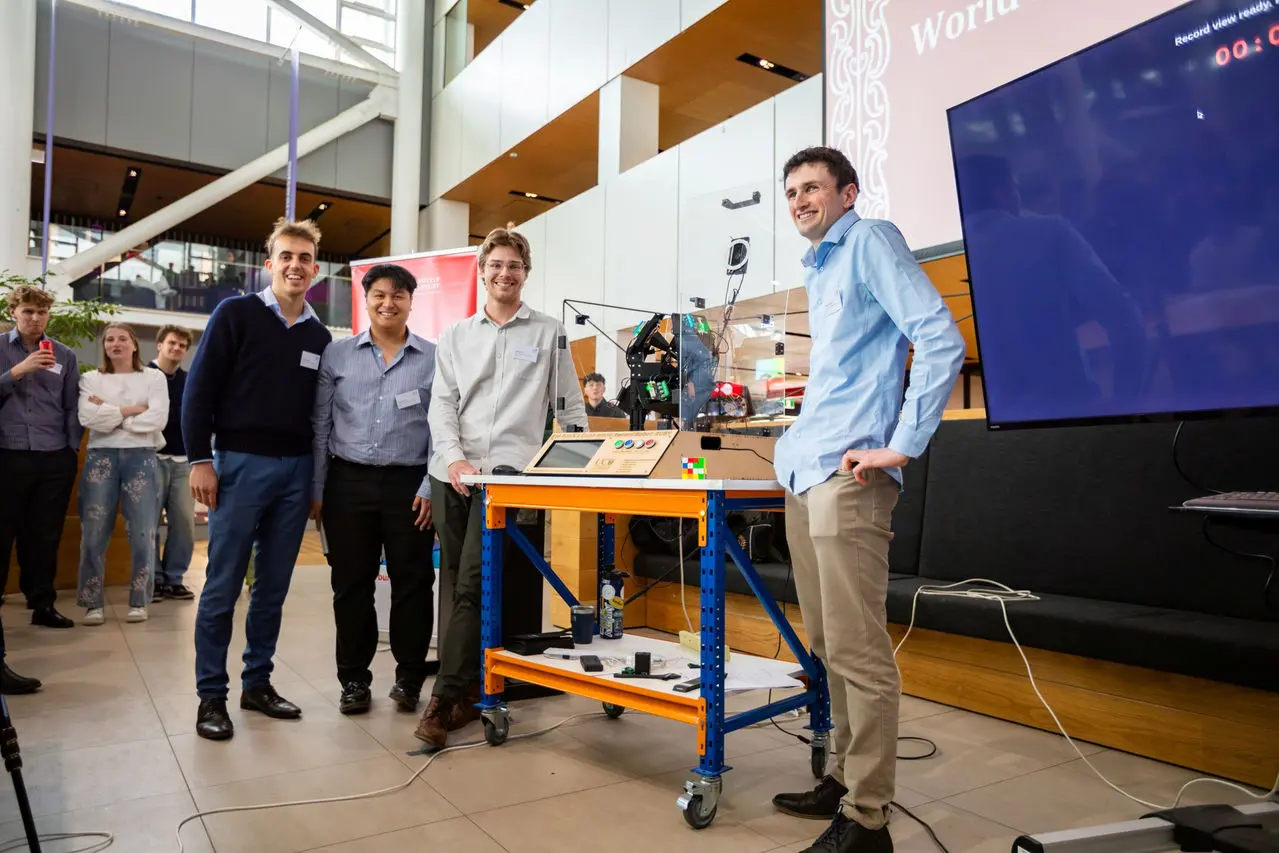
Fourth-year mechatronics engineering students Caleb Everitt, Hayden Watson, Maz Cameron and Johann Torres have submitted an official Guinness World Records claim and are awaiting confirmation of their time.
What began as a final-year project became an attempt to beat both the existing robotic record and the human benchmark for solving a 4x4 cube.
Cameron said the idea came after the group watched a video of the record-holding robot solving a 4x4 cube in 45 seconds.
“We knew that robots could be better than humans, and we wanted to be the people to break that gap,” he said.
While robots capable of solving the smaller 3x3 cube are relatively common, the team was drawn to the added complexity of the 4x4 puzzle.
Each student took responsibility for a different part of the machine. Everitt led the mechanical design, Torres worked on the electrical systems and motor control, Watson developed the computer vision system, and Cameron oversaw the software.
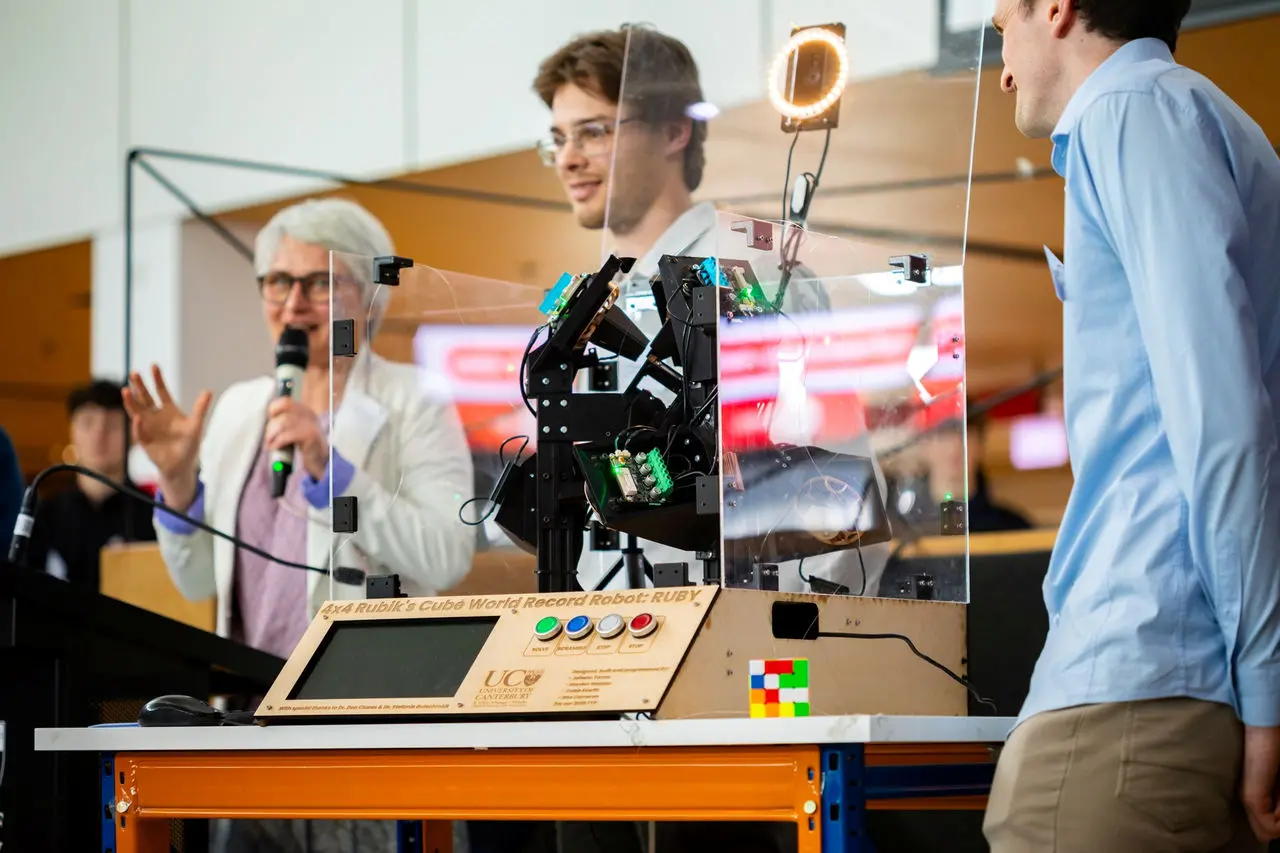
Watson said four cameras scan the cube and identify the position of each coloured square. The information is fed into an open-source algorithm, which calculates the sequence of moves needed to solve it.
“The robot has four cameras; it looks at the cube and sees where all the different colours are,” Watson said.
A key advantage was a design that allowed the robot to manipulate the cube along all three axes without having to reposition it.
Everitt said the existing record-holding robot could rotate faces along only two axes, meaning it needed extra movements that cost valuable time.
“Whereas we don’t do that because we can access all three faces,” he said.
Getting the machine to work at speed brought its own challenges. The cameras had to distinguish between similar colours under different lighting conditions, while the mechanism needed to move quickly without jamming the cube.
Months of testing helped the students strengthen the robot, refine its software and introduce suction cups to move the cube more quickly and accurately.
“One of the reasons that we needed suction cups was because to beat the human record, the time it takes for the cube to drop down from being pushed back to the base position is too slow if we just use gravity,” Everitt said.

With limited funding available from the university’s mechanical engineering department limited, the team used high-speed drone motors and specialised controllers to give the robot the speed it needed.
Torres said seeing the machine work for the first time was a turning point.
“I remember seeing it for the first time. I was like, ‘wow, this is insane. It’s actually possible that we’re going to beat the record’.”
With their degrees nearing completion, all four students have secured engineering jobs around New Zealand.
The robot will remain at the university, where the team hopes it will inspire future students to see how far they can push the limits of engineering.