
PHOTO
(Bellamys Metro)
The title of the latest exhibition at Bellamys’ Moray Pl gallery is a double-edged one. The exhibition features prints by Manu Berry made in conjunction with poetry by Michelle Elvy, alongside painted works by Pauline Bellamy.
The Berry and Elvy works are based on Elvy’s 2025 residency at Barr Cottage, close to the entrance of Manukau Harbour, and also from her time around the wild shores of the Otago coast. The poet’s words are presented on tracing paper overlaid on woodcut and woodblock prints, these latter inspired at least partly by photographs taken by Elvy. The resulting works form a happy symbiosis, the poet/photographer inspiring the printmaker, whose works then subtly infuse the printed words with colour.
Berry has also presented several larger prints inspired by Elvy’s works and surrounds, among them technical and aesthetic wonders in images of beech forests and a heady Indian Ocean seascape.
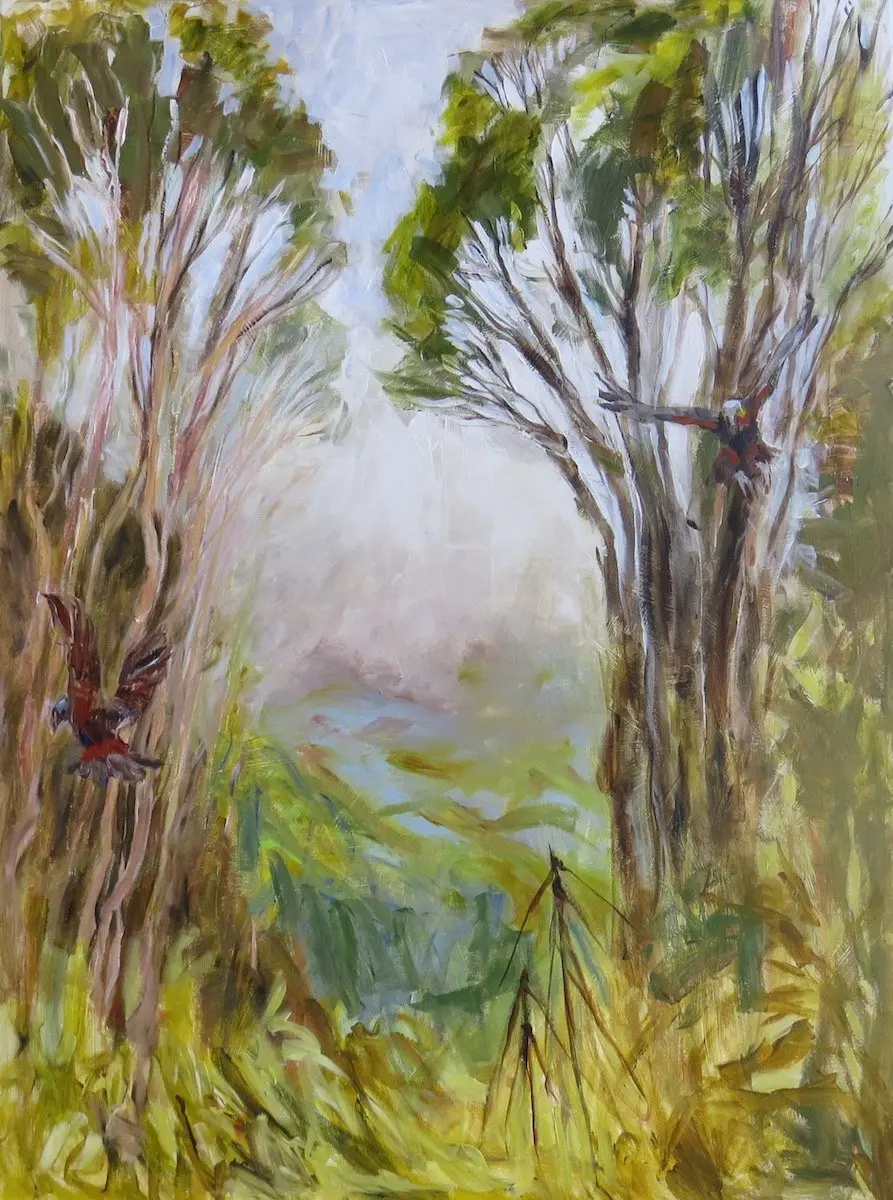
Alongside these works, Pauline Bellamy has provided a series of paintings created en plein air, images which allow the wild and aleatory to creep into the composition by chance occurrences within her compositional frame. This is particularly the case in two lovely works, one large and one small, created close to the flight path of kākā in Orokonui Ecosanctuary, and by a serendipitous encounter with a sea lion.
(Gallery De Novo)
Manu Berry’s wild oceanscape finds connection with Janet de Wagt’s exhibition at Gallery De Novo.
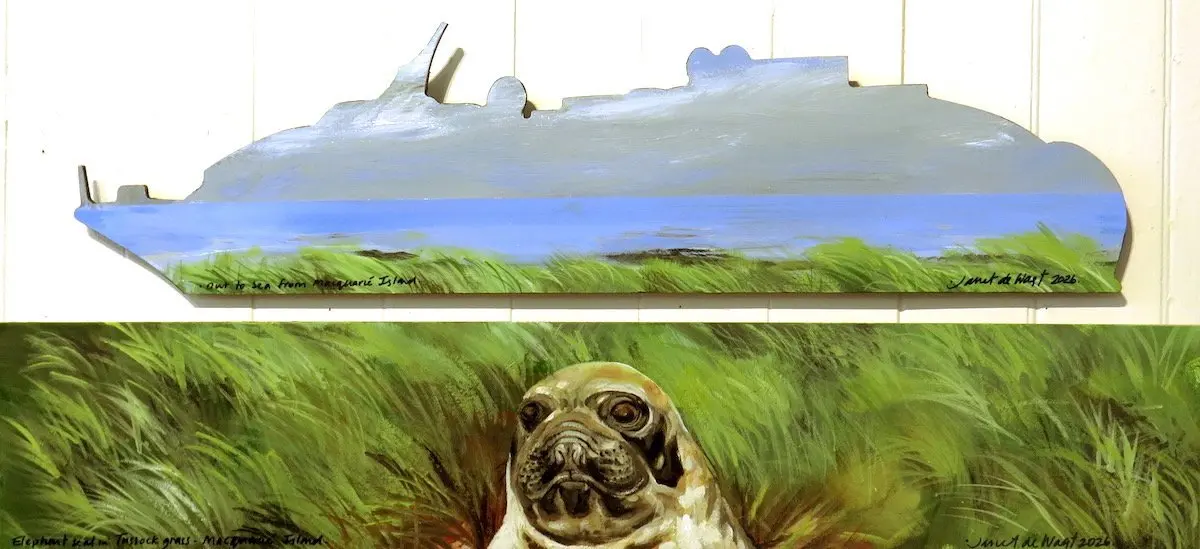
De Wagt’s display recounts her voyaging into the Southern Ocean as part of the Arts Aboard Residency, travelling by ship to New Zealand and Australia’s subantarctic islands. The images take us on a similar voyage, from Otago Harbour via Fiordland to lonely islands in the vast open ocean.
Through a series of diptychs, we see the fragile, endangered marine and island habitats of the Antipodes and of Campbell, Macquarie and Enderby Islands. Blue water turns to grey, jagged uninviting rocks jut from the waters, and petrels, royal penguins and elephant seals abound.
Each diptych is a vertical pair, the lower a simple rectangle, the upper a cut-out in the shape of the ship on which de Wagt travelled. Yet the ship forms become mirrors, their sides replaced by images of the ocean and land.
Bookending the exhibition are single large images of surging waves sitting below a distant bleak horizon.
There is a clear message in these pieces. We are all on giant, anchored ships — land masses surrounded by the unforgiving waters. We are not separated from the birds, sealife and plants — they are our fellow passengers, and if we ignore the threats to their safety, we ignore the threats to our own.
(Moray Gallery)
Jane Marshall Fitzgerald has long been fascinated by historic botanical plates and by the flowers depicted.
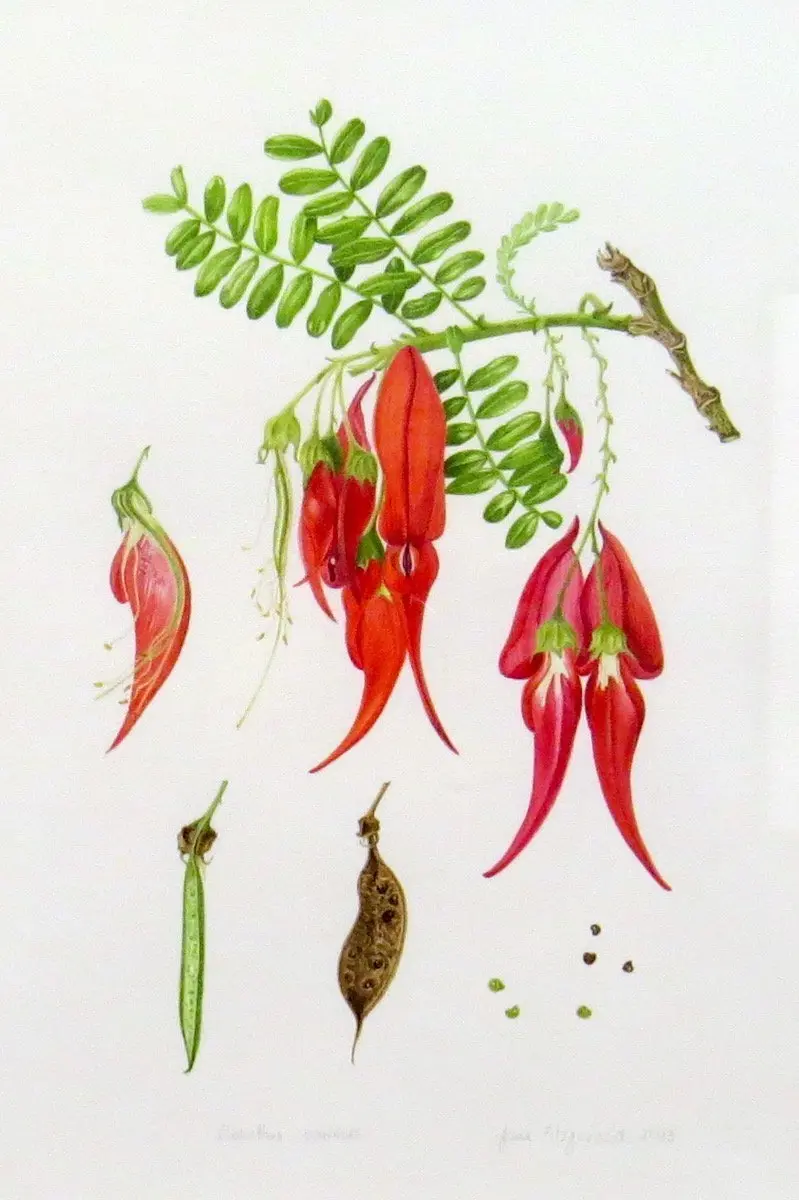
Botanical plates were never primarily made as art, but rather as detailed scientific studies of specific flora. Despite this, the work was often very beautiful, not just in terms of the beauty of the plants, but also in terms of the skill of the artist. There is a singular beauty about the composition of plant, leaf and seed studies, all placed against a pristine white background.
Fitzgerald has presented her own series of fine botanical illustrations composed mainly in watercolour but with additional graphite and ink work and here, too, the beauty is not just in the studies of plant life, but also in the presentation. Significantly, the artist has deviated from classical botanical studies by the inclusion of other species which affect the life cycle of the subjects, such as pollinators and insects which feed on the plants.
There are several highlights in this show, perhaps notably the depictions of tulip tree and kaka beak, a delicate graphite image of mixed flora from the Town Belt and particularly a tribute to the artist’s Karitane home, in which a floral border of local blooms surrounds a delicate graphite image of a boat at anchor in the town’s nearby estuary.
By James Dignan