
PHOTO
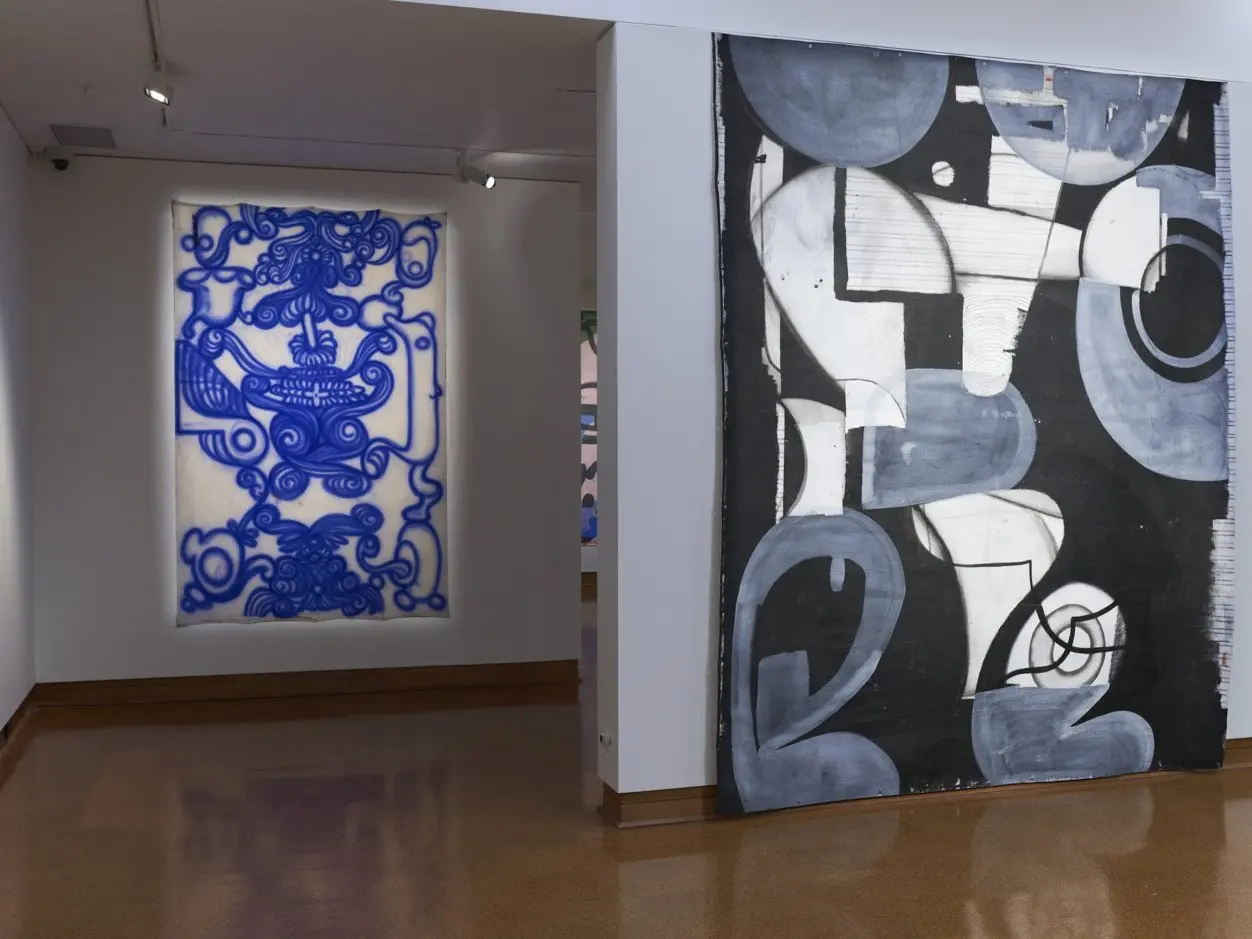
(Hocken Collections Gallery)
‘‘The Ogee & Manaia’’ comprises a series of very large-scale unframed paintings on canvas. Known for eschewing the role of meaning in terms of a communicative set of themes or ideas, Reece King’s work explores the possibilities inherent in an abundant visual language. And the viewer is encouraged to experience the works independently, as they are, and through time spent looking.
Reece King was the Ōtepoti Dunedin 2025 Frances Hodgkins Fellow at the University of Otago — Ōtākou Whakaihu Waka and this body of work is the outcome of the artist’s fellowship year. The work is substantial, prolific and visually meandering in an energetic and interconnectedly structured kind of way.
Relationships between form and meaning conveyed by the titles of the works are playfully dynamic, and not without a sense of depth. The title of the exhibition, for example, refers to the sigmoid or serpent-shaped line of the ogee, often seen in decorative architectural elements like moulding; and, similar in form, the manaia, a spiritual guardian and decorative figure, often used in customary Māori carving. Both forms have significant cultural and historical genealogies. King’s engagement with such visual language also seems to imply a broader activity of subjective meaning-making through image-making.

(Dunedin Public Art Gallery)
‘‘Hautāmiro’’ (2025), by the Mataaho Collective, is in its last few months at the Dunedin Public Art Gallery. This expansive wall installation forms an image of a korowai or kakahu (cloak). Using harakeke and New Zealand-grown wool, the work comprises an array of four specific kakahu adornments — ngore, pāhekeheke, kārure, pokinikini — that correspond with the four winds Tokohurumawake, Tokohurunuku, Tokohuruatea and Tokohururangi, the children of Huruteārangi, the atua of the winds.
Attaching the fibre components to the gallery wall are fencing materials: insulative clips for electric fencing and U-shaped nails. These materials make connections to colonial histories of land division and of the exploitation of natural resources, a theme that is also presented by the fibre components of harakeke and wool. Resembling and combining customary embroidery techniques, the fencing staples, for example, feature the ngore and pāhekeheke techniques in wool embroidery, referencing early adoptions of the use of wool in weaving traditions. The electric fence insulators affix the harakeke elements: kārure, reverse twisted tassel-like embellishments, and pokinikini, small cylindrical adornments of dried flax.
Hautāmiro is a significant installation by Mataaho Collective — artists known for innovatively integrating Māori fibre practices, repurposed contemporary materials and te ao Māori, where wāhine Māori narratives are featured.

(Joseph Pea Sea Art)
Featuring the Eastwoodhill Arboretum in Ngatapa, near Gisborne, this body of work is a celebration of place.
For Joanna Abraham Joseph, the arboretum is a place of respite and inspiration. An artist known for ‘‘land portraits’’, Joseph enlivens landscape paintings with a sense of movement and scale. Combined with a generous, very textural and layered application of paint, this dynamic sensibility is rewarding for the viewer — the several large-scale works on show are visually enveloping.
Apparent in the paintings is a definite sense of the artist’s connection and response to the subject matter or aura of location. Including a description of being enchanted by the arboretum, the artist’s statement muses on the distant and present histories of the place and the pathways that run through it, including an ancient footpath that was used to connect pa sites of the Te Whanau a Kai iwi.
Founded in 1910, the arboretum contains many thousands of temperate climate trees, shrubs and climbers from the northern hemisphere, including rare and threatened species. Now including a substantial collection of trees native to Aotearoa New Zealand, the arboretum is considered of national significance. Joanna Abraham Joseph intends to develop an ongoing series of works on residency there.