
PHOTO
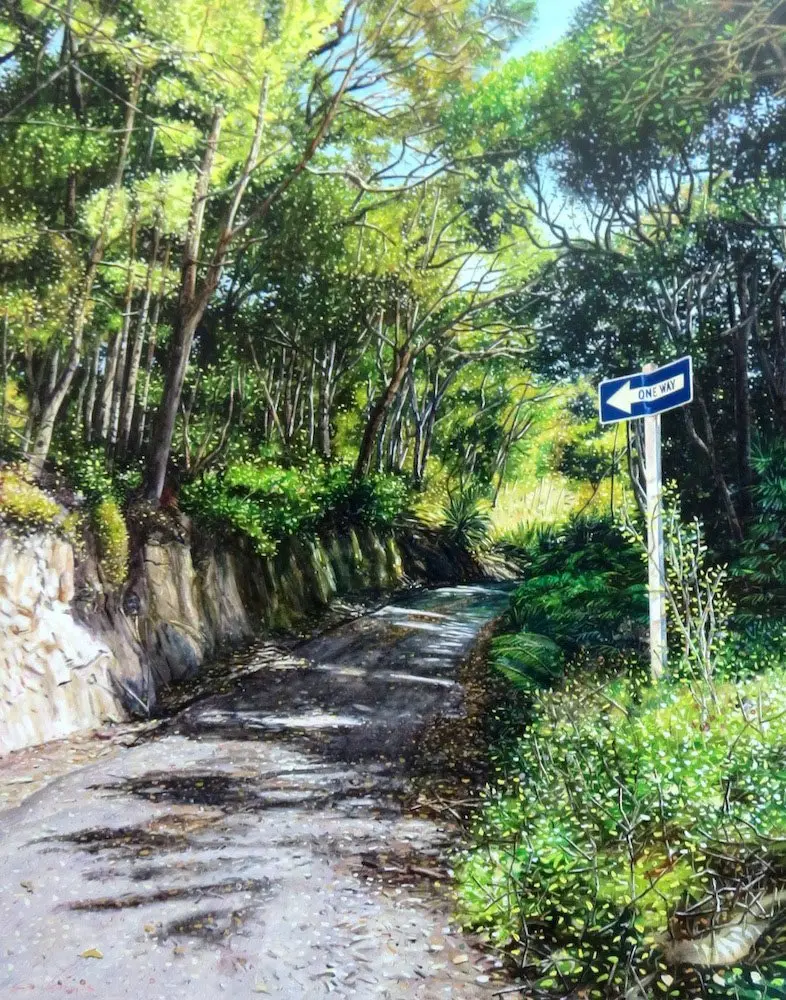
(The Artist’s Room)
There is a strange sensation known to anyone who revisits somewhere they once lived — a feeling that things are exactly the same yet completely different. One becomes an outsider in the familiar.
This feeling pervades Sam Foley’s latest exhibition at The Artist’s Room. As the artist marks the 21st anniversary of his first solo show, he returns to Dunedin’s Town Belt, which he calls the "green belt", to depict and contrast, seek the familiar, and welcome the changes with nostalgia and revelation.
Foley’s works are exceptional explorations of light and shadow, his depictions of the walkways simultaneously inviting and subtly sinister.
There is a sense of walking down these leafy paths never to return. The night images, in particular, carry a gentle threat, with dark shadows obscuring the peripheries. Paths are marked by barriers which are also handrails, simultaneously warning and supportive. This is a world of the ambiguous. The daytime images are often no more secure, as distance washes into blinding sunlight with no certainty of what lies beyond.
Foley’s exhibition features two parallel series, large canvases and smaller-scale works on board showing the same scenes. Through these two groups it is possible to both examine the artist’s painterly skills and also to grasp the scenes both in the precision of the larger pieces and the more impressionistic form of the smaller.
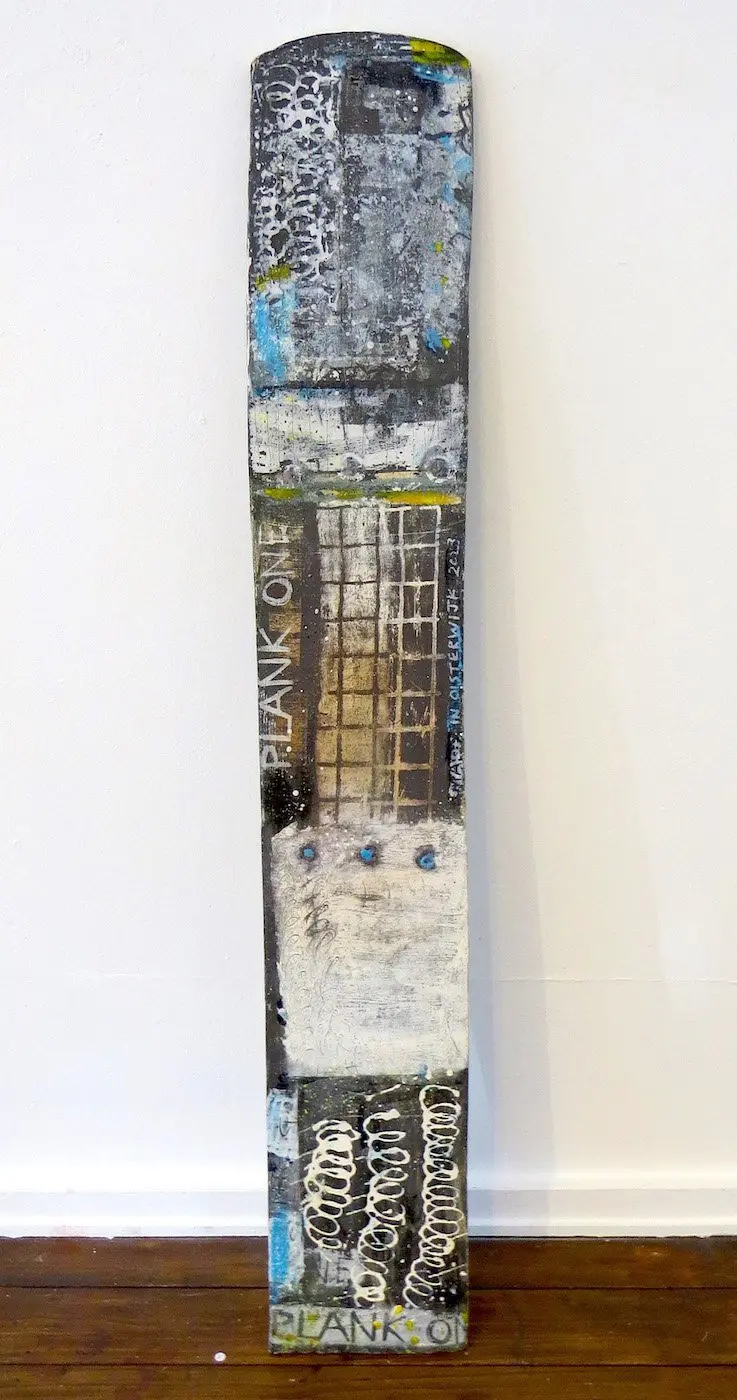
Madeleine Child’s exhibition at Brett McDowell Gallery is a bit of a game of two halves. The exhibition’s title, "Seven Long Planks" refers to the seven main items on display, yet there is also a selection of numerous smaller works displayed on shelves elsewhere in the gallery.
The planks are ostensibly what they claim to be — solid lengths of material, heavily decorated and distinctively calling up images from New Zealand culture. They are surfboards or snowboards, they are fence posts, they are pou whenua. They bring to mind the massive panels of New Zealand modern artists from McCahon to Hotere. Their construction, however, gives the lie to these antecedents, for they are not wood, canvas, or fibreglass but ceramics written in large scale. As such, they are exercises in pattern and technical skill as much as they are paeans to the New Zealand vernacular.
The smaller shelved pieces reference several of Child’s recurring
themes. Her Popcorn and Clod works are whimsical explorations of sheer form. The ice-cream Scoops seem to follow on naturally from the popcorn, and, as with the planks, have a distinct feel of kiwiana.
Alongside these sit several whimsical avians, the Odd Birds. The display is completed by a series of pieces of jewellery, the artist’s attractive but only vaguely practical ceramic Occasional Rings.
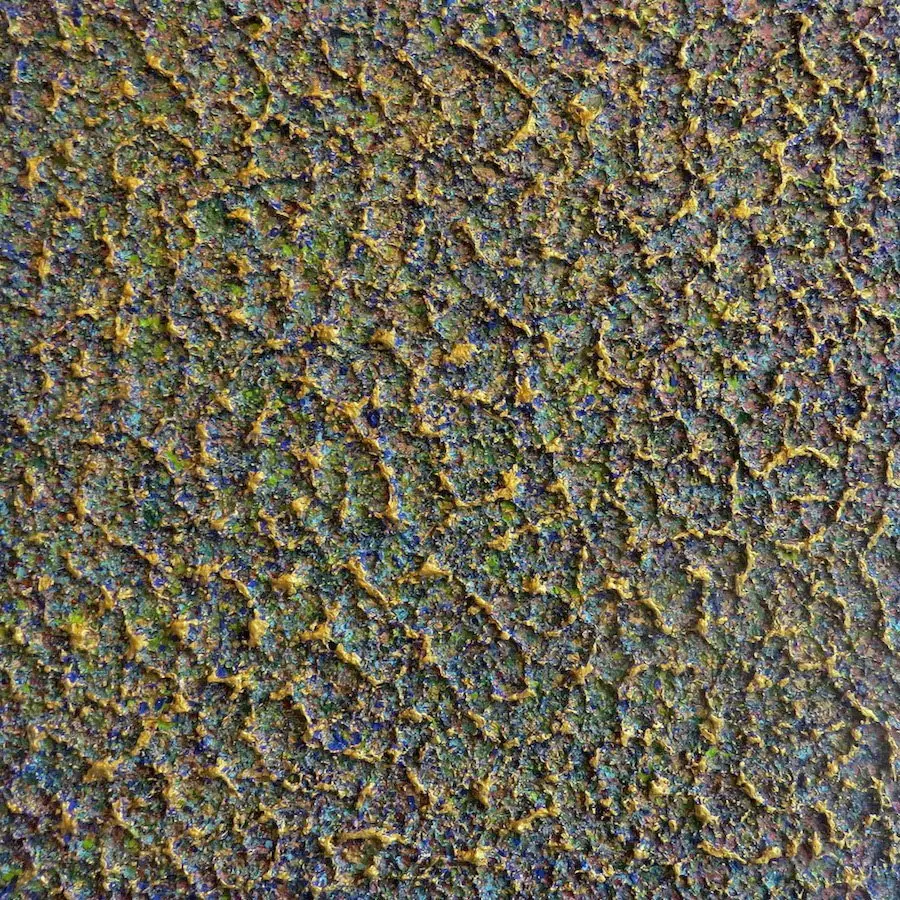
(RDS Gallery)
Jon Cox is displaying an array of bold abstract works at RDS Gallery.
Though these mixed-media pieces are predominantly painted works, they are perhaps best described as construction in paint, heftily layered and strongly impasto. Primarily created from acrylic, the artist’s practice involves the use of many often surprising additives to his creations, resulting in unusual and unique textures and surfaces.
Cox’s work is heavily influenced by the artist’s world travels, and are frequently strongly sociopolitical in nature. The works are linked by the idea of human error (deliberately misspelt as "Errpr" in the exhibition’s title) in both its personal and global senses. As such, the individual pieces are elegies to missed opportunities, poor decisions, and losses both on the individual and societal level. The ravages of Gaza are implied here, the destruction of the environment there, and the deterioration of relationships and friendships elsewhere. The latter is poignantly dealt with in the exhibition’s central work, Schonberg (Beautiful Hill), with its delicate patterns and colours reflecting remembered fields of grain, the colours of beer, and the sheen of a woman’s hair.
Ironically, the exhibition also delights in error as being a specific inspiration for creativity, and poses the question as to whether the increasing constrictions of technology will negatively affect or even stifle the future of art.
By James Dignan