


For many, art and technology are like oil and water, but not for Simon Ingram.
The Auckland artist and university teacher seeks out different ways of using technology in painting to extend the idea of what painting is and can be and connect it to the contemporary moment.
When he was last in Dunedin he teamed up with the NZTrio, getting the musicians to wear EEG headsets, connected to software. The software drives a painting machine, developed by the artist, Dunedin electronic experts Kasmahi Electronics and other collaborators, translating their mind’s electrical waves into painted lines on a canvas.
This was one of many similar projects Ingram developed using the machine to create paintings, starting with works made as he was doing different tasks while wearing the headsets.
‘‘When I started working with machines and painting 20 years ago we were living in a very different time.’’
Back then, machines that could do drawings or make paintings were not very common.
‘‘Artificial intelligence — it existed but it was being developed more closed-shop by research scientists. It wasn’t a common technology in society as it is now.’’
The increasing acceleration and pervasiveness of digital technology gave Ingram pause for thought.
‘‘In the last three to four years I started to feel differently about handing everything over to the machine.’’
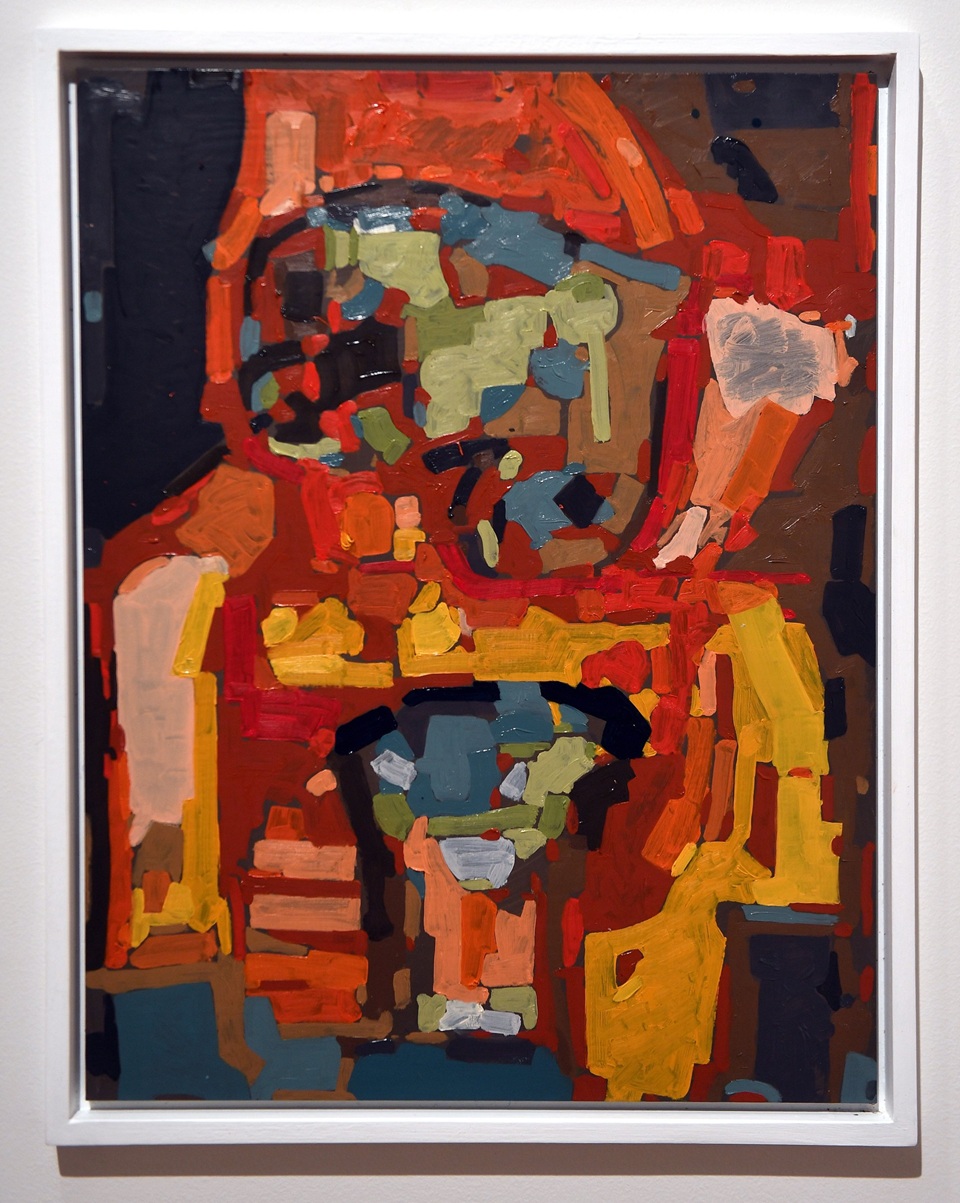
‘‘So all the work with machines, software and processing of data is in the background, behind a more traditional approach to painting [by hand].’’
In 2023, he developed a series of works based on Ukrainian modernist artist Kazimir Malevich (1879–1935), making the works by hand but using AI in the background.
‘‘The phrase ‘human in the loop’ is used a lot these days to describe possible human-technology relationships; these paintings are part of that in a broader sense.’’
For his latest Dunedin project, he has turned to Dunedin Public Art Gallery’s collection of Frances Hodgkins’ paintings, in particular 19 works from 1930 to 1941. He wanted to ensure his paintings in ‘‘Pictorial fictions — painting from Frances Hodgkins’ latent space’’ related to Hodgkins’ works but did ‘‘not copy them’’.
‘‘[To] make something new in dialogue with Hodgkins that passes through my particular way of working.’’
His connection with Hodgkins arises in part from his interest in early 20th century French modernist painting of the likes of Cezanne, Matisse and Derrain.
‘‘It just seems to me like Frances Hodgkins is really the only New Zealander who translated that period of painting into something of her own, into her way of working as a artist. But it’s particularly the way she interprets the French painting that interests me. So it felt interesting as a way to connect to that early interest in that period of French art.’’
It also interests Ingram that she is a woman who is often overshadowed by the male artists of her time and that she is considered an interesting character.
‘‘In my generation there was a lot of talk about McCahon and Walters. It seemed interesting to me to look at this wonderful painter who sustained a career in Europe in the first half of the C20 and whose work was collected widely including by the Tate Modern in London.’’

From those works, his computer tool developed about 1200 images from which he selected ones he thought compositionally would make a good basis for paintings, then simplifying the colour palette down to be more suited to his way of painting.
‘‘I select compositions that interest me and process them algorithmically as islands or zones of colour, I mix up a palette and paint these zones, breaking out of their boundaries and working back into the painting as a whole to make it work.’’
This process is a little like a complex version of paint by numbers but it leaves plenty of room for interpretation, he says.
‘‘In the way I’m painting them, I’ve been a bit influenced by the way my machine makes them up.’’
Ingram’s machines have tended to make marks in particular ways in the past. In these new works, Ingram has trained the way he makes brushmarks to resemble those made by his machines.
‘‘It’s a loop of interaction with a technological process, through customisation and engaged painting-based responses, I slow things down and re-route things to different ends unrelated to popular conceptions of AI replacing humans.’’
Going back to painting by hand in his 2023 show after having been focused on using machines for 18 or so years was not straightforward.
‘‘It was really hardcore. I sort of got lost in them. This process has been similar, but a little more fine-tuned. I’ve done more technological stuff myself and the works are smaller. Getting back to painting by hand is hard and kind of a challenge but a really good one.’’
Trying to paint ‘‘mechanically’’ adds to that.
‘‘I don’t really see a lot of difference between my hand and the machine. It’s harder to make them but it’s also hard to work with machines and build them.’’
He has completed about 12 works for the show and each have taken about 10-15 hours each.
For Ingram, his painting projects are part of a long tradition in modern art of artists absorbing or taking on the technology of the day — from Manet to Andy Warhol — to redefine itself but also to ensure its health.
‘‘That’s part of my jam — technology is not wonderful or bad, it’s part of what makes us human. In different ways over the years I have sought to use it and learn something of our contemporary moment while experimenting in painting.’’
While he has not faced any direct criticism about his use of AI in his work, as a researcher he is very aware of the ethical and cultural concerns around its use.
‘‘Rather than imagine that we can say no to AI or its impacts, I prefer to develop diverse ways of working with new technologies, to work imaginatively and experimentally and propose new non-standard and poetic ways of using such tools.
‘‘Unlike AI we’re not great at processing large amounts of data efficiently but we’re good at synthesising and coming up with new ideas from summaries of data.’’
Ingram seems to seek elliptical or contradictory loops in his work.
‘‘One could say that these paintings are more authentic than those made by one of my machines because they’re made by hand, but they’re also less authentic because I’ve trained myself to paint like one of my machines.’’
The inherent earnestness in taking 10 hours to make each painting is also a little undermined by the other processes behind the work, he says.
‘‘That doesn’t mean they’re not serious. It just means that they’re playing with those kinds of conventions by which we judge quality or skill or value.’’
Next door to Ingram’s exhibition and opening on the same day is another exhibition, ‘‘Panorama — An expanded view of Frances Hodgkins’’, featuring Frances Hodgkins’ works, including those Ingram used in his process, among others.
‘‘It’s an honour to have my work near her work.’’
TO SEE:
Simon Ingram ‘‘Pictorial fictions — painting from Frances Hodgkins’ latent space’’, Dunedin Public Art Gallery, June 13-October 18.


