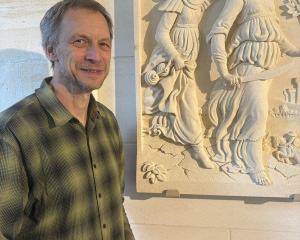
After a packed 2025 that included a stint on reality television show Portrait Artist of the Year Australia and a successful Brisbane exhibition, painter Marko Hrubyj-Piper is surfing the momentum with his first Dunedin solo exhibition.
‘‘When it was all finished I thought, ‘I really need to keep the ball rolling’, I think, for my brain. It’s always good to look forward to something.’’
Referred for the Portrait of the Year show by an artist friend, Hrubyj-Piper did the interviews and thought no more about it until a couple of months later when the producers got back in touch, giving him a month’s notice that he would be on the show.
The show challenges artists to paint recognisable Australian personalities in four-hour heats, so Hrubyj-Piper knew he needed to freshen up on his portrait skills.
‘‘I don’t think I’ve ever concentrated so intensely. I was doing portrait after portrait. I did a few online portrait courses. Even though I’m pretty good, I think it’s always good to kind of redo some learning to get a bit more of a grounding [in] whatever you’re doing.’’
On the day of filming in Sydney, he got to meet some ‘‘amazing artists’’ from all around Australia, but unfortunately did not get through to the next round.
‘‘But it was such an incredible experience for me to have been under that pressure and to have seen how much better of an artist I became because of it, because I really honed my skills.’’

‘‘I think from doing all that within six months, I realised how I’m quite fast and I can actually get a lot of work done quickly.’’
Working from his studio in Byron Bay, Hrubyj-Piper creates ‘‘landscapes’’ featuring people at the beach, but the style of the paintings is usually quite different.
‘‘Some are a bit more realistic-looking and then some are a little bit more expressive or a bit slightly more abstract or they don’t make sense as much.’’
The way he paints each work can be different; for some he uses more brushes, while for others he likes to use a palette knife, creating thicker paint on the canvas.
For his Brisbane show he created works featuring people swimming and what he likes to call ‘‘friends at the beach paintings’’.
‘‘So people under umbrellas, people strolling along the beach, paintings like that. It was the best show in terms of sales and collectors buying that went really well.’’
But it has not all been plain sailing for Hrubyj-Piper. In his school days, growing up in the eastern suburbs of Sydney, he always did well in sports and art, but struggled with sitting and paying attention.
In his last high school he found a great art department that fostered his skills, helping him get into the prestigious Australian secondary schools exhibition ‘‘Artexpress’’ and then into the National Art School, where he majored in ceramics.
‘‘Once you’re in university, you realise that there are a lot of other talented people. And then at art school, I learned how to kind of draw objectively quite well and I learned a few more skills.

He worked at whatever jobs allowed him to paint, dropping the ceramics just about straight out of art school, except for creating the occasional vase.
‘‘I think I just stayed with it and consistently worked at being an artist while I had other jobs and things like that. And being poor. I think I just have a good knack of being poor for longer.’’
When he got to his late 20s, he began to worry about not reaching the level of success he expected, and began to question whether he should continue to focus on his painting or look for something else.
‘‘I used to strive to want to be an artist, it was all consuming in my brain. Always thinking, ‘How am I going to make that artwork? Is it going to be good?’. And while I was doing it, ‘is this good?’. Constantly questioning, almost having self-esteem issues.’’
But he soon realised to continue painting, he needed to refocus.
As a lover of many different art styles and keen to use them all, he had an eclectic collection of work, including abstracts.
‘‘But the one thing I love doing is I always love painting faces, bodies or figures.’’
So he worked on developing a more cohesive concept that focused on Bondi beach and houses he knew. A girlfriend helped out by taking him to the Bronte Baths, where he took photos of her walking and swimming to paint later.

Adding water to the theme seemed to bring his work together and confident in his new approach, he headed to a Sydney art fair.
‘‘I had all my paintings of people at the beach and people in Bronte and things like that. And I didn’t sell anything until the last day. I sold two little artworks to one woman. And I was just in tears. I was in absolute tears. And I was really feeling sorry for myself.’’
But straight after the art fair, he was contacted by Studio Gallery, who now represents him, offering to show his works.
‘‘They took all the art works I didn’t sell and ended up selling them all. So that was really positive.’’
Hrubyj-Piper learnt a lot from that experience, in particular that he just needs to keep going and do the best he can, and hopefully people will connect with his work.
‘‘It did teach me that sometimes it’s not that the art’s not good enough, or that ‘oh nothing’s sold, I’m a failure’.
These days he heads to his studio, does his best and leaves.
‘‘I think over time, I don’t double-think too much any more. I think over time they just naturally develop into the works that they are. And I try not to say, ‘oh, it’s good’ or ‘it’s bad’.
‘‘I leave that up to other people to decide if they want to buy it or not.’’
But that is not to say he does not have works that do not work. While he has sent 13 works to Gallery de Novo to show, he has about six he didn’t.
‘‘I’m still looking at them thinking ‘are they finished or not?’. I do the work as best as I can, and if I get too stuck with it, I just move on to a new one and try not to waste too much time, because back in the day it was very easy for me to get stuck on one work for a month.’’
The Dunedin show came about after his Kiwi stepmother put him in contact with De Novo a few years ago. He had been submitting circle works for the gallery’s Christmas show each year, as well as other works he had done, before approaching the gallery late last year about an exhibition.
‘‘I [said] ‘even a small show, anything, just something I can plan towards’. They’re so lovely, so six months later or so I am going to come over.’’
More recently, he has discovered he has ADHD, and has found learning about his condition, how his brain works and medication has really helped his work.
‘‘I didn’t do very well at listening in class at school, but I think deep down I really love learning and I love learning about history, modern history, science, how the world works or how the human body works. I love that kind of stuff.’’
So he listens to podcasts of all different types as well as music — ABBA is a favourite at the moment — while he is working.
‘‘I think just having a noise in the background actually helps me concentrate even better, in a funny way. Just having something, or having some intelligent people talking about the Aztecs and how the conquistadors came and took over everything, I think it puts me in the zone.’’
He also takes inspiration from the many contemporary artists’ work he sees on social media.
‘‘I think we’re just so much more open to new artists and ways of working now, that you can really get good inspiration from what’s out there, and it can really help you get better at what you want to do.’’
Seeing their work also pushes him to be better at his own work.
‘‘It just takes a long time to come up with something cohesive that kind of looks good and feels good.’’


![Anna Caselberg (née Woollaston, 1942-2004), Mihiwhaka [sic] Hills, 3a, 1980, oil on board:...](https://www.odt.co.nz/sites/default/files/styles/odt_landscape_small_related_stories/public/story/2026/06/hocken_image_3.jpg?itok=GD1ELFdr)