
PHOTO
Many people have never knowingly seen Mercury. It's a small planet that stays close to the Sun, just as the new lambs in my Middlemarch paddock stick close to their dams. But every so often it wanders far enough out to be seen, and this is the best evening apparition we'll get all year.
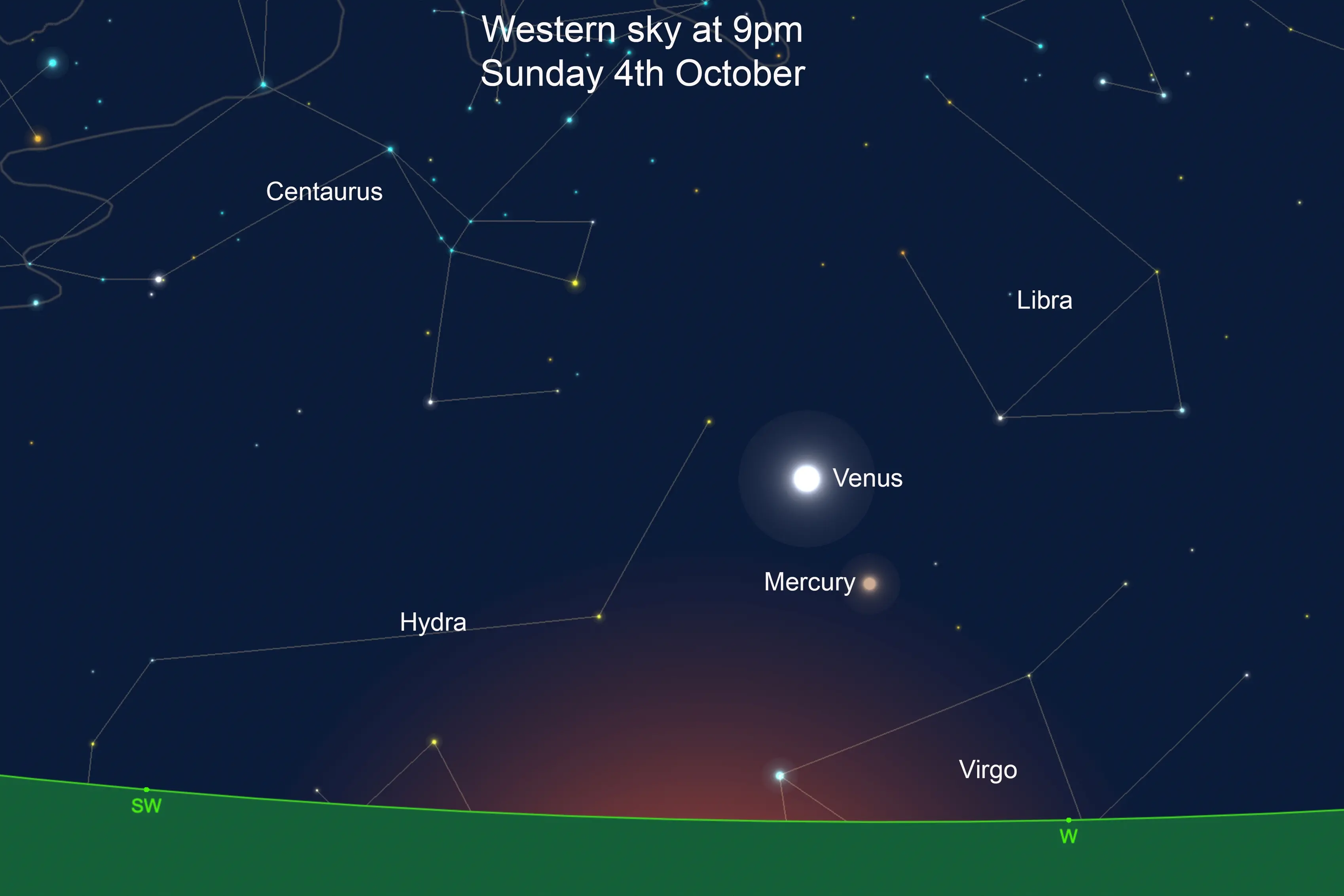
About an hour after sunset, look low in the west. You can't miss Venus, the brilliant light hanging over the place where the Sun went down. Just below it and a little to the right is a fainter, peachy point. That's Mercury. Both are moving through Virgo.
They look like neighbours, but they aren't. Venus is about 49 million kilometres away. Mercury is about 169 million, more than three times farther. You'll need a telescope to see Mercury's tiny disc, but it's worth the trouble. Mercury is about 75% lit, because we're seeing it mostly from the sunny side. Swing across to Venus, and you'll find a majestic crescent only 12% lit, because it's nearly between the Sun and us. I've been showing people that crescent for 40 years. It still gets an "oh".
Keep watching over the coming weeks. Venus is sinking and will be gone by about the 20th. Mercury is still climbing. Around the 9th it passes Venus, and around the 12th it reaches its greatest distance from the Sun before fading back into the twilight by the end of the month. Jot down where it sits each clear evening. People did that for thousands of years before anyone owned a telescope.
Meanwhile, a spacecraft is approaching the end of a much harder journey to the same planet. BepiColombo, a joint European and Japanese mission, left Earth on October 20 2018. You can't fly straight to Mercury. Falling towards the Sun means shedding speed, and the cheap way to do that is to borrow a little from the planets on the way past. So BepiColombo flew past Earth once, Venus twice and Mercury six times. On November 21, Mercury's gravity finally takes hold. In December, the craft splits into two orbiters, Europe's Mercury Planetary Orbiter and Japan's Mio, which will start studying the planet next April for at least a year, possibly two.
You won't need a spacecraft this month, though. A clear western horizon will do.