

This combination of events means this week is a brilliant time to explore the half-illuminated moon with binoculars or, better yet, a telescope. It will be high in the sky at sunset and remain visible until the early hours of the morning.

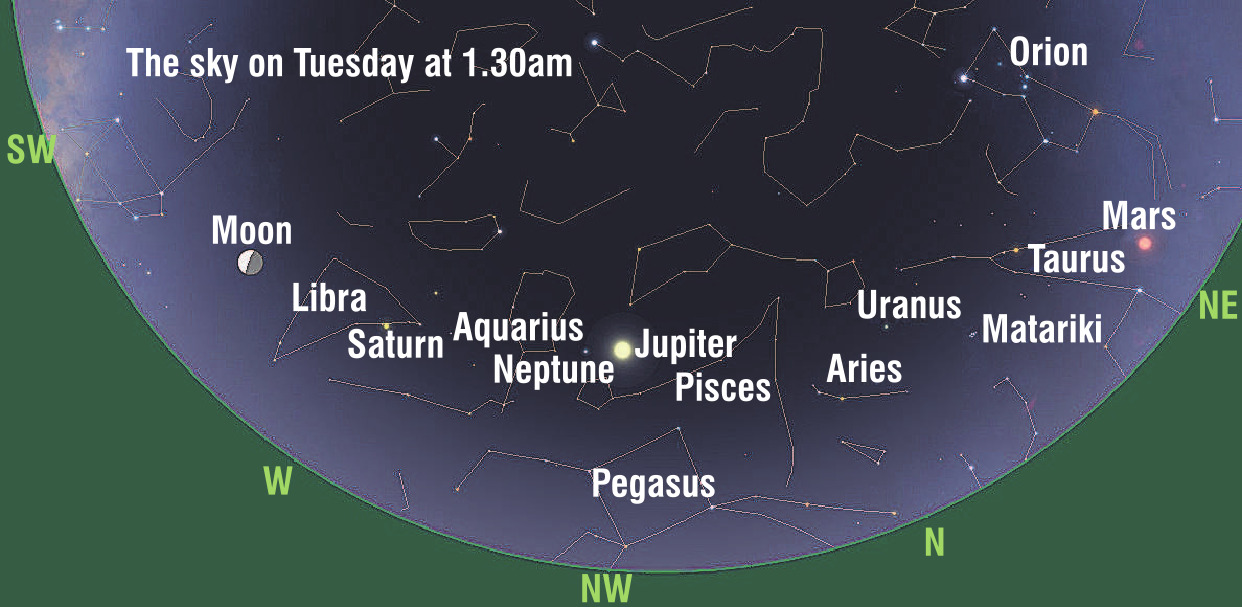
This week’s chart, drawn for 1.30am on Tuesday, should help you find the planets.
Start with the moon. It will be low in the southwest. Saturn is east of the moon in the constellation of Libra, the Scales. Look for a yellowish "star". If you have a telescope, then do take a look at Saturn. The rings are easy to see and beautiful to look at.
Both Jupiter and Neptune are in the constellation of Pisces, the Fishes. Jupiter is, by far, the brightest object in this part of the sky and is impossible to miss.
To find Neptune, you will need a pair of binoculars. The planet is too dim to be visible to the naked eye. This week, on Friday night, you can use the moon to help you find Neptune. Look for a distinctly blue star roughly three degrees southeast of the moon.
Uranus can be found in the Northern sky in the outskirts of Aries, the Ram. The planet can just be seen with the unaided eye. However, a pair of binoculars makes it much easier to see and will also show its fascinating greenish hue.
Last up is Mars. The red planet is approaching us and brightening with each passing night in the run-up to its close approach to Earth in December. Look for a magnificent orange-red star low in the northeast sky.


