
PHOTO
Out at Middlemarch, the night has a way of settling in properly.
Not city dark. Proper dark.The sort where the hills vanish first, then the fences, then eventually even your own boots, and the sky takes over the whole show.
I rolled back the observatory’s roof just after sunset. I’ve recently fitted an emergency stop, which means the roof no longer tries to leave before I do.

From the boundary trees came the soft, conversational calls of the little owls — two of them chatting back and forth like neighbours leaning on a gate. They’re regulars on clear nights. The night watch.
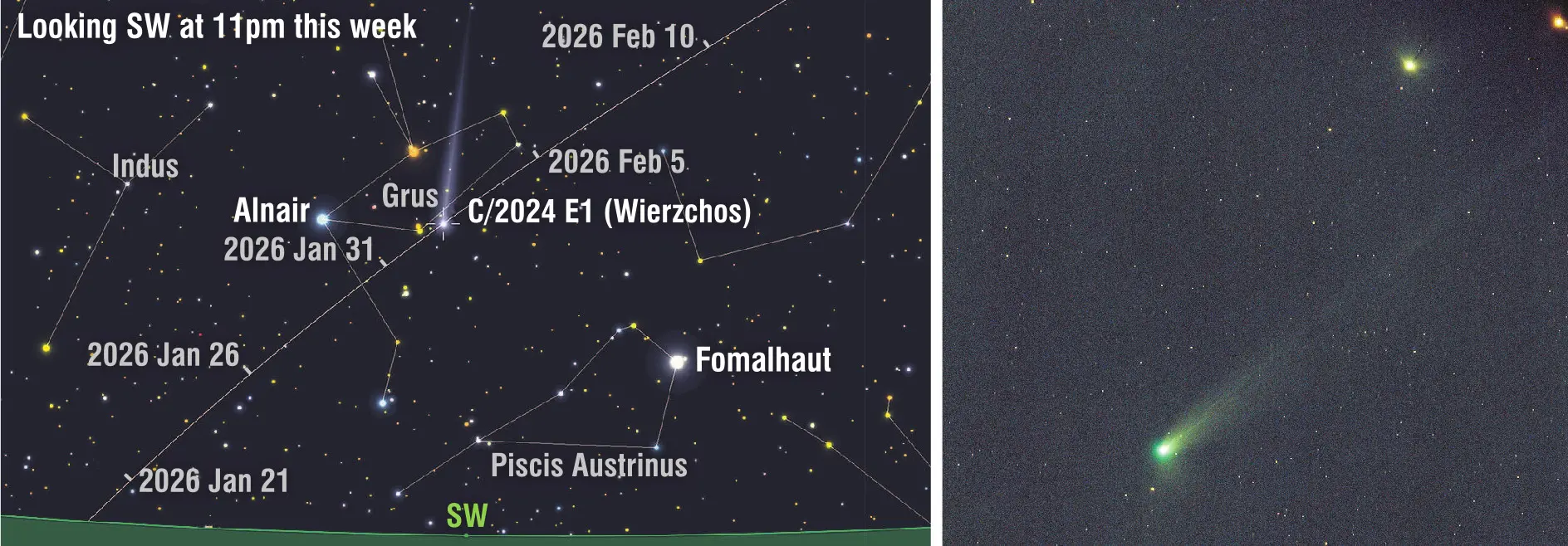
The telescope swung low to the southwest. And there it was.
A small, gentle smudge of light. A dab of green. A faint tail trailing away like woodsmoke.
Comet C/2024 E1 (Wierzchos).
A visitor from the deep freeze of the Oort Cloud, where comets spend millions of years doing absolutely nothing before suddenly dropping in on the inner Solar System. This one has been falling towards the sun longer than humans have existed. And now, for a few evenings, it’s hanging over Otago as if it booked the place.
Predictions said it would only be modestly bright. But comets, like weather forecasts and old farm utes, do what they please. On Saturday, it looked brighter than expected, the coma tight and luminous, the tail stretching a good degree across the sky.
And it’s not coming back. The orbit is hyperbolic. After this swing past the Sun, gravity gives it a shove and off it goes, out into interstellar space for good. A one-time visitor.
If you’d like to see it, head outside about an hour after sunset and face southwest.
Find Fomalhaut, the bright lone star low in Piscis Austrinus, then sweep upward toward Grus, the Crane. Through binoculars, you’ll spot a fuzzy star that refuses to focus. That’s it. The finder chart shows its slow drift through early February before it fades again.
Meanwhile, the little owls keep up their quiet conversation and something more ancient than humanity glows above the hills of Middlemarch. It will be gone soon enough.
Enjoy it while you can.