
PHOTO
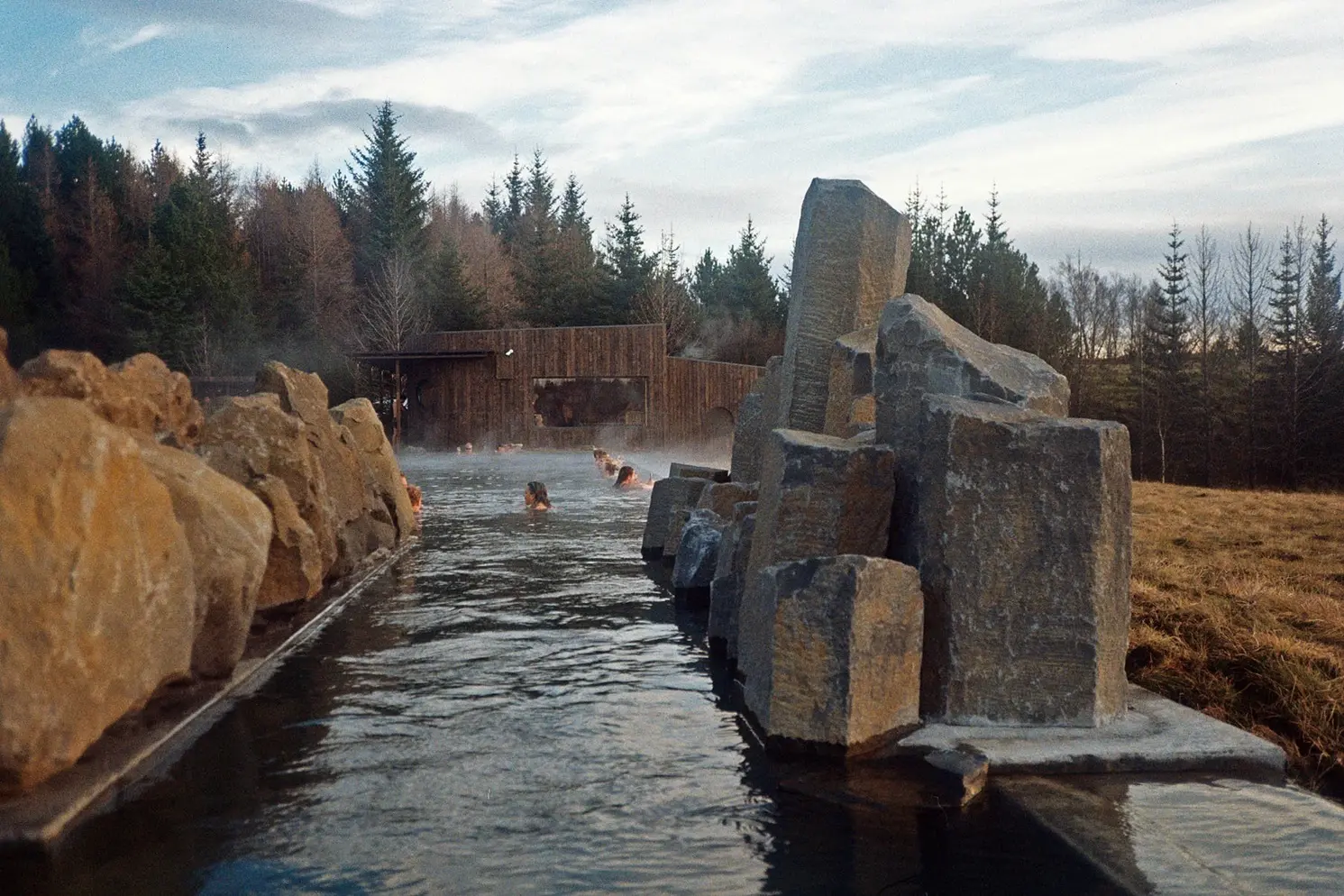
Icelanders love their hot springs. When the nights get dark and cold and they are in need of an energising lifeline, they converge on the pools.
Visitors, too, have been seduced by the scorching embrace of Iceland’s thermal waters, which is why a slew of new, sleekly designed lagoons have opened to harness these natural springs.
The latest is Laugarás Lagoon, a smart, two-level basin recessed into a river bank, conceived as an infinity pool hugged by basalt stone and punctuated with grassy seating islands that help it blend with the tufty meadows around it. It opened in October and sits on the outer edges of the Golden Circle, a route that loops 300km from Reykjavík and hits some of Iceland’s headline natural attractions, from Geysir, the geothermal area that lends its name to all erupting water jets worldwide, to Gullfoss, the mighty waterfall.
On a recent visit, I decided to take the longer route to the lagoon via the small town of Fludir. I had left Reykjavík before dawn one morning in early November, and taken a detour off the main road to Thorufoss waterfall, set in a snaking valley about 40km east, arriving just in time to see the sun rise behind its roaring, cascading waters. Back at the wheel, we wove through Thingvellir National Park and along its expansive central lake, where hundreds of tourists had stopped to admire its central canyon, the meeting point between Eurasian and North American tectonic plates.
Driving towards Laugarás, I spotted several greenhouses by the road, and once we arrive, the lagoon’s architect, Halldór Eiríksson, immediately offered context for the greenhouses.
"There is a lot of thermal heat in southern Iceland," he said, as steam rose slowly from the pool’s expansive, panoramic tubs.
"This area is the largest lowland in the country where vegetables have long been grown and cattle raised — like the Tuscany of Iceland."
In design, Eiríksson has responded to the area’s "docile" nature with a structure that — despite being clad in green grass — doesn’t disappear into the landscape. Instead, it borrows from the vernacular of both traditional turf houses and Roman aqueducts for an arched result that looks like a pitched tent.
The building is constructed with stone and wood sourced nearby. Meanwhile, the interiors of the lobby, changing rooms and on-site restaurant, Ylja, are tranquil spaces enhanced by a large work on Japanese fabric by the Icelandic artist Sigmundur PF.
This ethos of connectedness to the landscape extends to the lagoon’s kitchen: Gísli Matt — one of Iceland’s most accomplished chefs — can count on the produce that grows inside the region’s greenhouses. But he has also been experimenting with how to harness geothermal heat in cooking methods. "There is a real sense of warmth in this area," he told me. "And not just in the earth. Lots of people want to do amazing things, and they’re very proud of where they’re from."
After sampling his succulent lamb prime and a creamy skyr mousse — a worthy homage to two of Iceland’s best ingredients — I finally headed to the waters.
The lagoon is vast and warrants exploring. A smaller tub sits in a corner surrounded by perfumed conifers, and a wood-hut sauna is flanked by a frigid cold plunge. Submerged seating in the main pool invites guests to linger. During my visit, some groups bobbed about chatting, but most people chose to dangle at the pool’s edges, facing out to the expanse of the lowlands and the River Hvítá running its placid course below. — The Observer