

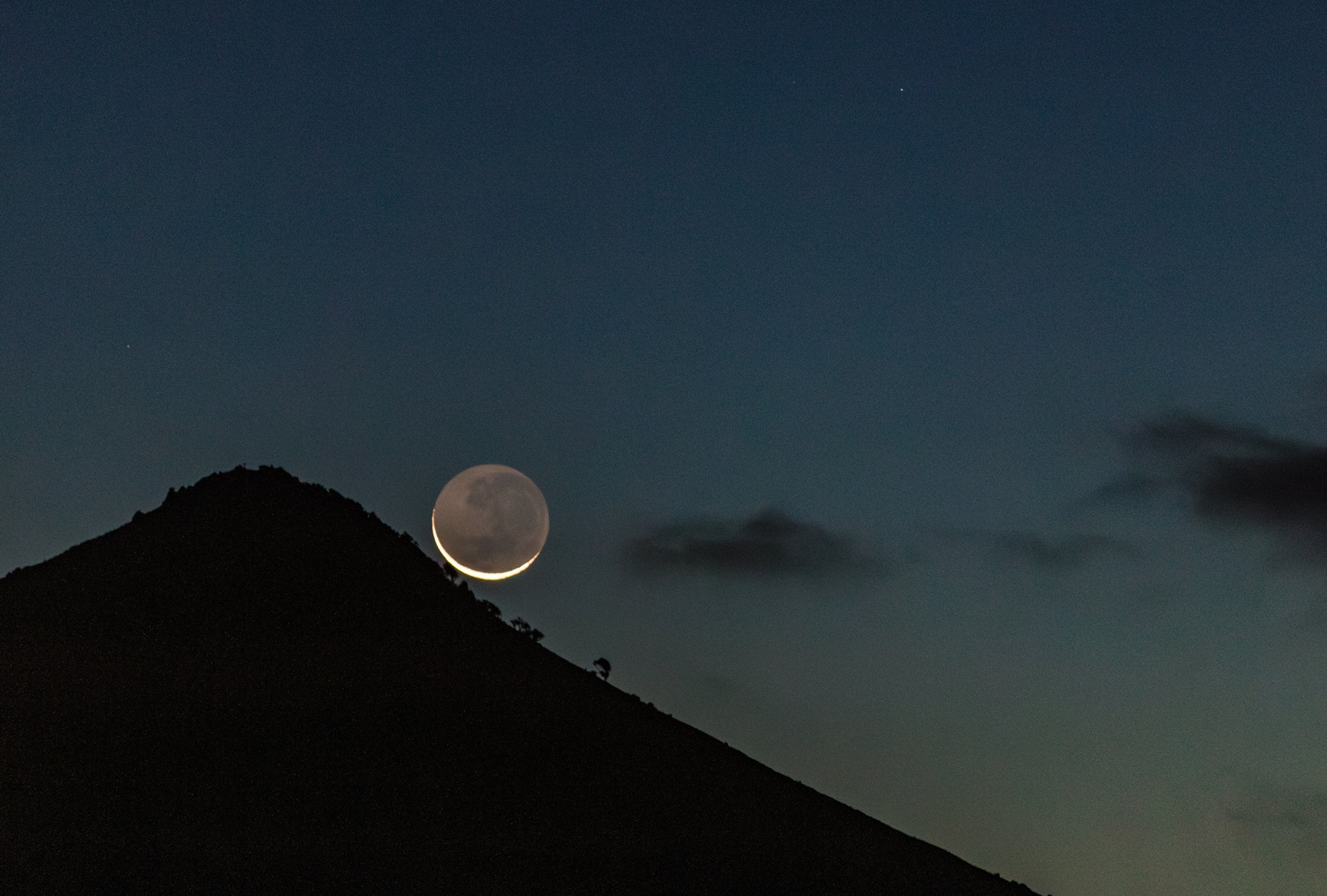
When I was growing up, my parents called this part of the cycle the smiling moon. It’s an affectionate name and a good one.

The word waxing has nothing to do with candles or polish.
It comes from an Old English word meaning "to grow".
A waxing moon is simply one that’s growing — night by night, sliver by sliver — as the sun rises on its craters and mountains.
After full moon, it wanes, from the same linguistic root as "to wane away". The moon, like most good teachers, is very patient about repeating this lesson.
One of the great pleasures of the waxing crescent is something Leonardo da Vinci puzzled over more than 500 years ago.
Look carefully at a thin crescent and you’ll often see the rest of the moon faintly glowing. This is earthshine, sometimes called "da Vinci’s ghost" — sunlight reflected from Earth, softly brightening the moon’s night side.
In those moments, you’re seeing our own planet shining back across space, revealing itself by proxy. It’s a miracle hiding in plain sight.
This phase is also a gift to photographers and casual skywatchers alike. A low moon near the horizon appears larger and warmer, shaped as much by the landscape as by light.
The photograph accompanying this column shows a very young crescent moon seemingly rolling down Harbour Cone — Hereweka — on the Otago Peninsula, a quiet meeting of orbital motion and ancient volcanic slopes.
Tonight, Saturday 24 January 2026, the moon is a little older than the fragile crescent in the photograph, edging closer to first quarter. It’s still well worth stepping outside after sunset.
Look west. Let the moon smile at you. It’s been practising for a very long time.


