

When the moon is full, it is bright and flat, like a light left on in an empty room. But at first quarter, the shadows are long.

Through binoculars, you can watch the light spill across the landscape. Peaks catch fire first. Crater walls glow. Lava plains remain in darkness for a little longer. It is sunrise happening in silence, 384,000km away.
Even a modest pair of binoculars will transform the view.
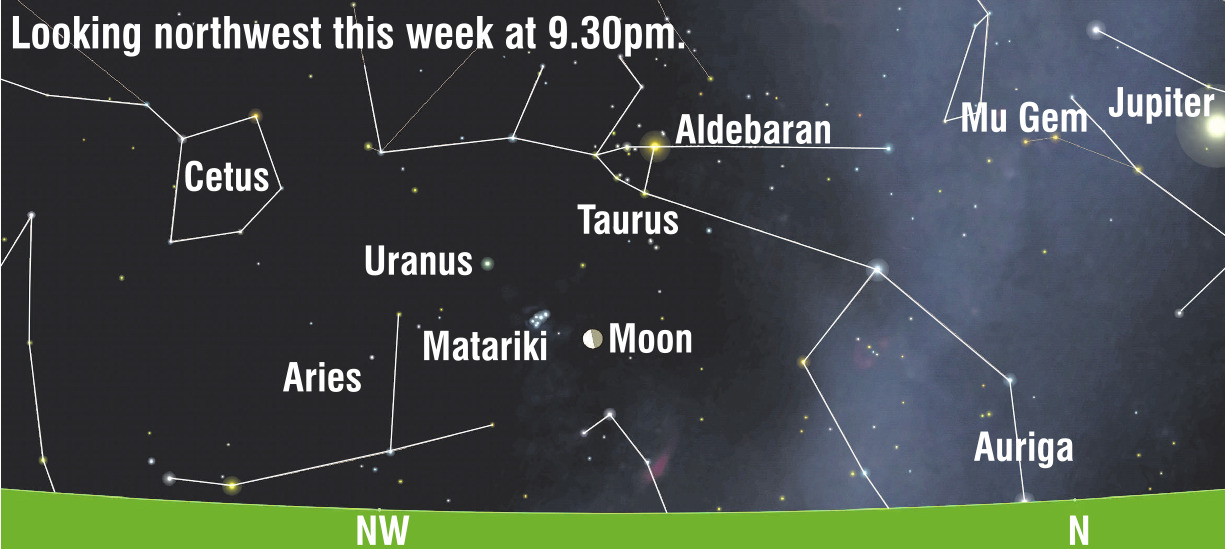
Once you’ve had your fill of mountains and shadow, ease the binoculars just a little up and to the left of the moon.
There you will find Matariki — the Pleiades star cluster — delicate and tight, like frost on black glass.
On a truly dark night, you might count a dozen stars with the naked eye. Through binoculars, even with the Moon blazing nearby, dozens more appear.
Look carefully at their colours: faint blues, hints of gold, the subtle differences that remind you these are suns, each with its own character.
Keep drifting upward and left, and you’ll encounter a small, steady point of blue-green light.
It looks like an ordinary star, but it is the planet Uranus.
Discovered in 1781 by William Herschel, Uranus takes 84 years to circle the Sun.
Since its discovery 245 years ago, it has completed not quite three full orbits — still working on its third grand lap of the solar system.
All three — the moon, Matariki and Uranus — sit within the constellation Taurus, the Bull.
Its brightest star, Aldebaran, glows warmly nearby, forming the apex of a gentle isosceles triangle with the moon and Uranus.
It is an arrangement that will not last long.
The moon moves on quickly. But for a few hours on Tuesday night, sunrise on the moon, newborn stars of Matariki and a distant ice giant share the same patch of sky. Go and look.
You will not regret it.


