

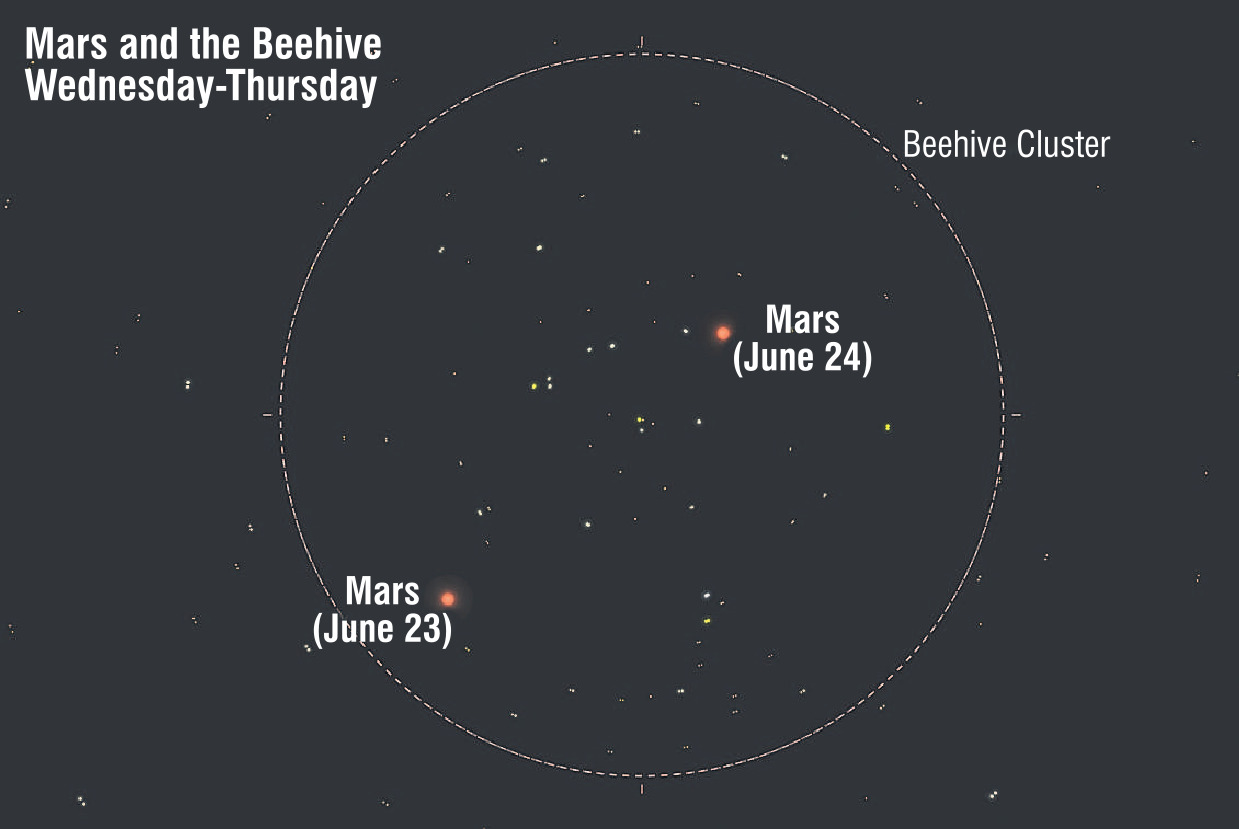
Astronomers everywhere love this time of year because the nights are long. With solstice sunrise in Dunedin at 8.19am and sunset at 4.59pm, we get a night of 15 hours and 20 minutes. With so much darkness on offer, I’m pleased to say that there’s actually something quite exciting to enjoy after sunset.
In last week’s column, I wrote about the show Mars and Venus are putting on in the northwestern sky. This week, I’d like to encourage you to once again find Mars. That is because, on Wednesday and Thursday, the red planet is passing directly in front of a lovely cluster of stars that astronomers call ‘‘the beehive’’. Mars is, of course, easy to find. An hour after sunset, it is visible as a bright red ‘‘star’’ 15 degrees above the northwestern horizon. At the moment, Mars is in the constellation of Cancer, the crab, and sets just after 7.30pm.
To get the best views, you will need a pair of binoculars or a small telescope. Once you find Mars, you will probably exclaim in wonder when you see the many, many stars around it. The sight of the red planet against a backdrop of dozens of colourful stars should look very pretty, indeed.
Astronomers call the beehive an open cluster. It has more than 1000 members, all gravitationally bound and moving through space together. The cluster is just over 600 light-years from us.
- Ian Griffin


