
PHOTO
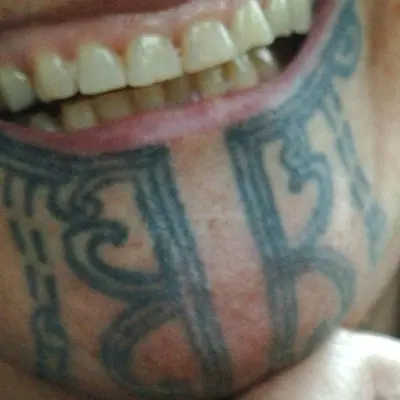
My youngest son puts a fairly low key pressure on me about getting my moko kauae. It’s not constant at all but it comes up in conversation, in the car, when something triggers the conversation. I feel good that he feels this way. He is kind and very complimentary of my skill set and feels I deserve to receive it, and I hear that, but my response is that I don’t feel it and I don’t want to. I don’t ponder on it or over think it and the conversation finishes there.
My husband and I discussed this a few times. He had considered getting moko of sorts on his arm, but that was mostly related to the six-legged spider he had inked himself in his younger and rebellious years. He wasn’t overly keen for him or I to receive it. I want to be clear here that I am absolutely no expert in tā moko nor do I have a deep understanding of the history of tā moko. In fact, even as I write this, I am questioning if I am using the correct words and descriptions.
My husband talked to me about the evidence of tā moko in our Kāi Tahu history and that it was noted by early Pākehā visitors that women had half-faces of moko. However, from memory, my husband said that he hadn’t seen evidence of moko kauae on women here in the South. To be clear, we have a deep history of full-face moko on our male tūpuna, we have all the evidence of that. Furthermore, I feel that moko kauae and the like are a true reclamation of identity and mana, and that it has simply become the norm, which is truly incredible and exactly where our people ought to be.
We (Kāi Tahu) have a history and narrative that corroborates the tā moko process, which entailed a very painful chiselling of the skin. The whakapapa and history of this is illustrated in the recording of the narrative of Rukutia and Tama. Tama received his moko and then went in search of Rukutia:
‘‘They told him that the tattoo process was very painful and although they survived others have died. However, they chiselled the moko on to him and he was in terrible pain. They tattooed his body and they took him back to the village to recover. He lay for three days and they put plant dressings over him and water and he eventually recovered.’’
Ultimately, the reason I am talking about this is that last week we had a mokopapa at my marae, that’s a wānaka where people receive their moko. There were seven wāhine who received their moko kauae and a few of them were my cousins. It was a beautiful process, filled with waiata, good wairua vibes, laughter and interconnectedness. The artists are nothing other than incredible. Three very young Māori women with talent, craft and whakapapa that flows through their veins and out their fingertips, spiritually and physically. I am in awe of their abilities, firstly, to see them take in the āhua and whakapapa of the person, then, like an unspoken science, to take in their physical canvas and carve their creation. It’s mind-blowing.
I was also full of pride and impressed with my cousins and friends who received their moko kauae.
Then my oldest son and I got talking about why I wasn’t receiving mine. He is a deep thinker and chatty, and so much like his father in many ways, he makes me feel like Tahu isn’t far away ... and he quizzed me hard on why I wasn’t getting it.
As I responded to him I started to question myself. I said I wasn’t really sure I wanted to out myself. I look Pākehā and that has made my life very easy, I can move in and out of worlds very easily. It has also allowed me to take people with me on a journey without immediate judgement. I talked to him about the power of being an undercover cop in an army of change agents. He turned to me and said — ‘‘actually, Māmā, I don’t like that, you need to think about that ...’’
In that moment I felt like I wasn’t as strong as I thought I was and that my cousins truly showed up as staunch Māori women, taking that honour and owning it. I said to my boy that I’d think about it.
A few days later he rings me from the North Island and says, ‘‘I think I understand why you don’t want your moko kauae now and I’m sorry — I have realised it forever changes the way people see you’’. I responded by saying his criticism of me was valid, because my decision is selfish. I think it’s beautiful and brave but I really feel like my moko kauae is one that isn’t physically seen but is carved in the deep lines of my life trajectory, like that of my te reo Māori journey, that of my writing and research, that of bearing my three children, that of nursing and burying my husband. No-one can ever walk your journey, no-one has walked mine, and I really feel like that’s it, that’s my moko kauae. And with that he said, ‘‘I totally get you, Māmā’’.