
PHOTO
Corinthian columns grace the State Library of Victoria, one of the world’s first, free public libraries.
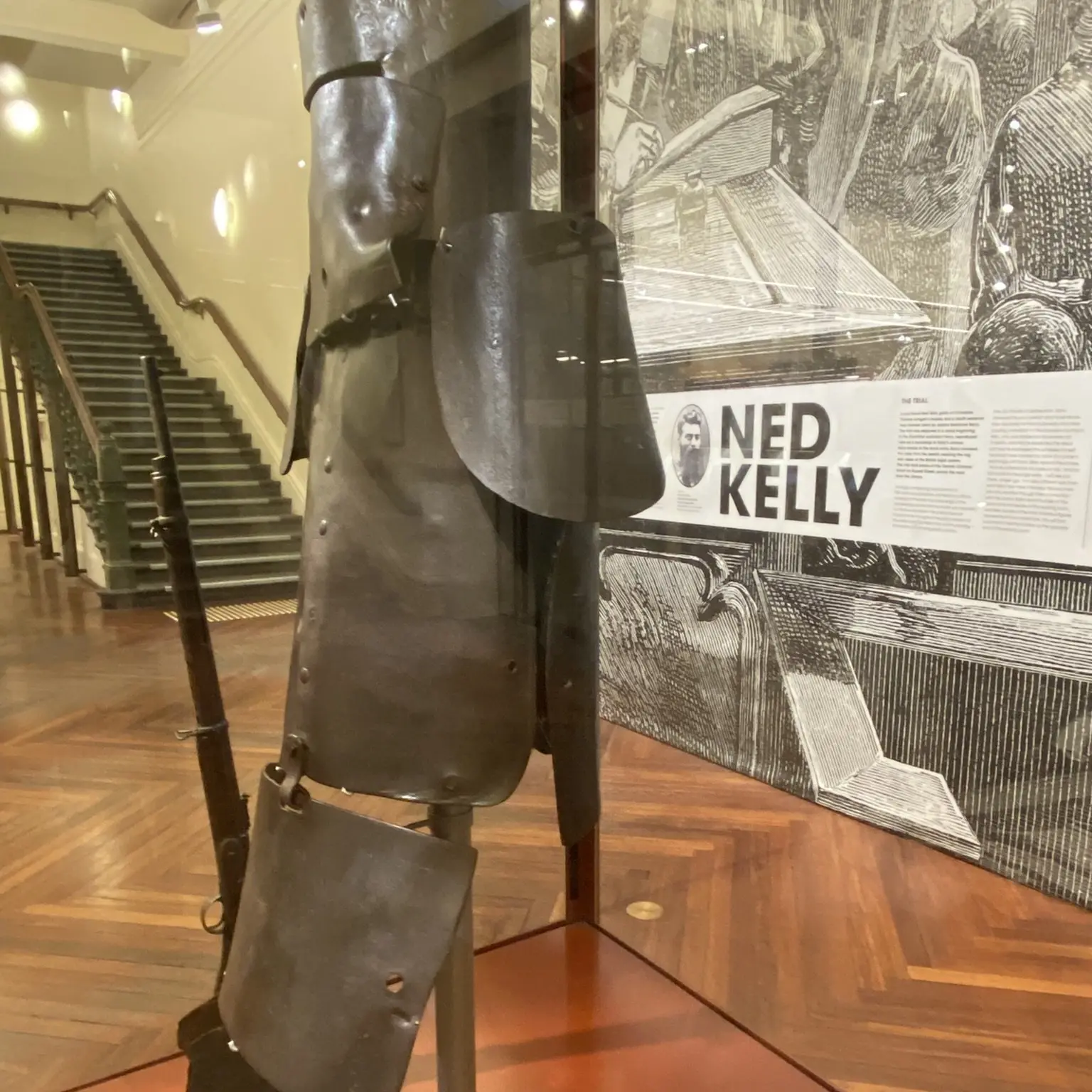
I climb marble staircases, look down on a dome-ceilinged, octagonal reading room with desks set out like a dial, and come across bushranger/outlaw Ned Kelly’s suit of armour, complete with bullet dents. Out front, I’m to hear his story, among others, on a three-hour walking tour of Melbourne with Lily from I’m Free Tours.
The library was built shortly after gold, discovered in the 1850s, brought boom times to the city. A second boom in the 1880s — known as the "Marvellous Melbourne" era — saw money spent in excess, with construction of over-the-top, intricately detailed buildings, inspired by those of Paris, London and Milan.
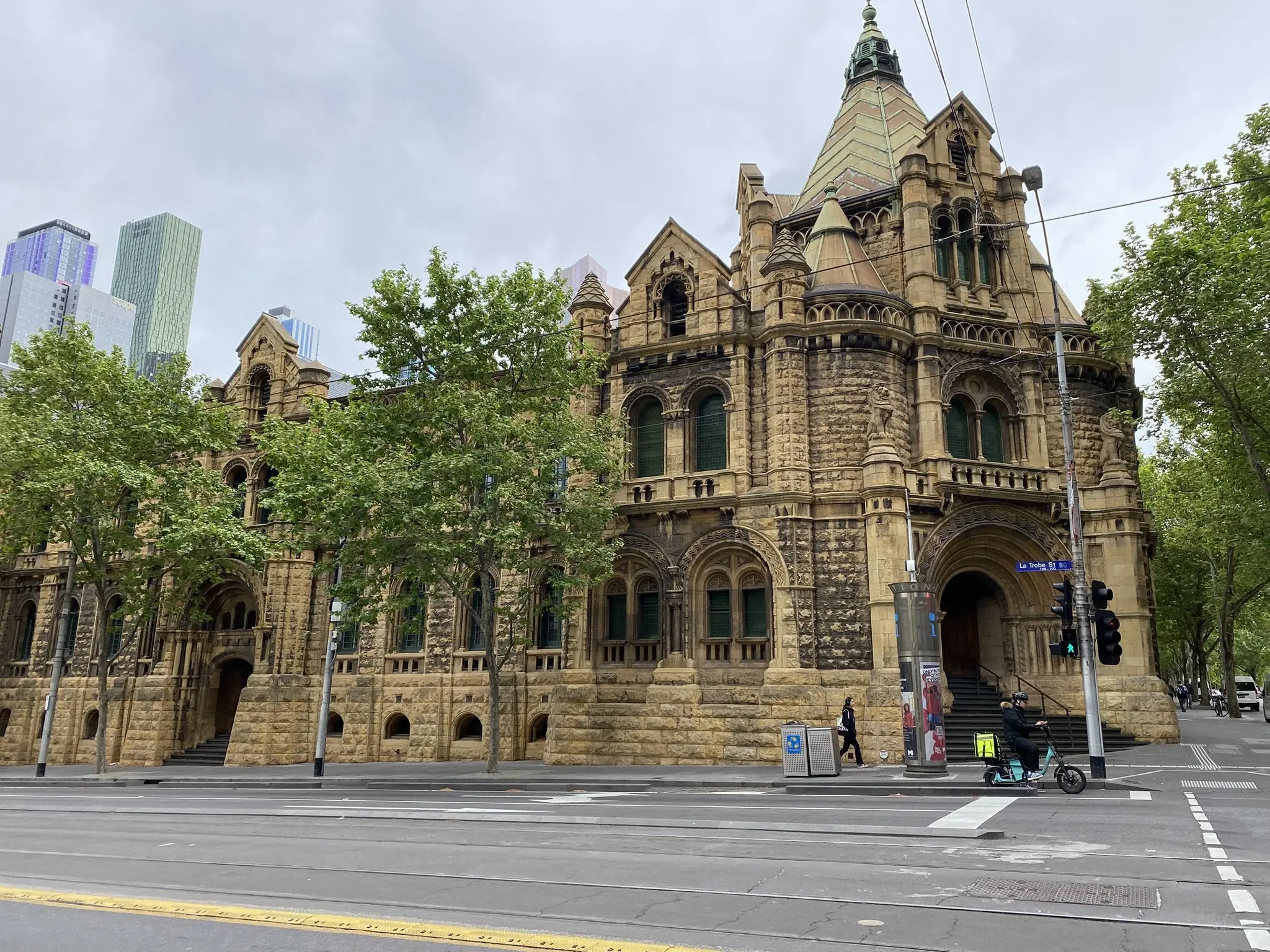
We wander past the Old Magistrates’ Court, built in yellowish sandstone and sporting arches, turrets and gables. In 1911, it replaced the Supreme Court where in 1880, Ned Kelly was sentenced to hang after being captured in a shootout and imprisoned at the adjacent Old Gaol. That bluestone building is now a museum, with tours through the cells and evening ghost tours.
Nearby, an obelisk bears a golden ball etched with the words "Labour, Recreation, Rest". Unveiled in 1903, the 8-Hour Day Memorial commemorates the eight-hour working day that was introduced in 1856 after stonemasons successfully protested at Parliament House for a 48-hour week. The "888" below the gold ball refers to the workers’ slogan: eight hours’ work, eight hours’ rest, eight hours’ recreation.
Across the road at the heritage-listed Trades Hall — a union conference building — a red flag flies, symbolising workers’ rights. The fluttering blue Eureka Flag, with white cross and stars, symbolises the Australian Labour movement. More on that later.
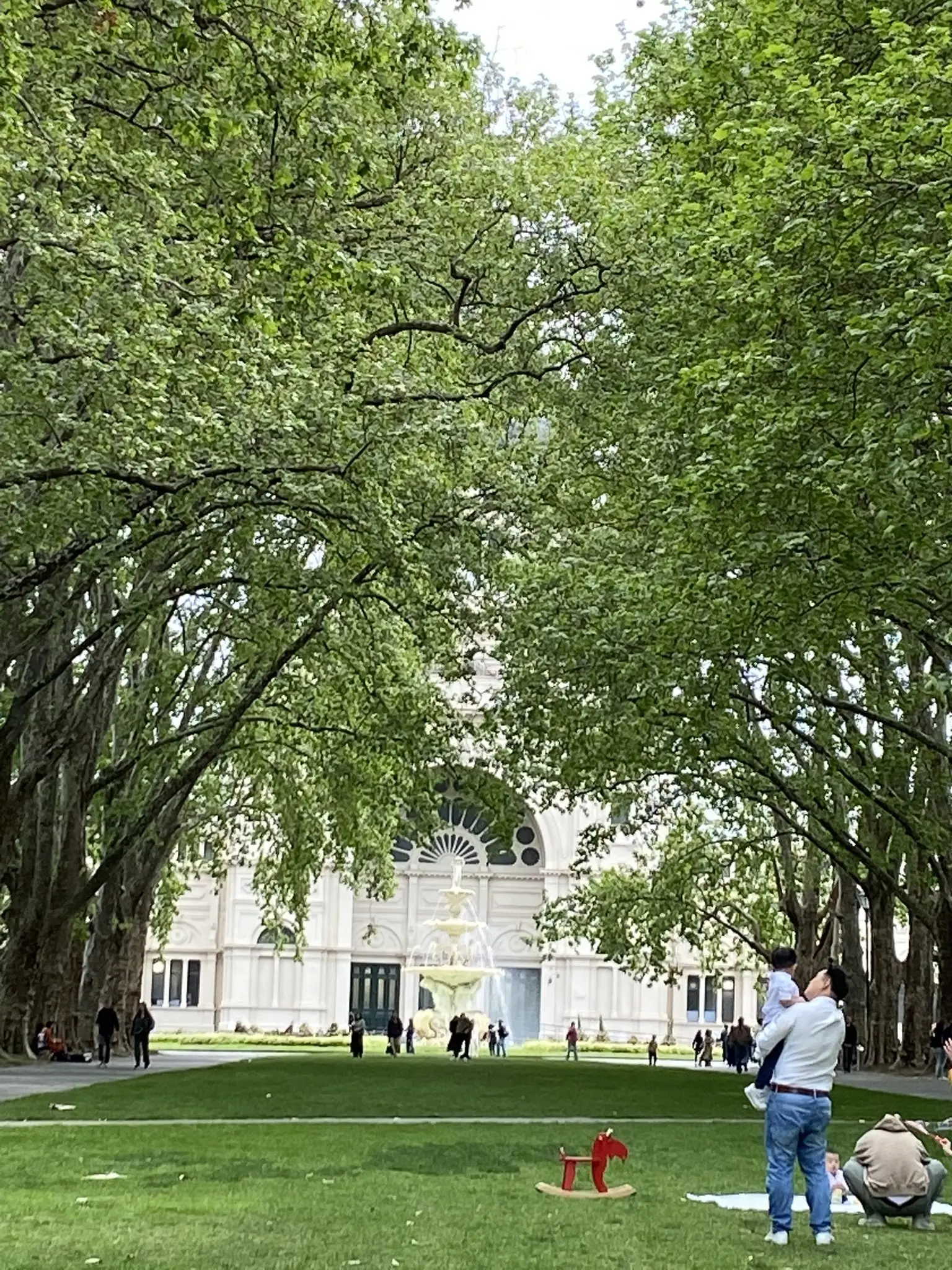
I glimpse a fountain through tall trees in Carlton Gardens. It is spouting in front of the domed Royal Exhibition Building. Built for the 1880 World Fair, the building is Australia’s first to be Unesco World Heritage-listed. It wouldn’t look amiss in an Italian city. It is now a concert hall and tours are available.
One of Melbourne’s oldest trams, the 35 Circle Tram or Green Rattler, clatters past on a loop of the city, taking in major attractions. The free hop-on, hop-off service has audio commentary on board.
Along streets lined with leafy plane trees, we reach the Princess Theatre, built in the Marvellous Melbourne era. Looking up past its copper awning and stained-glass windows to the roof, intricate ironworks look like crowns, and a 24-carat, gold-leaf winged angel holds a horn to her mouth.
We wander through the world’s longest continuously running Chinatown, which highlights the city’s multiculturalism and diversity. Lily tells us many nationalities arrived here, particularly in the 1950s. I see signs for a Greek precinct; Lygon St is known as Little Italy. The Chinese Museum and the Immigration Museum are recommended to learn about Melbourne’s diverse population.
Tucked between main streets, narrow Victorian service alleys are now trendy laneways. We wander one of the city’s oldest, Tattersalls Lane, which links Chinatown to Lonsdale St. Vibrant street art beautifies the rear of red brick buildings. In Stevenson Lane, Section 8 is a "temporary" bar with makeshift furniture — but it has been there since 2006! A tree high up marks Rooftop Bar, which apparently has great views.
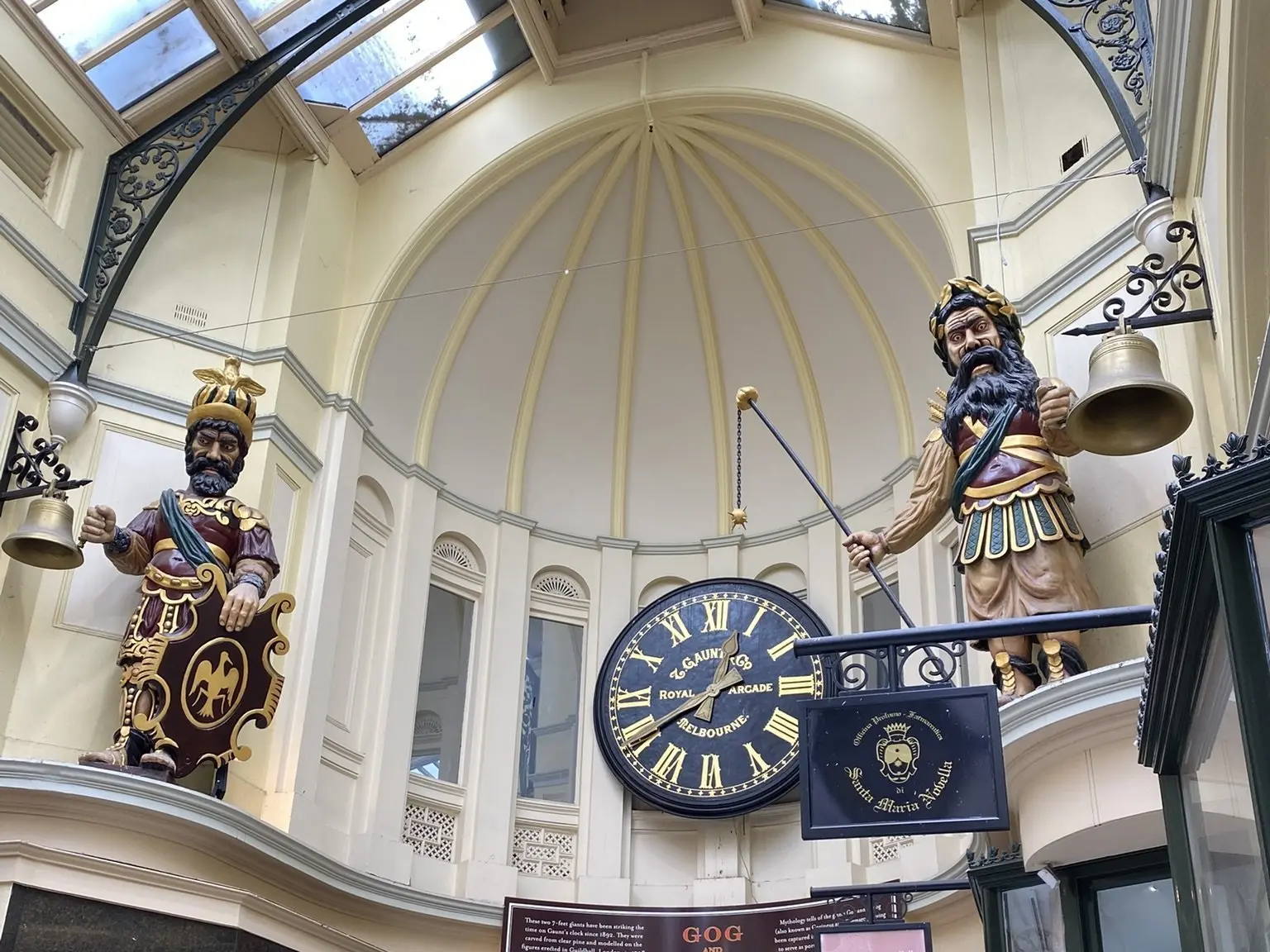
In the pedestrianised Bourke Street Mall, the shopping district, the Myer building, constructed in 1914, stands next to David Jones. A tram glides up the middle of Collins St, past Tiffany & Co, Versace and other high-end shops. At the heritage-listed Royal Arcade (1869), black and white floor tiles, glass roof and intricate ironwork create an old-world feel. Modelled on figures at London’s Guildhall, two seven-foot mythical giants, Gog and Magog, stand either side of a black and gold clock face. They’ve struck the clock on the hour since 1892.
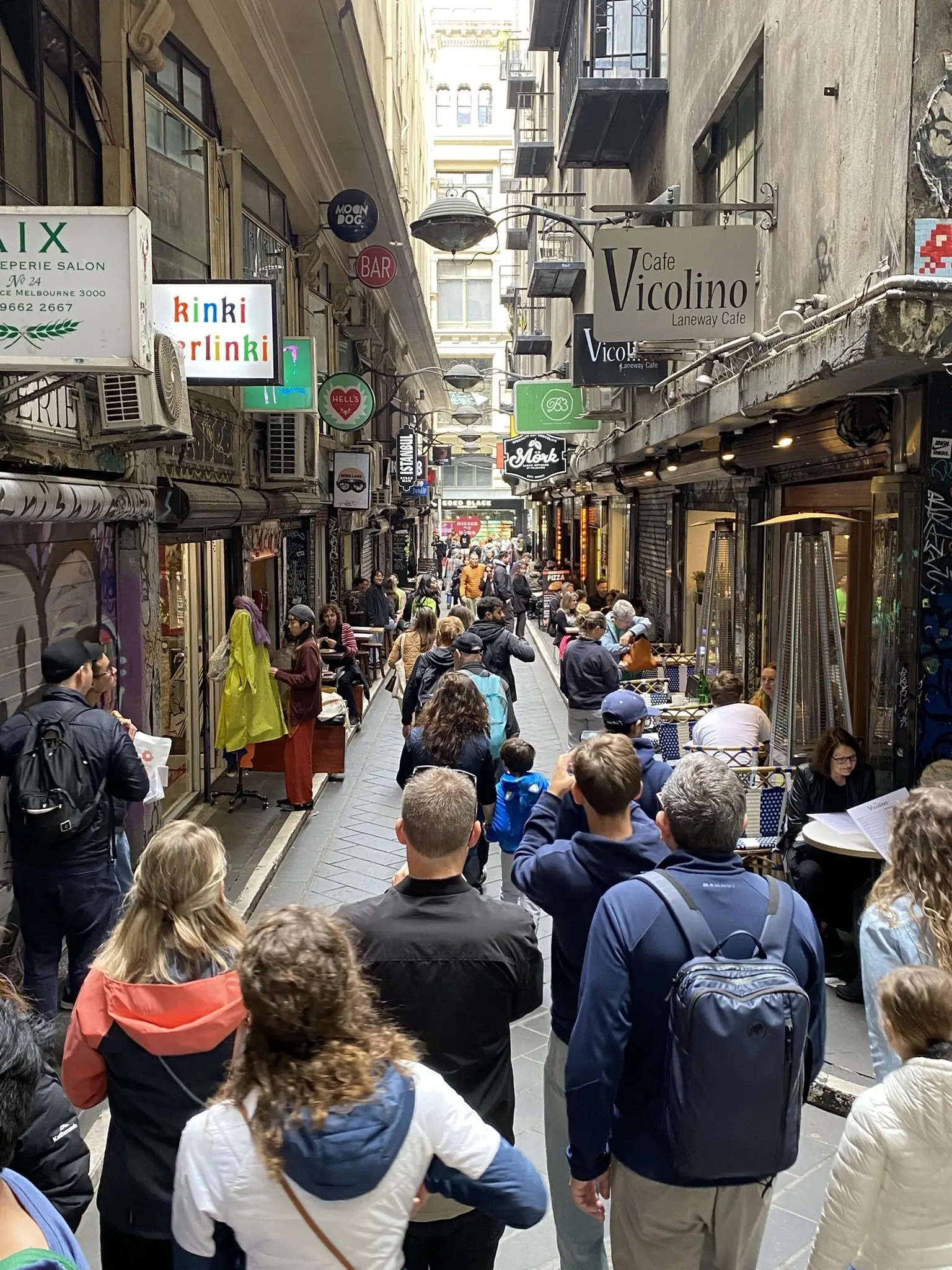
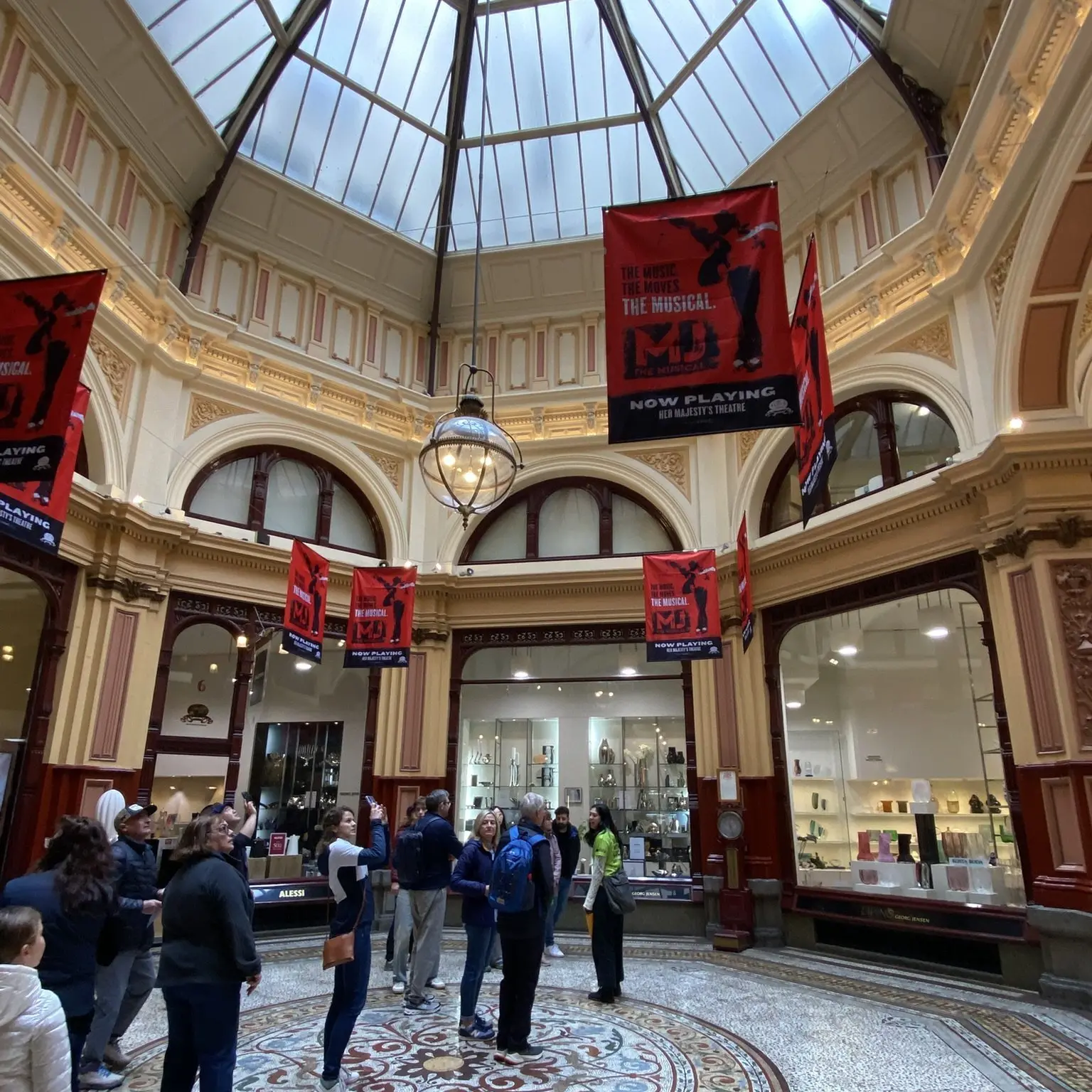
We walk Little Collins St to enter The Block, an L-shaped, 1890s arcade inspired by Milan’s architecture. Its mosaic floors feature colourful floral motifs and geometric patterns below a glazed roof; it was the place to be in the early 1900s. The phrase "they’ve been around the block a few times" originates here. Dressed in fancy attire, women promenaded in a clockwise direction around The Block, while eligible bachelors walked anti-clockwise. If someone caught your eye you would walk with them and chat, until, when the clock struck 12, you might take tea and eat dainty sandwiches with them in one of The Block’s many tearooms. Its last remaining one has a queue to enter.
We pass through laneways such as Centre Pl, designed as a lunch spot, and Degraves St, open for lunch and dinner, where chairs and tables clutter the alley. Melbourne’s coffee culture, popularised by Italians who brought over the espresso machine in the 1950s, can be experienced in recommended Journal Cafe and Dukes Coffee.
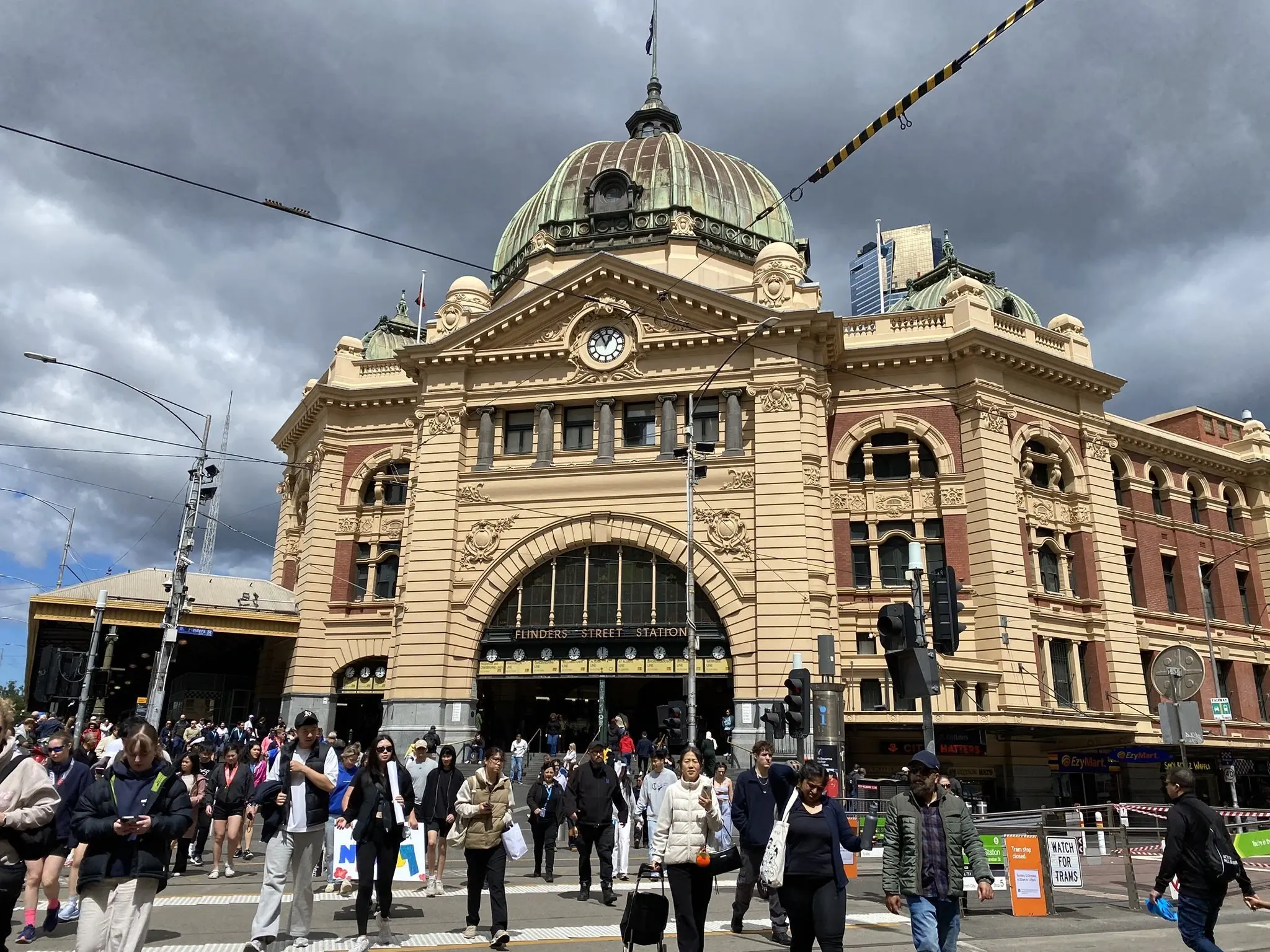
A popular meeting spot is below the clocks across Flinders St Station’s frontage which display train departure times from each of its platforms. Crossing the road, we reach Federation Square. Created to celebrate 100 years of Australia becoming a federation, this arts and culture venue is home to brash modern structures and older buildings, the Yarra River running adjacent.
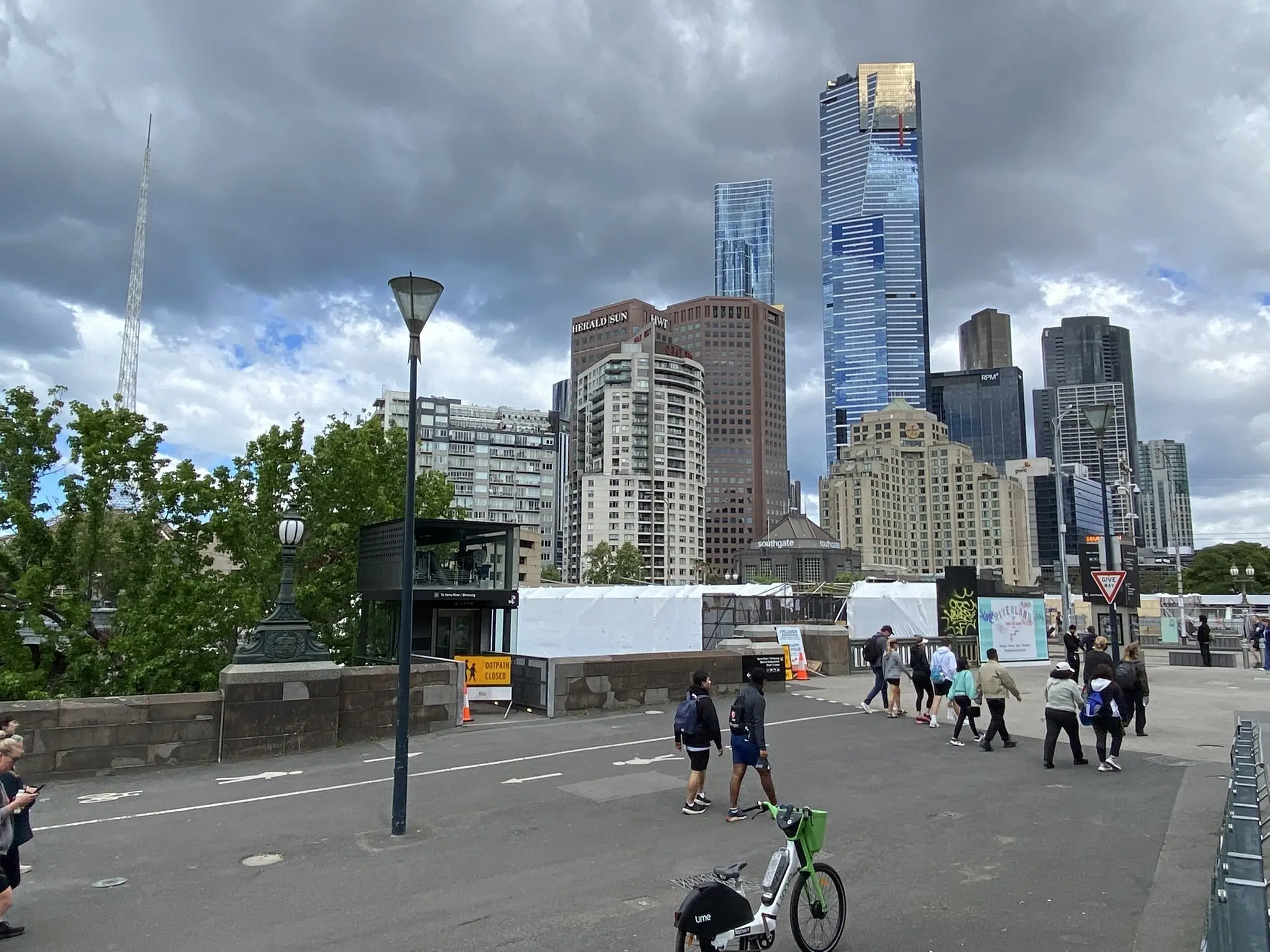
Lily points out the 297.3m Eureka Tower, its 88th floor observation deck giving views across the entire city. Like the Eureka Flag, it is blue with white stripes and symbolises the 1854 Eureka Rebellion which was about goldminers gaining rights. Goldminers were sold a licence to dig a 12sqft (1.1sqm) piece of land, measured with a tape measure (which the white stripes depict). If no gold was found, they had to buy another expensive licence for another plot. With strict rules, and brutal policing of fee collection, disgruntled miners eventually rebelled, created the Eureka Flag, and burnt their licensing papers beneath it. The military were sent in, 22 miners were killed and many injured, but miners won the right to have representatives in government and to vote — key events in Australian politics. Twenty-four carat gold at the tower’s top, pressed between thick glass, represents the gold rush. When lit by lights, it reflects gold on to the city. A 22m red line coming down from it pays respect to the 22 miners killed and the bloodshed. It’s a thought-provoking building, and end to the tour.
But this land’s history goes further back than Melbourne’s 1835 beginning.
I head to Federation Square’s Koorie Heritage Trust to learn of traditional owners, the Wurundjeri Woi-wurrung people, who walked this land for 65,000 years prior ...
— The writer travelled courtesy of Visit Victoria.