
PHOTO
Late afternoon on Loch Lomond, and I’m whizzing north along the lakeside curves of the A82, the car radio quietly burbling away, the odd burst of sunlight throwing up shards of sparkling water between the trees. I’m on a solo road trip into the southernmost tip of the Highlands and across to Perthshire, travelling from Glencoe to Pitlochry over five days. Somewhat shamefully, despite having been a travel writer for 25 years, I’ve never ventured further north than Glasgow, save for a friend’s wedding on Loch Lomond itself.
It’s partly my dad’s fault, who had a tendency to echo Samuel Johnson’s famous line, “The noblest prospect which a Scotchman ever sees, is the high road that leads him to England” whenever possible holiday locations were discussed. Thus, I never made it in my childhood, and plans to drive up the west coast, or rent a cottage in the Summer Isles, never came to be. So now, here I am, in my sixth decade, driving into unknown territory and entirely unprepared for the unsettling change of landscape as I leave the loch behind.
Slowly, everything — trees, houses, road signs, other cars — begins to fade into the vanishing point in my rearview mirror. There is nothing but me and Radio 2’s Sara Cox and a vast expanse of rugged, rusty moorland, pockmarked with silver-topped pools and giant, leather-skinned mountains looming on the horizon. I’ve seen photographs of Rannoch Moor: blue skies, limpid pools, auburn swathes of heather and gorse, strikingly spare and beautiful. But now, with dusk encroaching, rather than spare and beautiful, it feels raw and alien, and as the only car in sight melts away into the gloom, I discover I am a little spooked. I pull off at the Three Sisters viewpoint and step out of the car.
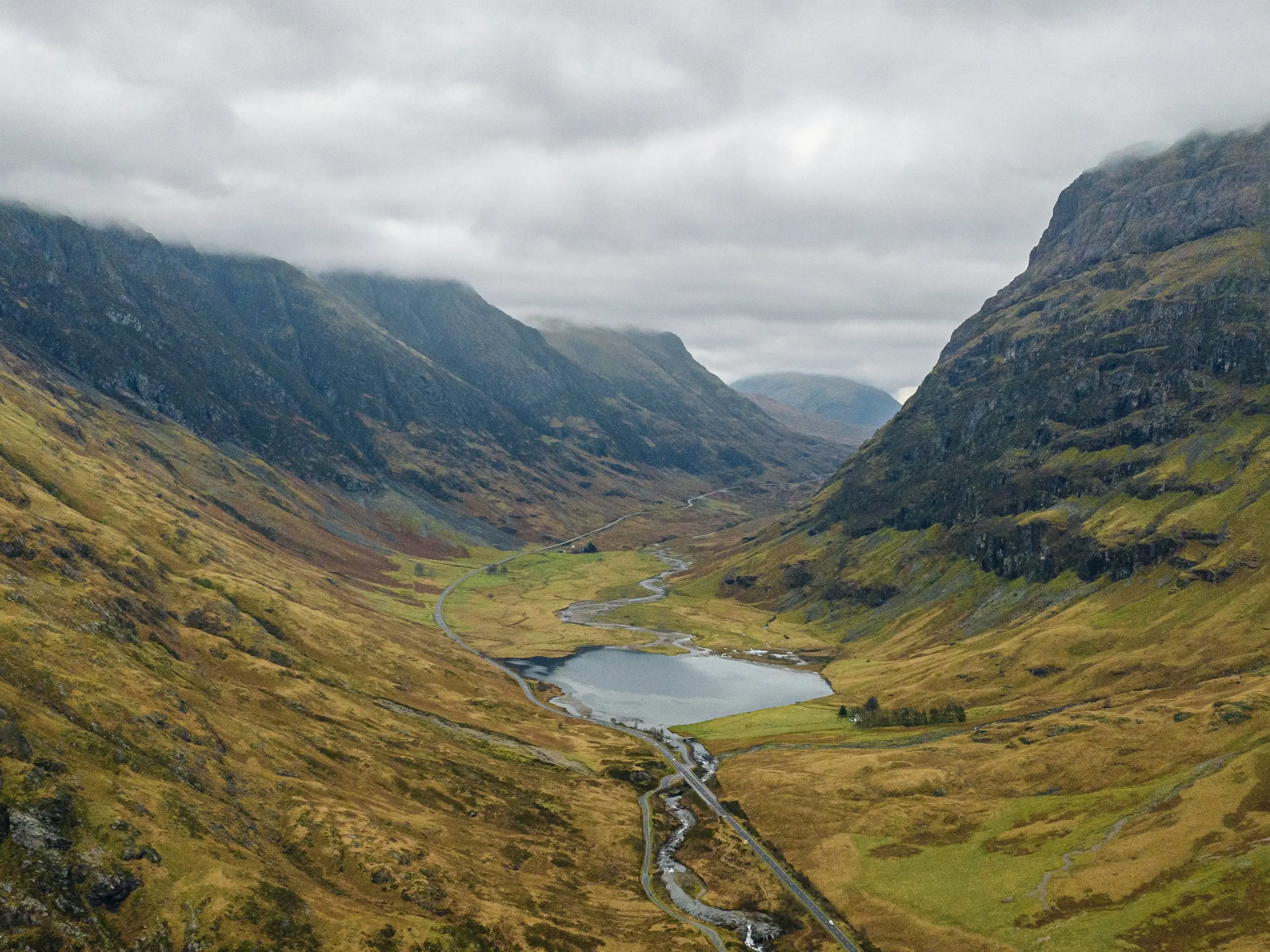
Outside the air is damp, thick and heavy with silence. In front of me, the three huge ridges of the Bidean Nam Bian range glower down, brown-hued, devoid of any trees or foliage to soften the mountain’s gargantuan scale. Another car draws in and a couple step out, their brightly coloured anoraks and chatter reassuring me as I stand among nature taken to extremes. Beyond us, the road snakes on between the mountains, a thin, metallic ribbon, distant car headlights like fireflies in the gloom. I feel minuscule, overwhelmed, astonished and elated all at the same time, and wish my husband was with me, so I could turn and raise my eyebrows. Instead, I suck in the moist, peaty air and climb back into the car for the 5-mile drive through the valley to the Glencoe Inn, my billet for the night, huddled between the other whitewashed village houses in the lea of the peaks.
I am driving into unknown territory and entirely unprepared for the unsettling change of landscape as I leave the loch behind.
It’s quite a relief to check in and be surrounded by the hubbub of walkers and tourists in the bar, a dinner of velvety scallops and chips softening the memory of the forbidding landscape outside. But, in the morning, driving up to the Glencoe visitor centre, the same sense of awe swings in. The scenery is on a scale I never expected to find in the UK. I walk across the fields to the centre’s re-created turf-and-creel house, a 17th-century dwelling that looks hopelessly vulnerable against the misty peaks behind. A Japanese visitor, clad top-to-toe in white, walks past, treading gingerly through the bracken. Back in the visitor centre, I’m drawn to an old photograph of a trio of women, clad in Edwardian hiking gear, ropes around their shoulders and axes to hand. They are founder members of the Ladies Scottish Climbing Club, set up in 1908, when the Scottish Mountaineering Club decreed women members unthinkable.
I’m not as feisty as the LSCC ladies and set off for the gentler side of Glencoe, following the one-mile trail around Glencoe Lochan, a man-made lake surrounded by towering redwood trees that feels more like British Columbia than the Highlands. “That’s exactly how it’s supposed to feel,” says Graham Steve, general manager at Glencoe House Hotel, when I pop in for a restorative cup of tea. “This land was owned by Lord Strathcona, who married a Canadian woman, Isabella, and brought her back to Glencoe. She was terribly homesick, so he shipped hundreds of native trees from Canada, to make the landscape feel more like home.” It clearly worked: Donald and Isabella were married for 54 years, until her death in 1913.
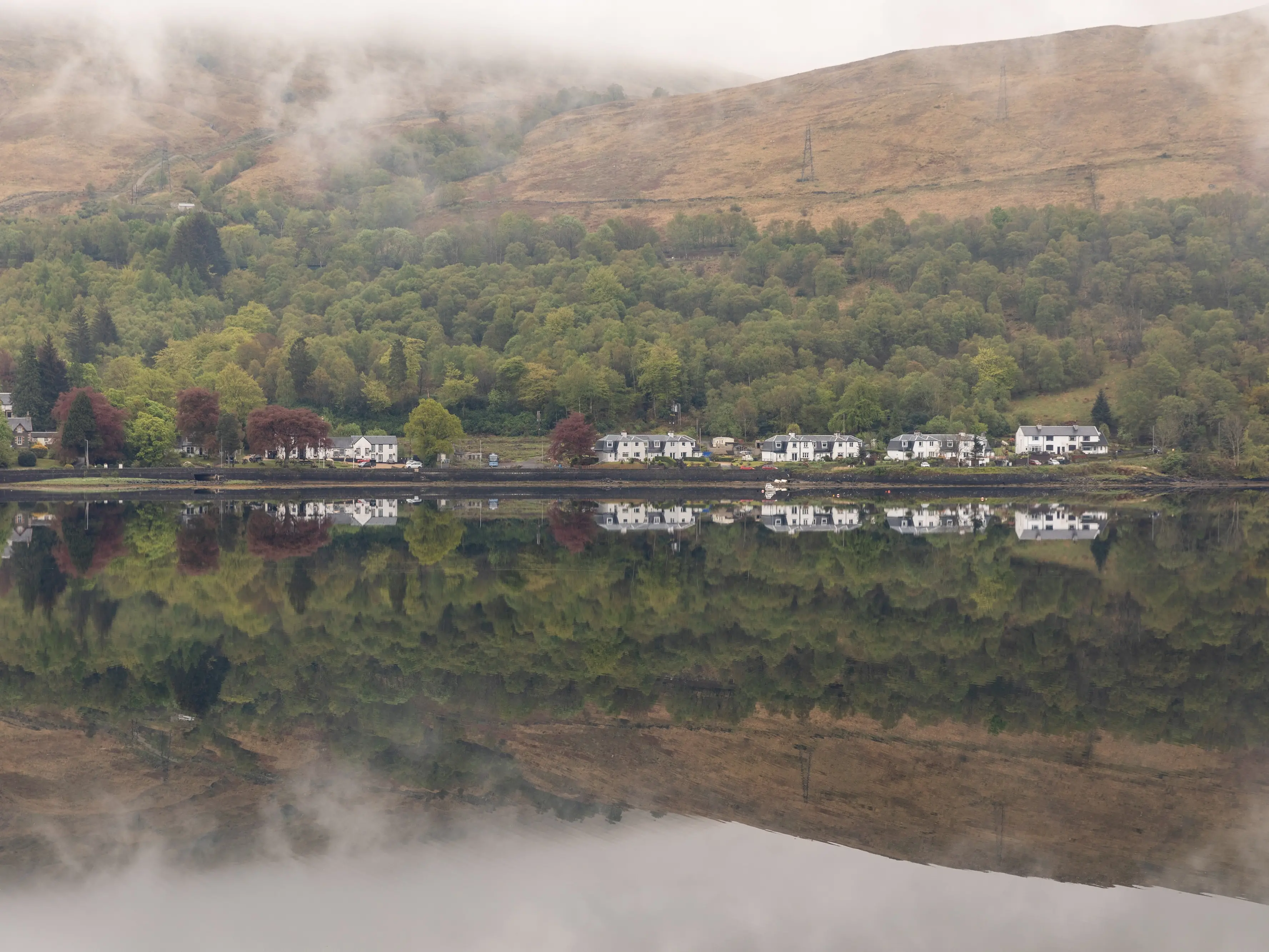
Back in the car, I set off towards Fort William, taking a short detour to the Lochleven Seafood Café, where I pick up the picnic to end all picnics: rosy, fat prawns, smoked salmon, small tubs of aioli and crab pate, thick slices of bread tucked between. After an hour’s drive, I find an empty layby on the shores of Loch Linnhe and perch with my picnic on the bonnet of the car. Great feathery clouds layer themselves over the sun before drifting off again, the lake below changing from deep purple to glittering blue, mountains hovering in the distance behind. I wish for the second time my husband was with me, just so I could sit in the passenger seat and properly take in the scale of the scenery whizzing past my window.
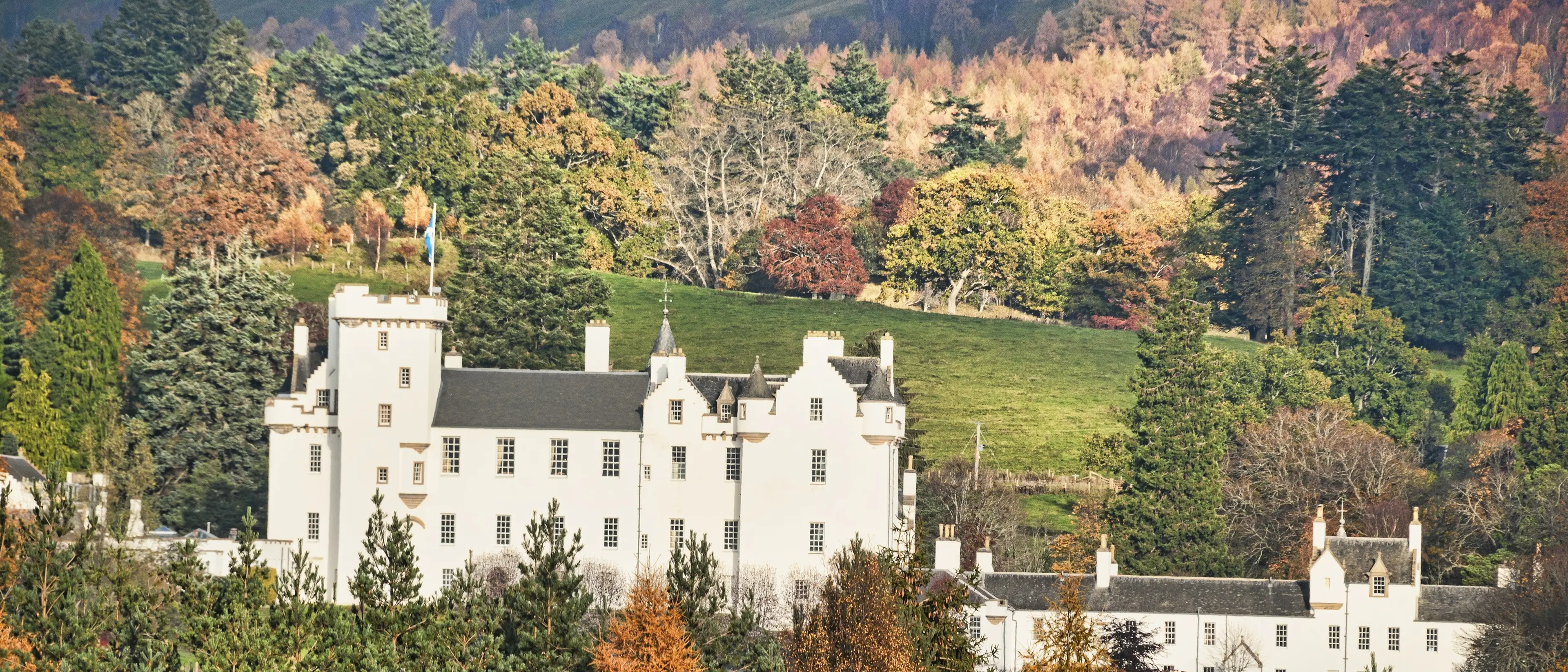
My base for the second leg of my trip is a cottage on the Atholl Estate, where the lush farmland and rolling hills feel far more familiar, almost disappointingly so. The estate is home to Blair Castle, where Queen Victoria first fell in love with Scotland, and where I have an appointment with the archivist, Keren Guthrie. I arrive to find Keren has laid out original, handwritten letters from the couple. Prince Albert’s are full of concern for his wife, clearly suffering from postnatal depression. Victoria’s are more chatty. One includes a detailed recipe for potato salad. The original ledger shows their extraordinary entourage, numbering more than 100, including four chefs, an upholsterer and a brace of footmen. Keren takes me on a tour of the castle. Shotguns are the wall art, arranged in concentric circles alongside stags’ heads, their antlers used for light fittings, armchairs, coffee tables.
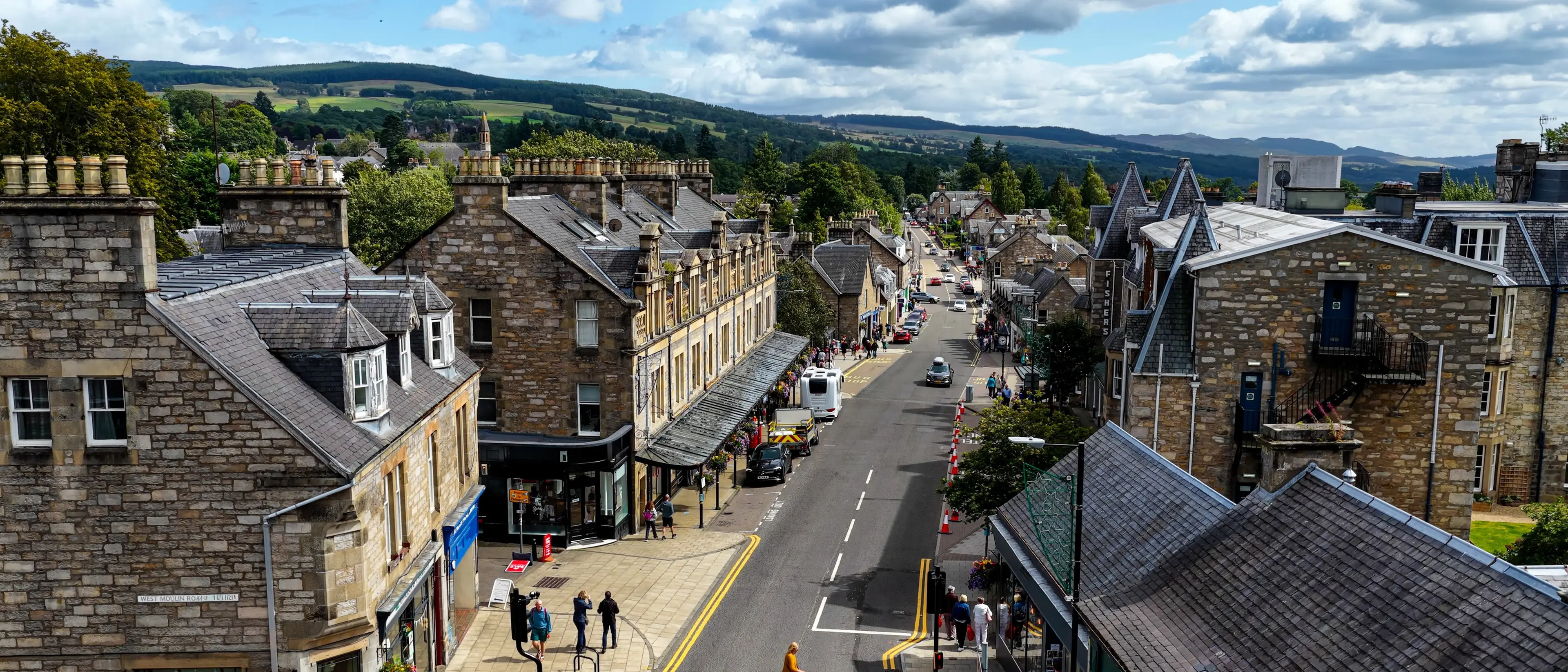
As I drive away, I am struck, as I was in Glencoe, by what an extraordinarily different country this is to England, the desire for independence suddenly much easier to comprehend. I feel it again in Pitlochry, where I settle in with a hot chocolate at the Mac & Pinch café, my English accent stiff and clipped against the surrounding Scottish burr. It’s hard to put my finger on quite what feels so different. The air, perhaps, and the light, and the shop windows full of tartans and shooting gear, balls of haggis and slabs of venison on display in the butcher’s.
I am struck, as I was in Glencoe, by what an extraordinarily different country this is to England
At the Falls of Bruar, 11 miles from Pitlochry, I take a stiff one-and-a-half-mile hike past a series of waterfalls that tumble down for more than 60 yards. It’s a leafy climb, through a swathe of trees planted at the suggestion of the poet Robert Burns, though perhaps not in the way he imagined. Legend has it that the Duke of Athol fired a cannon at the hilllside, packed with Scots pine and European larch seeds. It’s a wild, dramatic walk, with no sign the descent will deliver me back to the car park for the House of Bruar — otherwise known as Scotland’s premier out-of-town retail experience, a kind of Harrods-meets-Daylesford Organic, with vast halls of tweed plus-fours and cashmere sweaters, a sumptuous food hall and a cafe doing great business in afternoon teas.
Next morning, loading my bags into the car (shortbread: tick, Tunnock’s Tea Cakes: tick), I think about what it must have been like for a weary Queen to disappear into such a wild, untouched landscape. It clearly became a love affair, with Albert buying Balmoral Castle in 1852: an epiphany I can quite understand now that I’ve finally made it past Glasgow.
My trip has been a sharp reminder that it’s so easy to overlook our own landscapes in the endless search for the new and different overseas. It turns out my dad was, for once, entirely wrong: the best thing about Scotland is the road in. An unassuming highway that leads to a very different country, more beautiful, more forbidding, more extraordinary than I could have imagined.
Great Scots: Three more stunning Caledonian beauty spots
Loch Ken, Galloway Forest Park
This tranquil, 14.5km stretch of water, surrounded by dense forest and rolling hills, is equally spectacular at night, when the park’s Dark Skies status means that over 7000 constellations are visible with the naked eye. The Park’s comfy eco-bothies cost from $NZ1240 for a four-night break (lochkenecobothies.co.uk).
The Quiraing, Skye
An otherworldly landscape of rock pinnacles, high cliffs and hidden plateaux, the Quiraing remains one of Skye’s most extraordinary sights: the poet Alexander Smith called it "a nightmare of nature". The Trotternish B&B has doubles from $NZ372 (trotternishbnb.co.uk).
Luskentyre Beach, Isle of Harris
Scotland is home to some of the UK’s most glorious beaches, none more so than Luskentyre — a white-sand, teal-blue stretch of shoreline that feels almost Maldivian. The Ceol ne Mara guesthouse, 20 minutes’ drive away, has doubles from $NZ463 (ceolnamara.com).
— Annabelle Thorpe stayed at Clachan Cottage (atholl-estates.co.uk) and the Glencoe Inn (crerarhotels.com)