

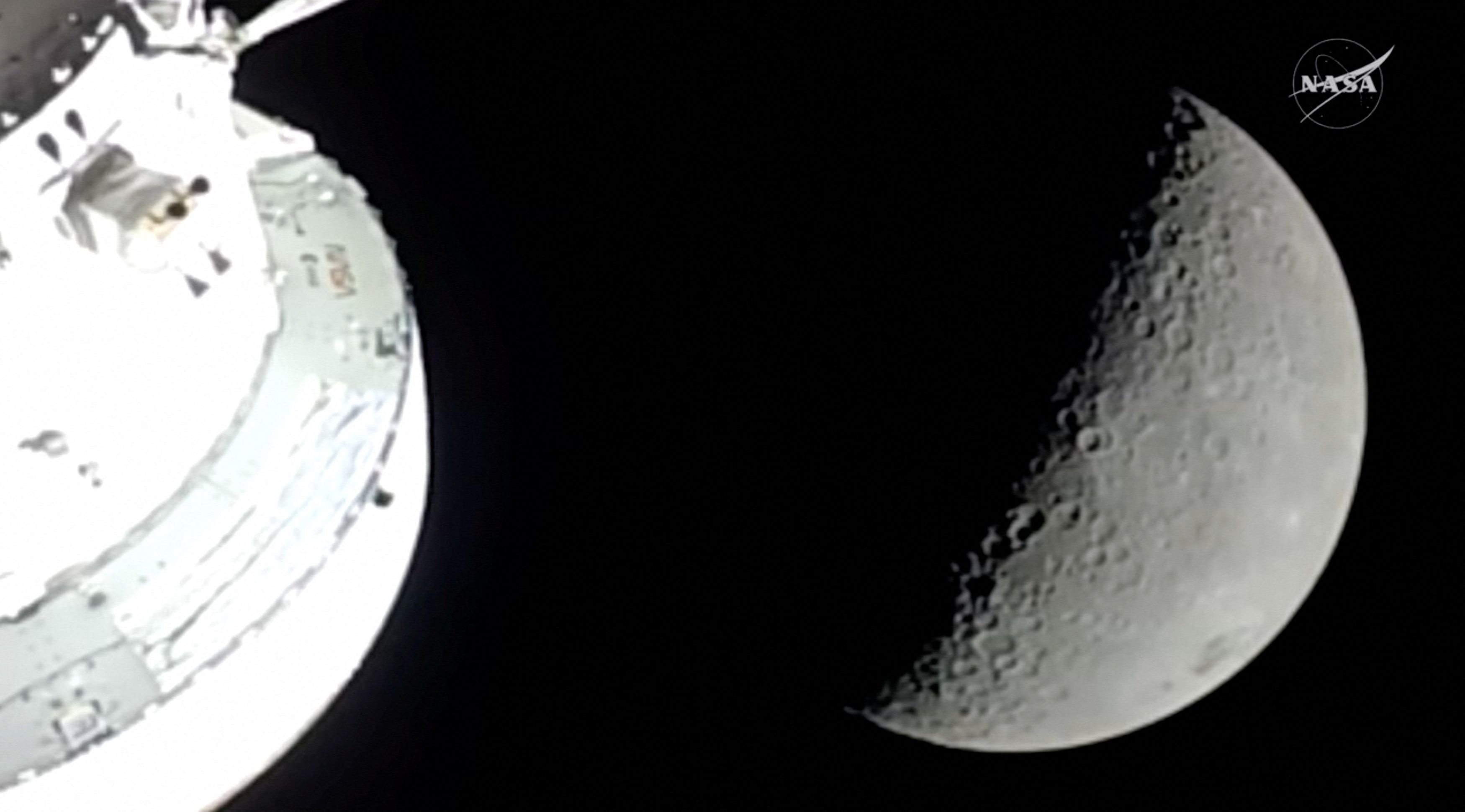
Now the time has finally come for him to put his master plan in place — to study the Artemis II crew’s images of the dark side of the moon.
The Dunedin astronomer is ‘‘salivating’’ at the prospect of seeing the images, which will be released over the next few days.
‘‘I’ve been listening between meetings to what was going on and it was really amazing to see. Even the low resolution pictures were amazing, but to hear them talking about what they were seeing was very interesting indeed, and it was great to kind of hear real time science being shared over the internet.’’
While a lot was already known about the dark side of the moon, there was always something else to learn, he said.
‘‘The whole moon has been mapped by robot probes, but the interesting thing is that they were taking pictures of some of the places they might want to land in the future — specifically, the south pole of the moon.
‘‘And so they might get some images there that are slightly more detailed and they will show us what it might be like.
‘‘The other thing is, they were viewing an eclipse of the sun for the very first time, so what they could see and what they couldn’t see would be very interesting.
‘‘They were also looking for dust around the moon as well, so lots of things that they were trying to look for, and we won’t know whether they see them or not until we start to see the pictures come back over the next few days.’’

‘‘It might be another couple of years until we actually land, and I’ve got to say, I’m kind of frustrated, because I was too young for Apollo and I’m too old for Artemis, so my chances of going to the moon are now jiggered forever.
‘‘But I think you can tell by the excitement, and people are actually getting quite excited about this, amidst all of the rubbish that’s going on in the world at the moment — the fact that we’re all looking at these astronauts, looking back at the Earth and seeing these amazing pictures is really inspirational.
‘‘It’s bringing the whole world together like it did back in 1969 during the first moon landing.
‘‘I remember being 5 or 6 years old and watching them walk around on the moon, and I’m hopeful it will maybe inspire 5 or 6-year-olds these days to take an interest in science, too.’’
Nasa said the four Artemis astronauts on board had been provided with a ‘‘fleet of cameras’’ to capture images during their mission.
Yesterday, Artemis II pilot Victor Glover told mission control the view they were seeing was ‘‘truly hard to describe’’.
‘‘The sun has gone behind the moon and the corona is still visible, and it’s bright and creates a halo almost around the entire moon.
‘‘But when you get to the Earth side, it’s the Earth shine that’s already shown.
‘‘The Earth is so bright out there and the moon is just hanging in front of us.
‘‘We can see stars and planets behind it.’’
Artemis II commander Reid Wiseman said it was ‘‘just indescribable’’.
‘‘No matter how long we look at this, our brains are not processing this image in front of us.
‘‘It is absolutely spectacular, surreal ... there’s no adjectives. I’m going to need to invent some new ones.’’
The crew joked they wanted 20 new superlatives added to the mission summary today to assist with their descriptions.
While flying behind the moon, their spacecraft reached its maximum distance (406,771km) from Earth — a record for the furthest distance travelled by humans from Earth.
It broke the previous record set by the Apollo 13 mission in 1970.
— Additional reporting BBC


