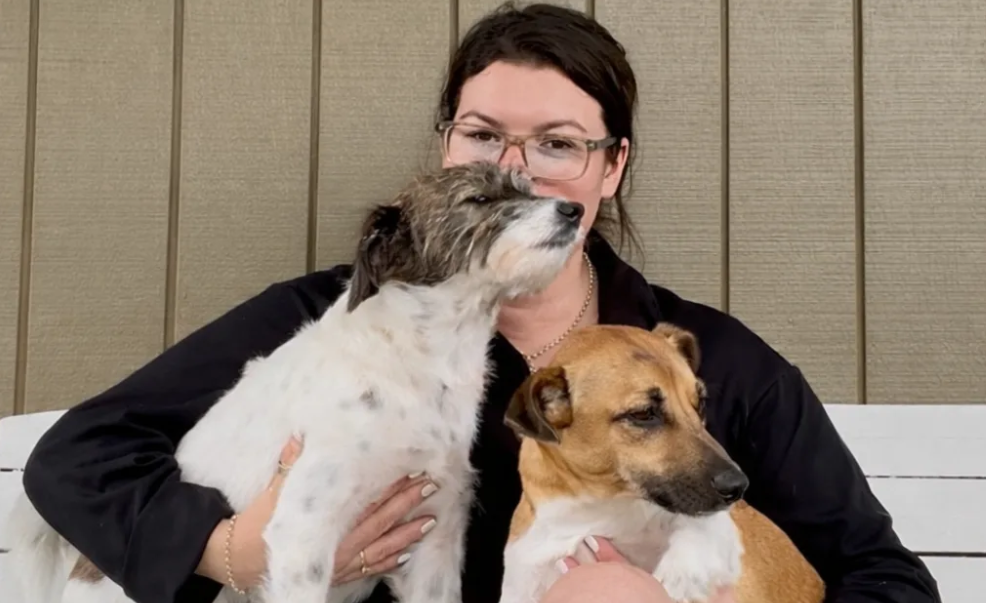
Sam Hall is the second person in less than a month to speak out about the stress of a council system that advises dog owners of complaints made about their pets by anonymous neighbours.
In Sam's case, there had been more than 50 complaints made about the barking of her two Jack Russells, Percy and Frank, since she moved into her Clive home with her partner in March 2024.
She continued to argue their barking was normal behaviour and came with reason - largely the consequence of when someone came to the door of her property.
But she said the threat of losing her dogs because of the complaints had left her in a state of paranoia.
"It consumes me. I can't escape."
The council said the complaints about the dogs started in February last year and come from five different sources, "but mostly from two properties".
Regulatory solutions manager John Payne said it was a difficult situation for the dogs' owners and residents.
"We strive to work with all parties to achieve satisfactory resolutions. Each year HDC Animal Control deals with about 500 barking dog complaints - 99 percent of which get resolved."
The council had agreed to stop calling her.
"Given the dog owner's discomfort, officers will stop calling," a council spokesperson said.
"Our officers do not want to be seen as intimidating, especially as these calls are designed to help owners by providing information on the nuisance their animal is causing so they can do something about it."
The spokesperson said the council was still getting complaints regarding the property with the latest on January 30 this year.
"These will be managed in writing, following the regulatory process."
Hall's father Trevor Hall said the system was flawed.
"Keeping complainants' names anonymous allows them to use the system to bully and harass neighbours."
Trevor Hall said it had been incredibly hard to watch his daughter become stressed, anxious and worn down by the process.
"She feels harassed, bullied and is even fearful of leaving home in case her dogs are unfairly taken.
"She now padlocks her gates every time she goes out."
Sam said for eight months everything was fine, then the complaints started.
"We have dropped notes in letterboxes with our address asking anyone with a problem to come and talk with us so we can solve it. We also posted it on social media."
She said she just wanted to live peacefully in her home with her partner and dogs.
But the calls and letters keep coming.
She claimed council officers sat in her street every day for two weeks.
"It was stressful and intimidating. I just want them to stop ringing me - especially while I'm at work - and stop giving us letters unless they have evidence."
The spokesperson said officers spent some time in the area to observe the dogs' behaviour to determine if the complaints were legitimate.
"The dogs were heard barking on and off."
They also surveyed the neighbourhood, with five people supporting claims that the dogs were creating a nuisance.
Hawke's Bay Today knocked on several doors in the neighbourhood. The three people who answered said the barking of Sam's dogs was not a problem.
Amanda Whitfield, who lived across the road, said she was home all day and had never heard them.
"I have a dog as well. Dogs bark, so even if I did hear them, it wouldn't bother me. But if it was at night and they were keeping me awake, I would go and talk to the owners," Whitfield said.
Sam said no information had been provided to her about the times the complaints were made.
"I have cameras so I can see what my dogs are doing when I'm at work.
"And yes, they do bark if someone comes to the door or a courier driver pulls up the driveway. I want them to bark if there is someone outside."
She said she had even had complaints when the dogs had not been at home.
"When I explain the dogs are not on the property, I'm told the complaint was 'pinpointed' to my address."
The council had since provided her with dates and times.
A council spokesperson said Sam had also supplied video footage of her dogs to them "which confirmed the nuisance barking behaviour".
But she disputed that.
"I did send them a video to prove my dogs were barking for a reason. There's a fence between our property and a community garden. There were people behind the fence and the dogs could hear them. Of course they were barking."
In January, Dean Sewell said the complaints left him feeling he might not have any choice but to euthanise his beloved 16-year-old fox terrier Dan.
Following the article, Sewell received support.
"I had one of my immediate neighbours drop off vegetables and confirm Dan was not a problem," Sewell said.
"I had calls from all over the country, random people from Warkworth, for example, offering to have their mother-in-law, who lives in Hastings, look after Dan during the day."
He also had a couple offer the dog a home in the country.
Sewell was locking Dan in the garage, but he had now started putting him out the back and filming him. He had not heard from the council.
The dog barking complaint process
Council dog control processes are governed by national legislation which provides a framework for dealing with complaints.
Payne said, in most cases, it worked well.
"Our animal control staff must determine if the barking is natural or excessive and have reasonable grounds beyond any complaints received or survey results to start the process of addressing an issue with the dog owners."
It starts with:
• First notice: A letter bringing the matter to the dog owner's attention with educational material.
• Second notice: If it continues, a second letter informs the owner of the legislation and offers advice.
• Survey: A survey of neighbouring properties to help validate complaints. Officers must have reasonable grounds to believe a nuisance is being created and will attend the property to assess the situation. This can also include checking any video footage recorded by the dog owner or the complainant.
• If no action is taken by the owner, an abatement notice may be sent listing requirements to address the nuisance.
Most matters were resolved in the first two steps.
- By Linda Hall, Hawkes Bay local democracy reporter
LDR is local body journalism co-funded by RNZ and NZ On Air.