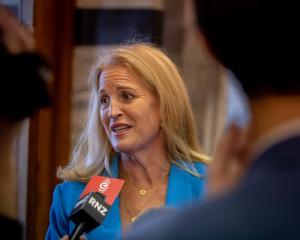
Education Minister Erica Stanford wants higher pay rates for tradies who work as unqualified teachers - but she has to persuade the teacher unions first.
Tradespeople who did not have teaching qualifications were employed under a Limited Authority to Teach (LAT) and did not have access to the top rates on the teacher salary scale, she says.
The top rate for a LAT with a degree on the Untrained Teacher Pay Scale is $91,086, while the top rate for a qualified teacher with a degree on the Qualified Teacher Pay Scale is $105,686.
Stanford's suggestion was made in the context of a curriculum and qualification overhaul that would see industry-bodies developing the curriculum for some subjects.
She said she wanted to work with teacher unions on raising pay rates for skilled tradespeople who did not have teaching qualifications.
"There are some incredibly skilled people, some master builders who have spent 40 years being a master builder and are experts.
"The question we have is, do you need to have a teaching degree to be able to go in and be on the unified pay scale. Because the problem is at the moment if they don't have a teaching degree or a teaching qualification they are paid less as a LAT [Limited Authority To Teach] and I think that that needs changing."
Schools wanted the change and it would make a massive difference to their ability to employ expert, skilled people, she said.
"It's something we're going to need to work with the PPTA over to get a change."
Post Primary Teachers' Association (PPTA) president Chris Abercrombie said teachers should be qualified and people on a LAT should be studying to become a teacher because Limited Authority to Teach was designed to be temporary.
"If you don't have a teacher qualification you can't get paid on the qualified rate. It's pretty simple and it's not just specifically a tradie thing.
"We believe teachers should be qualified. It's not just about being good at your subject. Being a good accountant doesn't necessarily mean you'll be a good accounting teacher. Doing the qualification is really important in helping understand assessment, understand curriculum, how those two interact, how to help students."
Abercrombie said a bigger problem was the financial barrier to studying teaching and the union had pushed for more scholarships and for paid placements for students.
"All of these things would be a better use of time and resource to make sure young people have a trained teacher in front of them."
Abercrombie said people who became teachers after working in vocational fields often did not have Bachelors' degrees and the union had successfully changed the pay scale to recognise their work experience as equivalent to a Bachelors' degree in terms of pay rates.
"That was where we were seeing the need."
He was a big supporter of better vocational courses in secondary schools. "It makes sense having people coming from industry to teach those, but we believe in qualified teachers."
Head of technology at Otumoetai College Kevin Meyer said there was a nationwide shortage of technology teachers and about 200 of those working in school workshops were working on Limited Authorities to Teach. They often came from industry backgrounds and their highest qualification might be a level 3, 4, or 5 national certificate rather than a level 7 degree.
Meyer, who was a level 5-qualified cabinet-maker, said a teacher on a LAT could have their previous employment counted as steps up the untrained teacher teacher pay scale through a salary-assessment exercise.
"Where the current system seems unfair is that these much-needed teachers who go on to gain their Diploma of Teaching are then not able to be re-assessed on the trained teacher pay scale using the same industry background qualifications and years of work experience."
Meyer said it was a complex issue but there were ways to improve the situation, such as back-dating salary reassessments or even starting them from today.
"The second pay inequity is that currently the top pay scale step of G3+ is only obtainable for those with level 5 qualifications and above, and there is a lot of complexity with that as well.
"So its true, a level 4 carpenter cannot access the highest pay scale steps, no matter what other roles or years spent in the classroom they have. This is something that could be changed very easily. Even if it meant that it only applied after four years of being a teacher."
This story was first published on rnz.co.nz |  |