

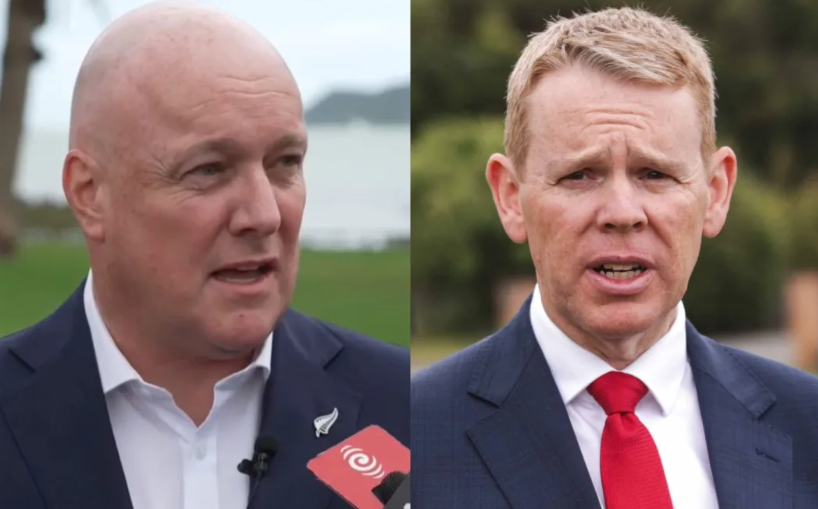
Christopher Luxon has told Ministerial Services everyone needs to be "fully aware of their obligations", after his office said it had no record of a document that came to light following a court order.
Meanwhile, Labour leader Chris Hipkins says the prime minister has "got some real questions to answer here", including who received the document and what they did with it.
RNZ reported on Sunday that a previously undisclosed briefing document had been provided to the Prime Minister's Office (PMO) by Fonterra and Z Energy, regarding climate activist Mike Smith's case against those companies and other major emitters.
The briefing note discussed why legislative intervention was "necessary and appropriate", and it proposed a two-sentence legislative amendment to the Climate Change Response Act 2002 that would "resolve the uncertainty and risks posed by private law claims like Mr Smith's".
The Environmental Law Initiative (ELI) wrote to the Ombudsman on Monday, calling for an inquiry into the apparent withholding of official information by the PMO in relation to lobbying and communications.
The government announced this month it would amend climate laws to prevent companies from being sued over damage caused by greenhouse gas emissions, stopping Smith's landmark case in its tracks.
Justice Minister Paul Goldsmith said it would "remove the possible development of a new regime that contradicts the framework Parliament has already enacted to respond to climate change".
Luxon told Morning Report on Monday he did not know about the document. He was adamant Z Energy and Fonterra played no part in helping to write the amendment, saying Cabinet made the decision.
Asked about the issue on Monday afternoon, Luxon told reporters his office had reached out to Ministerial Services that everyone needed to be fully aware of their obligations, so it was a "good reminder to do that".
He said ideally his office would have a record of the interaction. He also said he had not sought information from Z Energy and Fonterra about who in the prime minister's office they gave the document to.
Hipkins said Luxon had some "real questions" to answer.
"Including who it was in his office that these documents were given to, who met with those companies, who received their lobbying, and what did they do with that?"
Hipkins said it was a significant issue of public interest.
"These are big corporations asking the government for a law change, then are getting that law change, and the prime minister seems to be washing his hands of anything to do with the lobbying around that."
Hipkins acknowledged the possibility of a document getting lost if someone "happened to bump into someone who happened to work for the prime minister and just handed them a document."
But he said if someone senior from the Prime Minister's Office was meeting with them and receiving documents, "they must have a system in place to record that, and the prime minister has to be accountable to that".
The ELI said it had sought information in March 2025 about meetings, discussions or conversations regarding the Smith case, and any proposed legislative or regulatory response.
Dr Matt Hall, the group's research and legal director, said it received "only limited material" in response.
The letter to the ombudsman, seen by RNZ, stated that ELI's request that the watchdog would inquire into the "apparent withholding" of official information by the PMO in relation to "lobbying and communications concerning the Government's response to Smith v Fonterra."
"These circumstances raise serious concerns about transparency, accountability, and the integrity of official decision-making.
"If powerful commercial interests were able to lobby for legislative intervention behind closed doors, and if records of that lobbying were not disclosed in response to official information requests, there is a compelling public interest in establishing how that occurred, who was aware of it, whether other relevant documents or communications were withheld, and whether the PMO complied with its obligations under the Official Information Act."


