

PHOTO
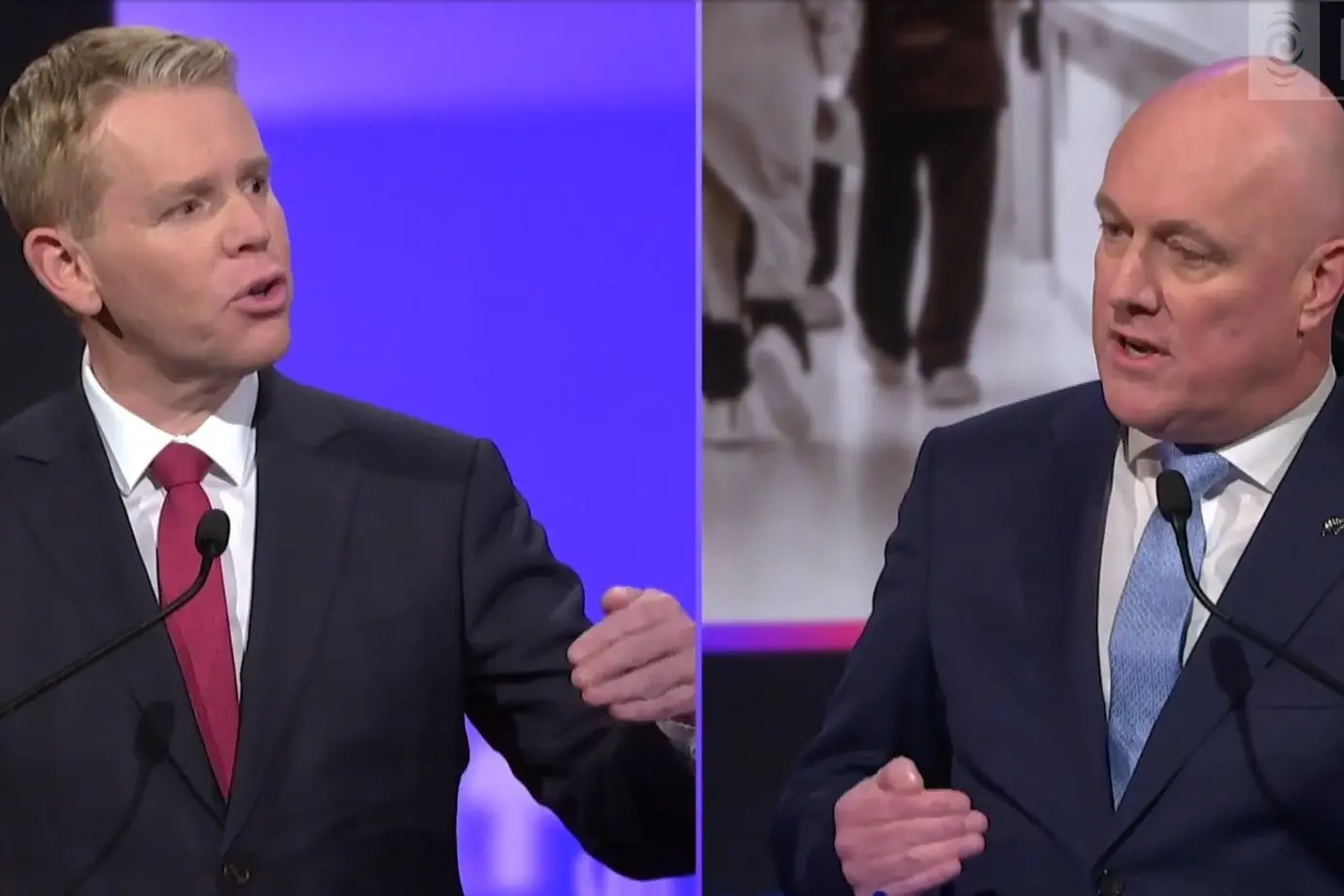
Last week I attended the Stuff Leaders Debate hoping to hear something that might help me decide where my vote should go at the next election.
I didn’t hear a lot that was new.
Hipkins’ supermarket shopper was still putting the nappies back, I just hope he offered to pay for
them so they didn’t have to, and Luxon was diligently pushing the 3 R’s. A compulsory one hour of reading, riting and rithmetic every day.
I found this interesting because both of them seemed to be struggling with the rithmetic when it came to how many new nurses had been employed.
Luxon claims 2,100. Hipkins insisted it was just 54. That’s a difference of 2046. Perhaps we should make that hour of rithmetic compulsory for politicians as well.
But sitting in the audience watching the two Chrises, something struck me. It was clear that both genuinely want to make this country a better place.
But there was something else that struck me about the two Chrises. Both are promising to build a world-class education system. Yet both seem to struggle with something we expect our children to learn at school. Answer the question you've been asked.
But even as I sat there this crazy thought kept popping into my head.
What if they formed a coalition?
I know. Ridiculous. National and Labour forming a grand coalition? I can almost hear the collective choking on the morning coffee. But bear with me.
Despite all the political point-scoring, there was actually quite a lot they agreed on. We need to grow the economy, improve productivity, get better outcomes in education, health and infrastructure, and lift living standards.
And perhaps that's the real challenge facing the two Chrises. Neither seems particularly comfortable giving a straight answer to a straight question. Yet after the election, one of them will have to
negotiate with parties offering a bewildering assortment of answers to New Zealand's problems.
Surely someone should be asking a rather more important question.
How do we actually create the wealth that will allow New Zealanders to earn more and enjoy a better standard of living?
That seems like a pretty good place to start collaborating.
Which raises another interesting question.
When did winning 7%, 10% or even 16% of the vote become something to celebrate as a great political victory?
Imagine your child coming home from school proudly announcing they'd scored 16% in their maths test. Would you be breaking out the champagne?
Of course, under MMP those votes deserve representation. That's how our democracy works. But surely there's a difference between having a voice at the table and deciding what's on the menu.
And that's what makes the possibility of Luxon and Hipkins finding common ground so interesting.
Between them, they represent a far larger proportion of New Zealanders than the smaller parties they may have to negotiate with.
They clearly have different ideas about how to run the country. But on Tuesday night they also demonstrated that they share many of the same ambitions for it.
So why not start with one that should unite us all? Make New Zealand rich again.
Because we were once one of the richest countries in the world. There's no reason we shouldn't aspire to be there again.
And we already have New Zealanders showing us how.
I've written previously about the work being done by the New Zealand Product Accelerator, identifying opportunities that could help build Tomorrow's Economy.
Mint Innovation, recovering valuable metals, including gold, from electronic waste. Bio-forestry, where we have the opportunity to turn the trees we grow into high-value products rather than simply shipping raw logs overseas. And supercritical geothermal, where our expertise in geothermal energy could open up an entirely new source of energy and economic opportunity.
These are not ideas waiting for someone to invent them. The science and technology are already being developed here in New Zealand.
On Friday I was invited to the opening of Fisher & Paykel’s multi million dollar Innovation Centre in Auckland. It was inspirational, and I left there wondering why our politicians spend so much time talking about what's wrong with New Zealand when we have so much that is right.
When Chinese appliance giant Haier bought Fisher & Paykel, it didn't pack up the business and move it offshore. It recognised the value of what New Zealanders had created and invested in making Fisher & Paykel its global premium brand.
Today, that Auckland campus is Fisher & Paykel Appliances' global headquarters, with 800 people working across design, engineering, research and innovation. Kiwi ingenuity being used to develop products for homes around the world.
And they've set themselves an extraordinary challenge. To reduce the carbon footprint of every appliance they make by 50% in 2030 and 90% by 2050. By 2025, they'd already achieved a 24% reduction. And we're talking about well over a million appliances sold around the world every year.
So here's a suggestion for the two Chrises. Why not take a break from the election campaign and visit this extraordinary example of tomorrow’s economy.
But do it together.
And perhaps Chloe Swarbrick could join you. She might enjoy seeing what a successful New Zealand corporate, backed by one of the world's largest appliance manufacturers, is doing to tackle climate change and create high value jobs in Aotearoa New Zealand.
Corporate greed this is not. This is what creating wealth looks like.
Imagine what we could achieve if the two Chrises stopped arguing about who gets to run the country and started exploring what might be possible if they ran it together.
A grand coalition with one shared ambition. Make New Zealand rich again.
I know. About as likely as the two Chrises agreeing on how many nurses we've employed.
- Dunedin businessman Sir Ian Taylor is the founder and managing director of Animation Research.