
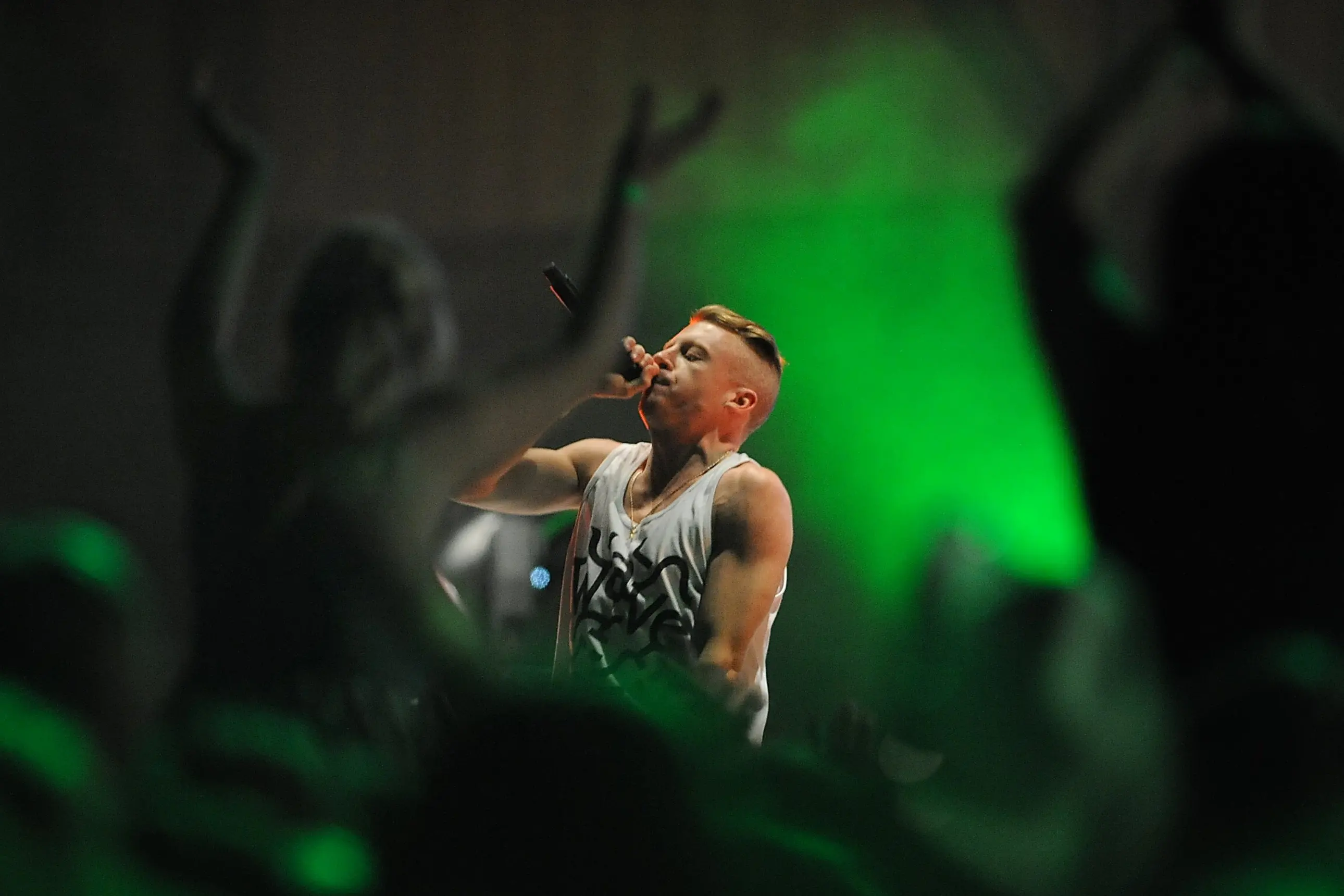
PHOTO
The ongoing fallout from Macklemore being dropped from Ed Sheeran’s tour is arguably the most significant conversation in popular music at the moment.
In the wake of the furore over Macklemore's removal, reportedly at the behest of a billionaire stadium owner, his "Free Palestine" tour sold out in less than a day. A raft of other celebrities including Lorde, and Zach Bryan – while performing at the very venue from which Macklemore was banned – have also expressed solidarity with this message.
In spite of his attempt to address the issue, Sheeran’s tour has experienced a slump in demand, with resale prices for tickets falling below face value.
While it is tempting to frame these events as a heartening tale of the triumph of solidarity and empathy over attempts to suppress free speech, Macklemore is not the first – and almost certainly won’t be the last – to be deplatformed after speaking out against the ongoing genocide in Gaza.
Khelani, Kneecap, Bob Vlyan, Massive Attack, Zara Larsson, and Roger Waters have all previously lost business, performance opportunities, and/or had visas withdrawn due to their public statements.
Taken broadly, these responses to political speech by musicians raise questions about freedom of expression in music, and the ways in which acceptable speech and political action are defined and constrained.
The contemporary media landscape is one in which the very wealthy few are controlling public discourse in unprecedented ways. Aotearoa New Zealand has a shrinking public sphere, with a highly deregulated media, limited public broadcasting and, due to cutbacks and downsizing, less hard news and investigative journalism.
Simultaneously, we are seeing a global consolidation of media control. Many people increasingly rely on social media — which, like traditional media, is largely controlled by a small number of wealthy people — for their information.
There is an illusion of freedom and democracy in online spaces, but algorithms have an enormous impact on what news we see. Both Amnesty International and Human Rights Watch have argued that pro-Palestinian posts are impacted by social media censorship.
However, censorship is not always apparent: we have the illusion of individual control over our personal news consumption, even as information is mediated by an oligarchy of control.
The deregulation of media, consolidation of ownership, and rise of social media algorithms as information intermediary have resulted in a shrunken public sphere.
Simultaneously, there is often a call for events that bring together large groups of people – particularly music and sports – to remain apolitical.
Sheeran’s initial statement encapsulated this view that politics shouldn’t be brought into music.
Often, when we engage with the work of our favourite musician, we imagine that we experience a direct connection to them, with their work as an expression of their own – and perhaps a shared set of – deeply held views.
The reality, for better or worse, is that the production of pop music, be it recorded or live, is both a team sport, and big business: the live music market in 2025 was worth around $US40 billion and is forecast to reach over $US65b in the next decade.
Live music, like traditional journalism and social media, is also increasingly subject to control by a small number of corporations.
In his initial explanation, Sheeran suggested that his promoter was ultimately responsible for dropping Macklemore. It has since emerged the situation was exacerbated by an ultimatum a group of billionaire stadium owners.
It is worth noting that the two large organisations involved in Sheeran’s tour (promoter Messina Touring Group, and Live Nation subsidiary Ticketmaster, who maintain a monopoly on ticket sales across the US) are currently at loggerheads over Live Nation’s increasing concentration of power.
These two players account for the majority of the global live concert market, with Live Nation being deemed a monopoly in the US, and subject to ongoing court proceedings to force the breakup up of the company.
The past few weeks have caused music fans to confront not only their views on political action (or inaction) in the face of the genocide in Palestine, but also the fact that their connection to the music they love is subject to forms of corporate hegemony and gatekeeping by a group of huge corporations and property-owning billionaires, in a way that sits uncomfortably alongside Sheeran’s own naive and hypocritical rhetoric of taking an “apolitical” stance aimed at simply “bring[ing] people together”.
The controversy around Ed Sheeran and Macklemore is not simply about whether music should be political.
Rather, it asks key questions. What does it mean to be an authentic artist? What happens to public discourse when there is a consolidation of power in the hands of the very few?
Do we have a functioning public sphere (and thus a functioning democracy)?
The furore over Macklemore’s removal from the tour reflects the increasingly limited public domain in which political issues can be discussed, and the desire by some to depoliticise the few remaining spaces.
Yet even as this article explores authenticity in music and concerns about free speech and democracy, we cannot lose sight of the situation in Gaza and the West Bank.
As Macklemore said, we are witnessing an “entire people being displaced, starved and killed while the world debates which words we are allowed to use to describe it, how those words make us feel, and whether our discomfort matters more than the people living through a genocide”.
- Mike Holland is a senior lecturer at the School of Performing Arts, University of Otago; Fairleigh Gilmour is a Dunedin musician and lectures in criminology and sociology at the University of Otago.