


This Queenstown property was rated one of New Zealand’s best homes. Kim Dungey looks at what can be achieved when vision and craftsmanship align.
There's nothing conventional about this geometric house built on a steep site in Queenstown.
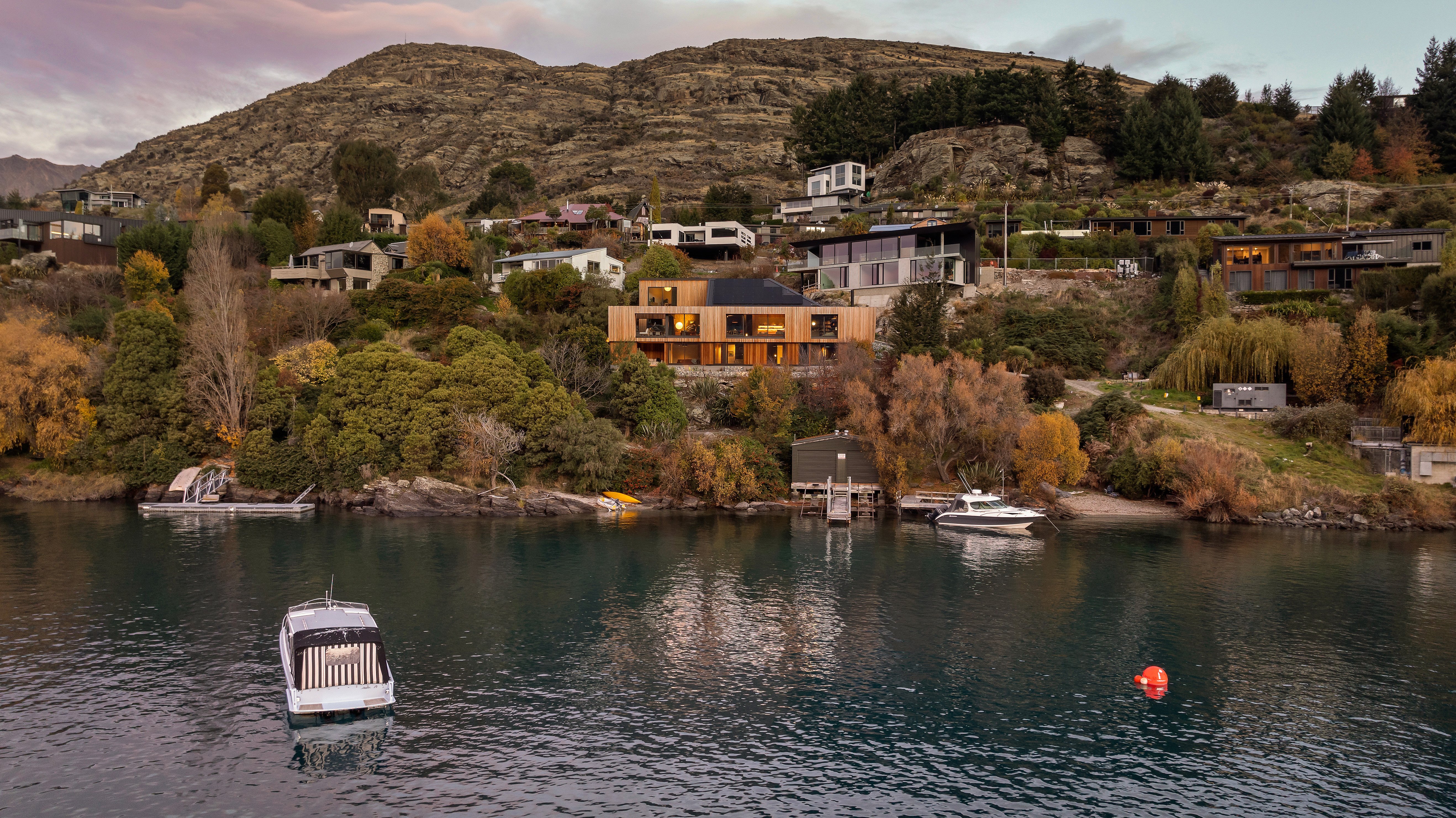
With an unusual shape and creative use of materials, it sits on one of the last lakefront sections in Kelvin Heights to be developed.
It’s not difficult to understand why the site was not snapped up earlier: falling 15 vertical metres from top to bottom and hemmed in by a paper road which leads down to a pump station and Lake Wakatipu, it was never going to be straightforward to build on.
However, the 40-metre lake frontage meant any house built there could spread out and every room could have a lake view.
The design they eventually settled on was for a three-storey, 450sq m property with five bedrooms, one of which is in a self-contained guest studio.
Wanting a reasonably monolithic building, they used a single material on both the roof and the driveway-facing facade - reverse-profiled Colorsteel, which provides privacy from the paper road.
The dark metal cladding was devised as a ‘‘skin’’ which gives way to a ‘‘lusher, warmer interior’’.

The use of steel grating as a sun and privacy screen on the exterior and for balustrades on the interior stairs highlights the couple’s enthusiasm for mixing industrial elements with more refined materials.
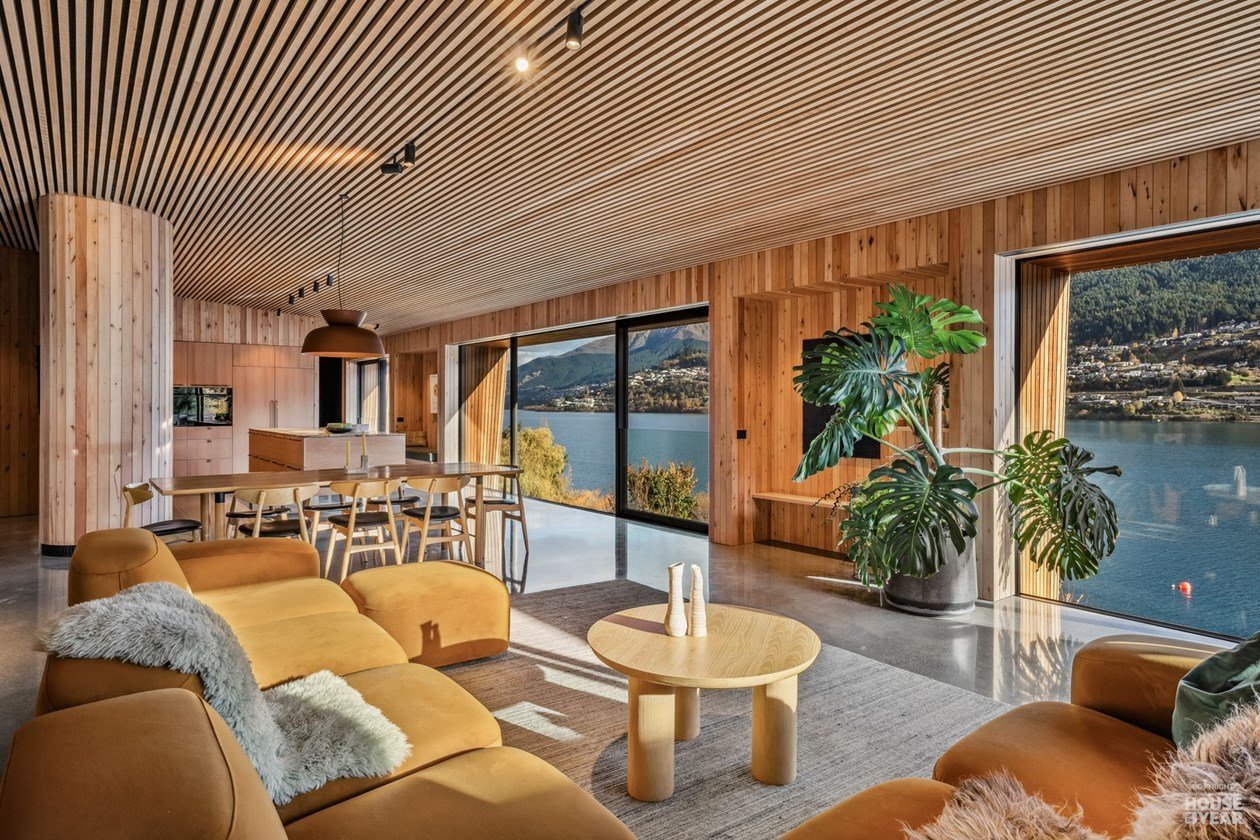
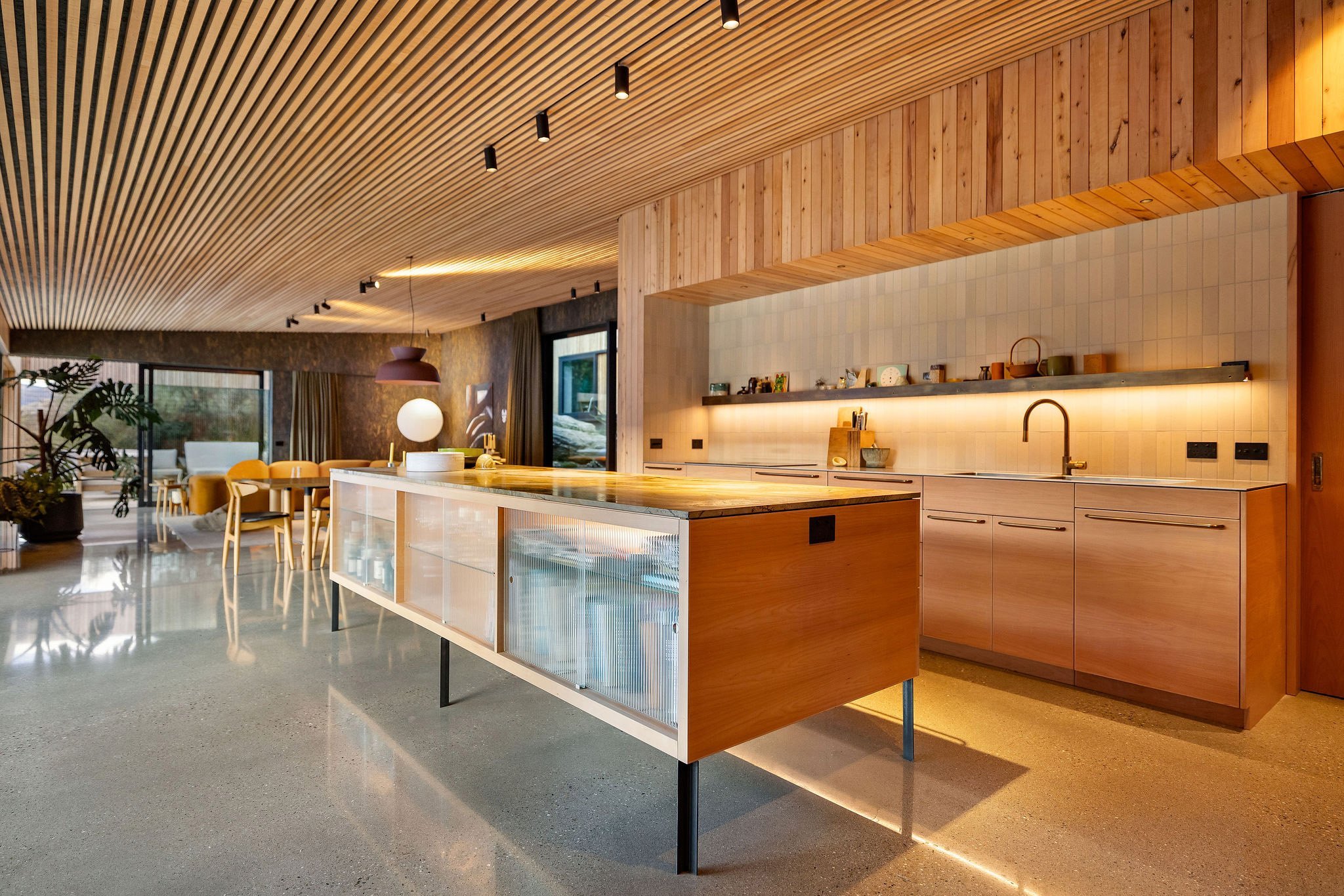
Interior walls, floors, doors and ceilings were crafted from Southland beech with orientated strand board (OSB) - the inner layer of the home’s prefabricated panels - left as the wall linings in selected areas.
This includes a courtyard on the middle level, formed around the schist boulders and steel grating, and an internal deck downstairs.
‘‘Because you’ve got the living upstairs and the bedrooms downstairs, sometimes in that situation you can feel like you’re living in an apartment but it’s more grounded than that.’’
With generous insulation, triple glazing, a mechanical ventilation system, air-to-water heat pump and solar panels, the property doesn’t overheat or get cold but stays a consistent temperature.
The project earned Velvin Building a string of national awards in the 2025 Master Builders House of the Year competition - including Supreme House of the Year (over $1 million), the award for new homes worth $2m-$4m and the Kitchen Excellence Award.
The judges said it felt original, sophisticated and full of personality, adding: ‘‘This was a build with nowhere to hide. Every material, junction and detail are fully exposed - each handled with outstanding care.’’

‘‘Here, everything we touched was the final product, so all of the beech tongue and groove, all the ceiling battens, the mitred OSB and the concrete floors. If there were any imperfections, it was on us so you had to execute things perfectly the first time. There was no going back ... No pressure at all!’’
It was the second successive year the firm had won one of the three supreme awards handed out nationally; in 2024, its remodelling of a 1970s Queenstown A-frame was named Supreme Renovation of the Year.
Raised in Hamilton, Mr Velvin-Turner started a fine arts degree before realising it wasn’t ‘‘practical enough’’ for him and taking up a building apprenticeship. He established Velvin Building in 2012 with partner Amber McGrath, who has a diploma in architectural design.
He described the Kelvin Heights site as a ‘‘triangular piece of rock’’ and said there was a reason it hadn’t previously been built on. However, being so close to the water, it had a special feeling: ‘‘It was a great place to be at work every day, hanging over the lake and having people staring up in disbelief.’’
The biggest challenge was not having anywhere to easily set up a crane, which made delivering materials difficult and co-ordinating everything ‘‘a bit nerve-racking at times’’.
It was the first time he had built with spotted gum, the exterior cladding which was recycled from power poles in Australia. The timber was ‘‘really, really heavy’’ but it was nice to use products other than cedar and something that hadn’t travelled ‘‘from the other side of the planet’’.
Another unusual move was using Colorsteel instead of timber or plywood as the formwork for a curved in-situ concrete wall on the south side of the house. This created peaks and troughs which matched the metal on the roof.
As well as winning accolades at the Master Builders awards, the property was named the 2025 Colorsteel Residential Building of the Year. For judge Ken Crosson it was the element of surprise as well as the crafted nature of the home that set it apart from other entries.
‘‘It’s an extraordinary design in a beautiful location,’’ he said.


