

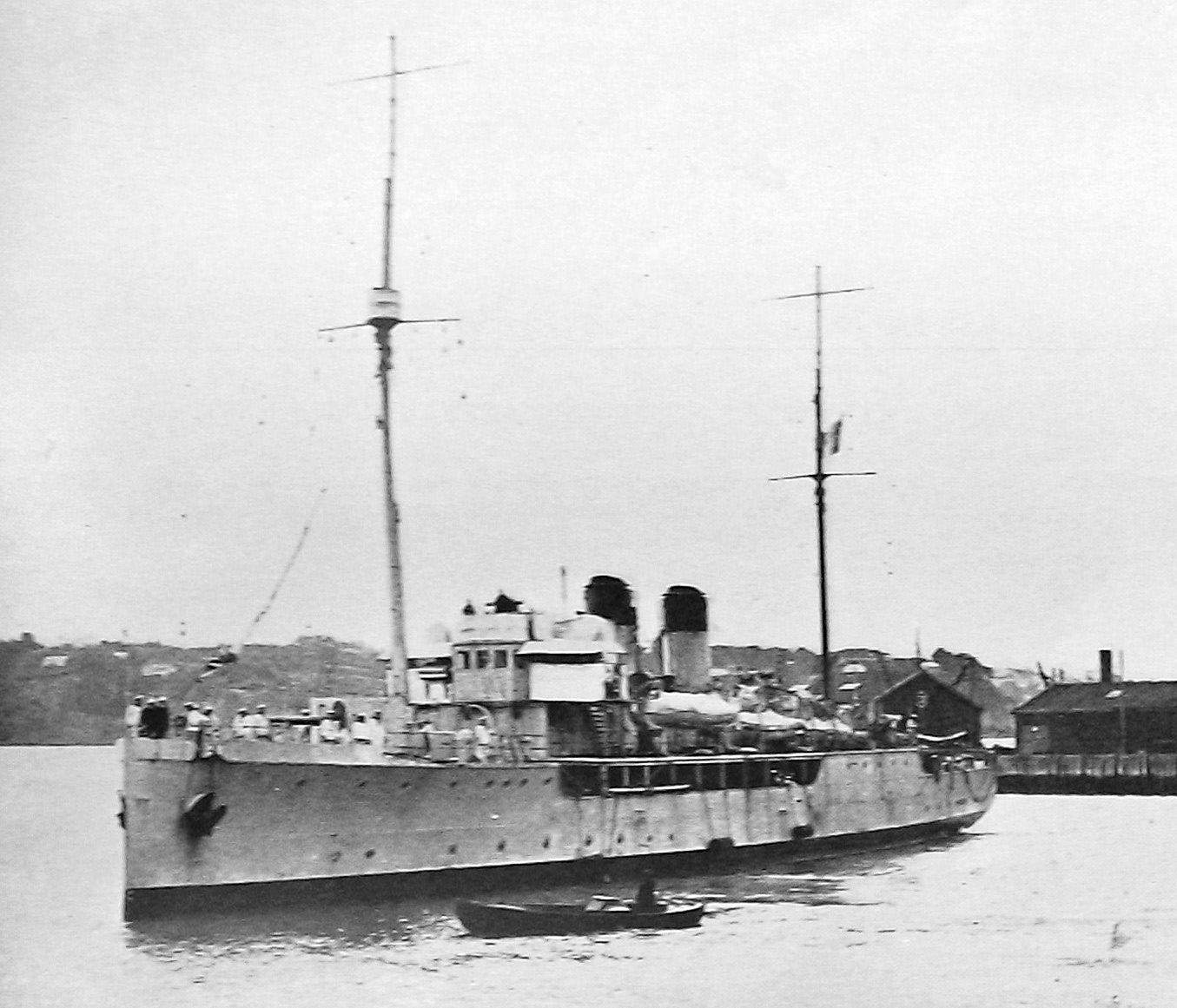

"You must excuse our dirty appearance", said a jovial officer in broken English, when a Daily Times reporter boarded the ship. "We have had a most terrible time in one big gale, and you must excuse coal dust, will you not?" he asked.
The Cassiopee belongs to the "Star" class, which corresponds to the "Flower" class of the British navy, and was launched at Glasgow in 1917. She was used mainly as a patrol ship during the war in the Gulf of Biscay. She is armed with two 5-inch and two 75-millimeter guns.
She is a coal burner and has a sea-going speed of 17 knots.
Education rejig proposed
The report by Mr Francis Tate, Director of Education in Victoria, on post-primary education, covers 77 pages and contains 32 recommendations. Several of the recommendations are here given:
1. That primary education be ended at about the age of 12 years.
2. That technical high schools concentrate upon the preparatory technical courses so as to provide a sound basis for higher technical education and trade instruction. That these schools and such junior technical schools as may be established be worked in close co-operation with a technical school.
12. That a sound system of training secondary teachers be developed.
18. That a close inquiry should be made into the courses of study of primary and post primary classes to provide a better articulation of the instruction.
21. That in the smaller centres new secondary schools established should be of the present technical high school type and should provide evening classes of a general and vocational character.
22. That the governing bodies of high and technical high schools be amalgamated.
24. That the technical schools be encouraged by the more adequate provision of skilled teachers and equipment.
25. That a system of technical school examinations and certificates be established by the Education Department.
27. That courses of study for all branches of technical instruction be prepared by expert committees and published for the information and guidance of technical schools.
28. That the work of the technical schools be recognised by the University.
29. That the technical schools should be given adequate representation on all apprenticeship committees concerned with the training of the apprentice.
30. That every effort should be made to induce employers to recognise qualifications gained by students in technical schools.
31. That such large employers of labour as the Railways Department and other public bodies should actively assist in the development of technical education by recognising the work of technical schools.
— ODT, 25.1.1926


