

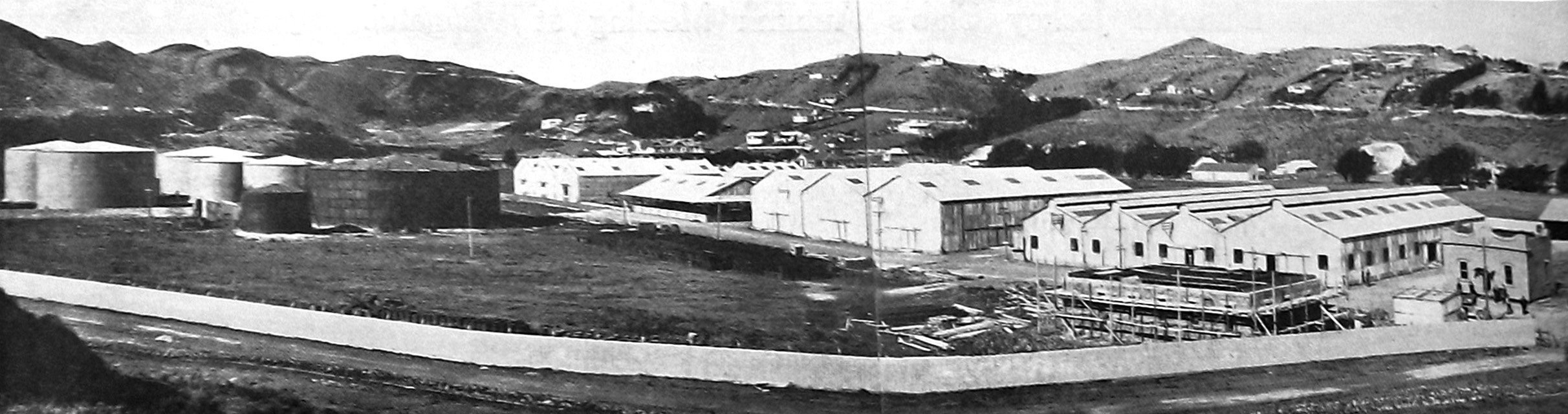

The ever-growing importance of the petroleum trade in this country, coupled with the natural desire of consumers to support really British enterprise, renders the present moment particularly opportune to refer at some length to the Shell Co’s organisation and their present extensive operations in Wellington and other centres. The Miramar works comprise a vast manufactory, developed on the most modern and efficient lines, and an inspection of the site, well-known in earlier years as Miramar’s "Wonderland", arouses every instinct of pride in New Zealand effort, as the Wonderland Recreation of old has certainly been replaced to-day by a Wonderland of Industry.
Asphalt spreads through city
Several big programmes of work in the improvement of the city are now being formulated in the office of the city engineer, stated Cr Wilson, chairman of the Works Committee, yesterday. The most important work at present is the laying down of Bond street with Trinidad asphalt. One block has already been completed, and the gang is now near Jetty street. It is expected that Bond street will be completed within two weeks. When that work is finished, the asphalting gang will commence laying Trinidad on the Anderson’s Bay road from Crawford street to Wilkie road. The remainder of the Bay road will be tar sealed. This will minimise the dust nuisance, which has been in existence. At present, surface drainage is proceeding, and as no similar work had been done on the road previously, an expenditure running into thousands of pounds is involved. Wilkie road to King Edward street will also be covered with Trinidad asphalt. On completion of that work, a start will be made to asphalt King street from Frederick street northwards.
Flying off the shelves
We are assured that the experience of the local bookseller, which was mentioned yesterday, that there is a general dullness in his trade and that there is only a small demand for the better class of works is not shared by all his competitors. One bookseller has informed us that his business during the present month has doubled that of January, 1925.
— ODT, 27.1.1926


