
PHOTO
Owning a real estate business and selling a lot of property in Queenstown, I’m often asked for my predictions on the housing market.
Will prices keep rising? Is a crash coming?
And why is Queenstown so expensive compared to the rest of New Zealand?
Queenstown really is a bubble.
Its property market behaves differently to almost everywhere else in the country and it always has.
Outside of Queenstown and Central Otago, the past five years have been tough for much of New Zealand.
In many parts of the country house prices are still 10%-30% below their peak.
The era of ultra-cheap money is long gone.
Higher interest rates, tighter lending rules and a big hit to buyer confidence have left their mark.
Queenstown has been different.
Since 2021 we’ve generally seen steady increases of around 2%-5% most years.
It remains one of the most unusual property markets in New Zealand and I don’t see that changing any time soon.
In 2025 Queenstown house prices rose by about 4% overall.
That may not sound dramatic compared with the boom years, but in the context of where interest rates have been and how cautious buyers are across the rest of the country, it was yet another year of growth for Queenstown.
The median sales price is now around $1.6 million.
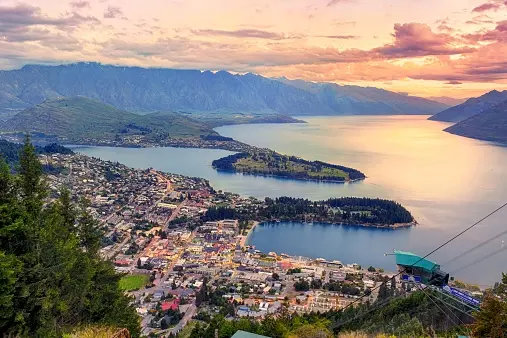
The main reason Queenstown stands apart is simple: land supply.
We are genuinely constrained.
Land supply here is capped by mountains and lakes.
Auckland, Christchurch and Dunedin can keep spreading outward. Queenstown just can’t.
You can’t build your way up the mountains.
Another key support for our market continues to be outside demand, particularly from Australia and, interestingly, from Auckland as well. I see this every week. Australians understand natural beauty, lifestyle markets and scarcity.
They see Queenstown as a world-class destination, not just a small New Zealand town.
That interest hasn’t disappeared. If anything, buyers are more selective now, but also more confident again than they were 12 months ago.
The government’s decision to ease the foreign buyer rules for properties over $5m is also likely to add another layer of demand at the top end of the market.
Financing conditions are slowly improving too.
The Reserve Bank’s recent changes to bank capital requirements have made lending a little easier.
It isn’t a game changer, but it removes one extra hurdle for buyers and in a market like this, small shifts matter.
That said, there is a down side to Queenstown’s success and it’s something I see up close every week.
I regularly meet with young families who want to sell in Queenstown for $1.5m-$1.7m and move to Christchurch.
Up in Canterbury they can buy a large lifestyle block, have more land, more space and often better job opportunities.
In Queenstown, that same budget usually buys a much smaller home, with higher living costs and more financial pressure.
For most of these families the move isn’t emotional. It’s practical.
At the other end of the scale, I’m also selling more homes for longtime locals who feel Queenstown has changed too much.
Traffic is heavier, the area is busier and the small-town feel they remember from 20 years ago has gone.
There’s often real sadness when these people leave.
Honestly, it’s one of the hardest parts of my job.
On a positive note, organisations like the Queenstown Housing Trust, led by Julie Scott, have made a real difference.
Since it was formed just over a decade ago, the trust has helped many first-home buyers get into the market who otherwise would have been locked out forever.
Looking ahead to 2026, I expect moderate growth again, probably around 5% overall.
The days of runaway price surges are behind us, but so too are the fears of major declines.
Well-located homes, quality builds and good sunlight will continue to attract strong interest.
Properties beside busy roads, with poor sun or needing major work will take longer to sell and need sharper pricing.
I should be upfront about my position. I have a conflict of interest. I own a real estate company in Queenstown and I sell property for a living.
But having personally sold over $100m of real estate here in each of the past three years, I’m inside this market every single day.
I see buyer hesitation, renewed confidence and subtle shifts before they show in official data.
Queenstown is maturing. It’s no longer a quiet alpine town and it’s no longer driven purely by optimism or hype.
But it remains scarce, desirable and globally recognised.
Those fundamentals matter far more than short-term headlines.
In 2026, Queenstown property will keep growing, but it will reward patience over speculation. For a place like this, that’s probably exactly where it should be.
• Hamish Walker is a former National MP and director-salesman of Walker & Co Realty, Queenstown.