

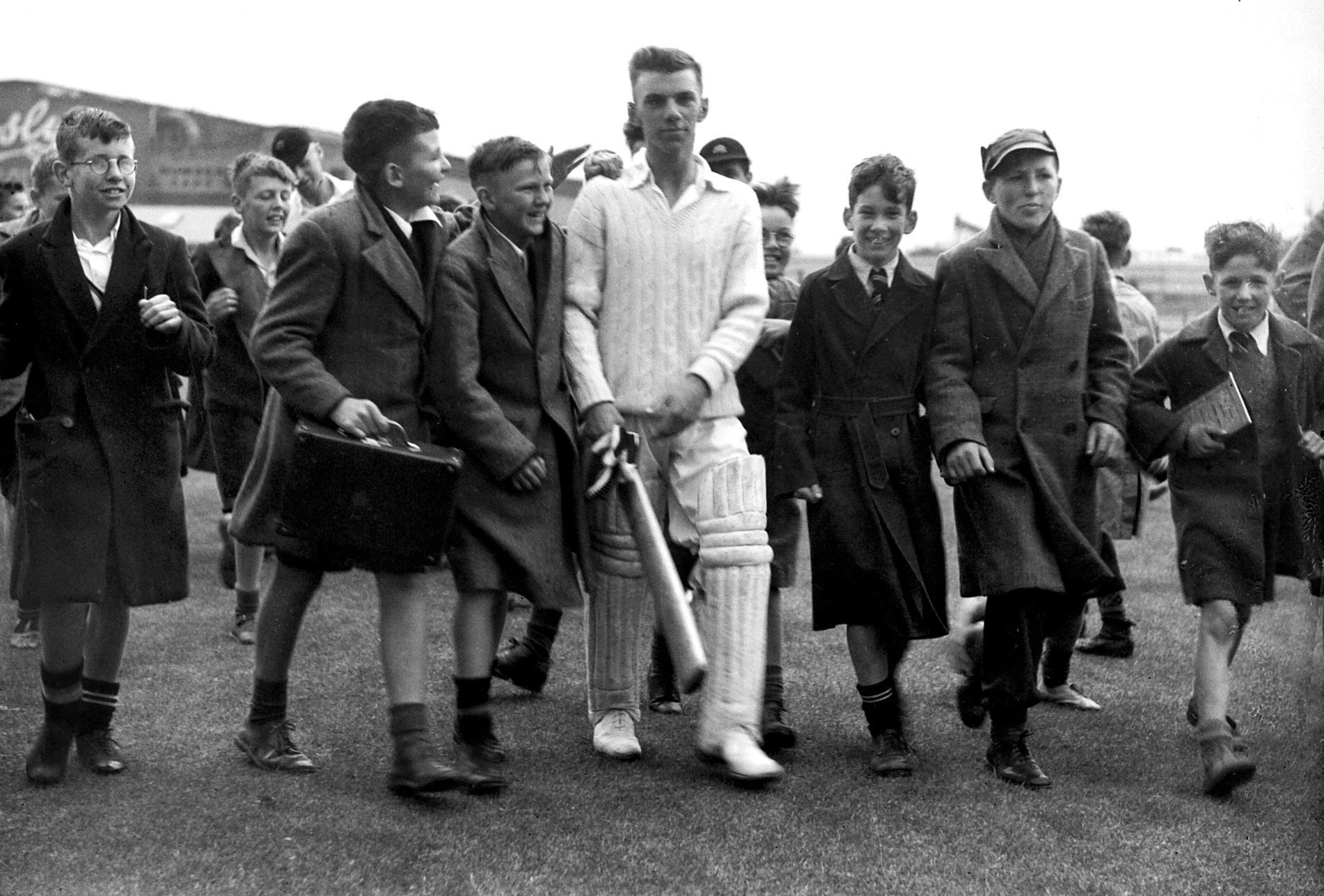
I hung around the back of pavilions and hunted them down.
Collecting anything is odd. Who needs a hundred bits of Ming Dynasty porcelain, or a thousand matchboxes, or sheets of misprinted stamps?

A collection represents both ownership and control, an organised and reassuring little precinct in a wide chaotic world.
My autograph-collecting was also a form of worship, for as a kid I saw first-class cricketers as the nobility: exalted figures who were paid to do what I loved to do.
They had reached the promised land and I longed to follow them there. I ached with the yearning. So collecting their autographs was a way of both paying homage to my heroes and of securing icons — relics — that I could revere. Those autographs were juju fetishes.
In preparation for my own hoped-for admission to the Happy Isles of first-class cricket, I practised my signature. I filled exercise books with it.
It was modelled on the signature of Geoffrey Boycott, a dour and selfish batsman, but a very good one. I retain that signature today.
But no small boy has ever come up to me as I leave the pavilion and held out a grubby scrap of paper for me to sign.
At the age of 12, in addition to collecting autographs of cricketers, I kept a diary, though kept isn’t quite the verb. I wrote bursts of entries for a few days then nothing for months.
What prompted a burst was generally a moment of strong feeling and one such was when I was invited to attend some cricket coaching sessions. One of the coaches went by the name of John Trevett and he, as I expressed it in my diary, HAS PLAYED FIRST-CLASS CRICKET.
Furthermore, after the first coaching session I wrote that he was a ‘GREAT BLOKE’, a term I emphasised not only with capital letters but also by underlining it.
By that time I had already known a cricket coach or two. They ranged from well-meaning ancients who knew less about the game at 60 than I did at 10, to a serial sexual molester of little boys, who, I fervently hope, has since died a lingering death in prison.
Later in my teenage years I was coached by one or two other former first-class cricketers, including the England fast bowler John Snow, of whom I was in awe.
He told me once in the nets, while eating a ham salad roll, that I was getting on to the front foot too early, and if he were bowling at me in a test match he’d let me have one round the ears.
Yes, Mr Snow, I said, but I continued to get on to the front foot early because a habit is a habit.
John Snow ambled to the bowling crease with the ham roll kheld between his teeth and let rip a bouncer round my ears that made my innards deliquesce.
I have no such vivid memories of John Trevett, indeed I have no memories of him at all. I know only the good things I wrote about him in my diary.
But today there is that cruel beast the internet and I have looked up his first-class cricketing record.
He played in a total of two first-class cricket matches. As a slow left-arm bowler he delivered 168 balls over the course of those two matches and took no wickets. So he has no bowling average.
And as a right-handed batsman he played three innings. In total over those three innings (one of which was not-out) he scored a single run. His batting average, therefore, is 0.5.
It is a record of minimalist beauty. There is poetry there.
And had I known about that record at the time, it would have made no difference. He was a first-class cricketer and as such he wore the stamp of Achilles.
I bet I got his autograph.
• Joe Bennett is a Lyttelton writer.


