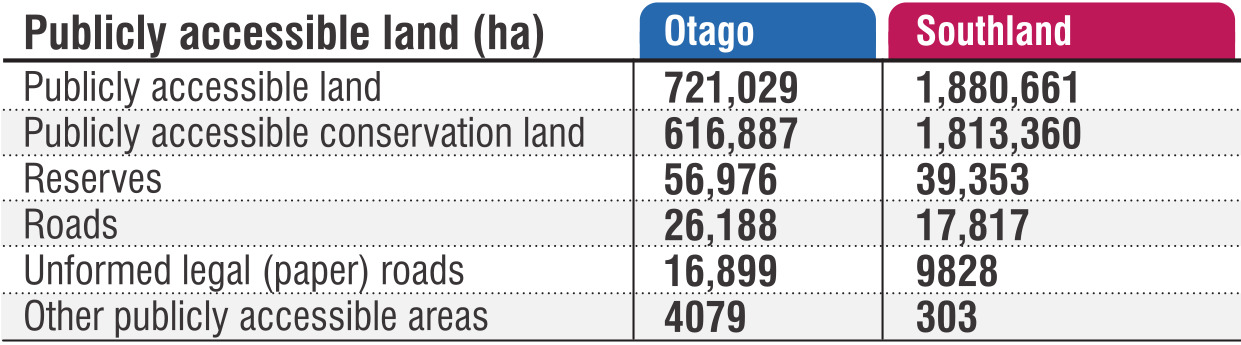
The inaugural report highlights wide regional variation in access, including that Otago is the region with the largest area in unformed legal — or paper — roads, which are legally public roads, but many of which may be inaccessible for various reasons.
Commission chief executive Dan Wildy said the report was significant as the first annual opportunity for people to examine whether access to New Zealand’s outdoors was as free, certain, enduring, practical and inclusive as it should be.
"This is crucial, because public outdoor access is good for mental and physical health, wellbeing, community connections, the environment and the economy."
Among the data in the report was that while the North Island had about three-quarters of New Zealand’s population, it had only about a quarter of its publicly accessible land.
It also showed that the South Island and Stewart Island had 61% of the country’s paper roads — an "essential" source of permanent legal public access, Mr Wildy said.
The purpose of including this type of information was to encourage New Zealanders to think and act on where public access needed enhancement, he said.
"We can’t change the fact that Auckland, for example, doesn’t border Fiordland.
"But when we have a clear picture of where the demand for public access is, we can see where best to focus our efforts."
The level of data in the report was unique, he said.
"It’s the first time we have collated and published in one place details such as how much of New Zealand is State-owned land [44%], and then how much of that is publicly accessible conservation land [66.6%], reserves [7%], formed roads [2.1%], and unformed legal roads [0.9%]."
The report breaks down the data by region, which is also a first for the commission.
Regional insights included that Auckland had the highest percentage of land in private hands (80%); West Coast had the largest area of publicly accessible conservation land (1,864,204ha) and Otago had the largest area in unformed legal, more commonly known as paper, roads (16,899ha).
The report also "initiated a discussion" about addressing public access challenges, Mr Wildy said.
Private occupation of unformed legal roads, or paper roads, was one with particular relevance to the deep South, as Otago hosted the most of anywhere in the country.
Unformed legal roads are parcels of land designated as legal roads but not always physically constructed.
Legally, they are exactly the same as formed roads.
There may be limitations — the Land Transport Act gives road-controlling authorities the power to restrict vehicle access if it is necessary to protect the environment, the road and adjoining land and the safety of road users.
They are often physically indistinguishable from private land, are not shown on topo maps and/or are not yet visible on digital maps.
Many are inaccessible because adjoining landholders occupy them as part of existing farm or forestry activities. However, that did not create any legal right to the road in favour of the adjoining landholder and the right of public access remained, the report noted.
Another is the lack of a national framework and fund specifically designed to assess and acquire public access.
With this type of focus, easements or covenants could be secured, enhancing the reach and value of outdoor access for all to enjoy.
"Over the years to come, we want iterations of this report to help New Zealanders find ways to rise to these and other types of public access challenges," Mr Wildy said.
The report concluded with suggestions for how New Zealanders could continue to support public access.
These included giving local communities more control over their walkways, exploring the enhancement of public access through investment processes, promoting public access in forests, and digitising more public access parcels. — Allied Media