
PHOTO
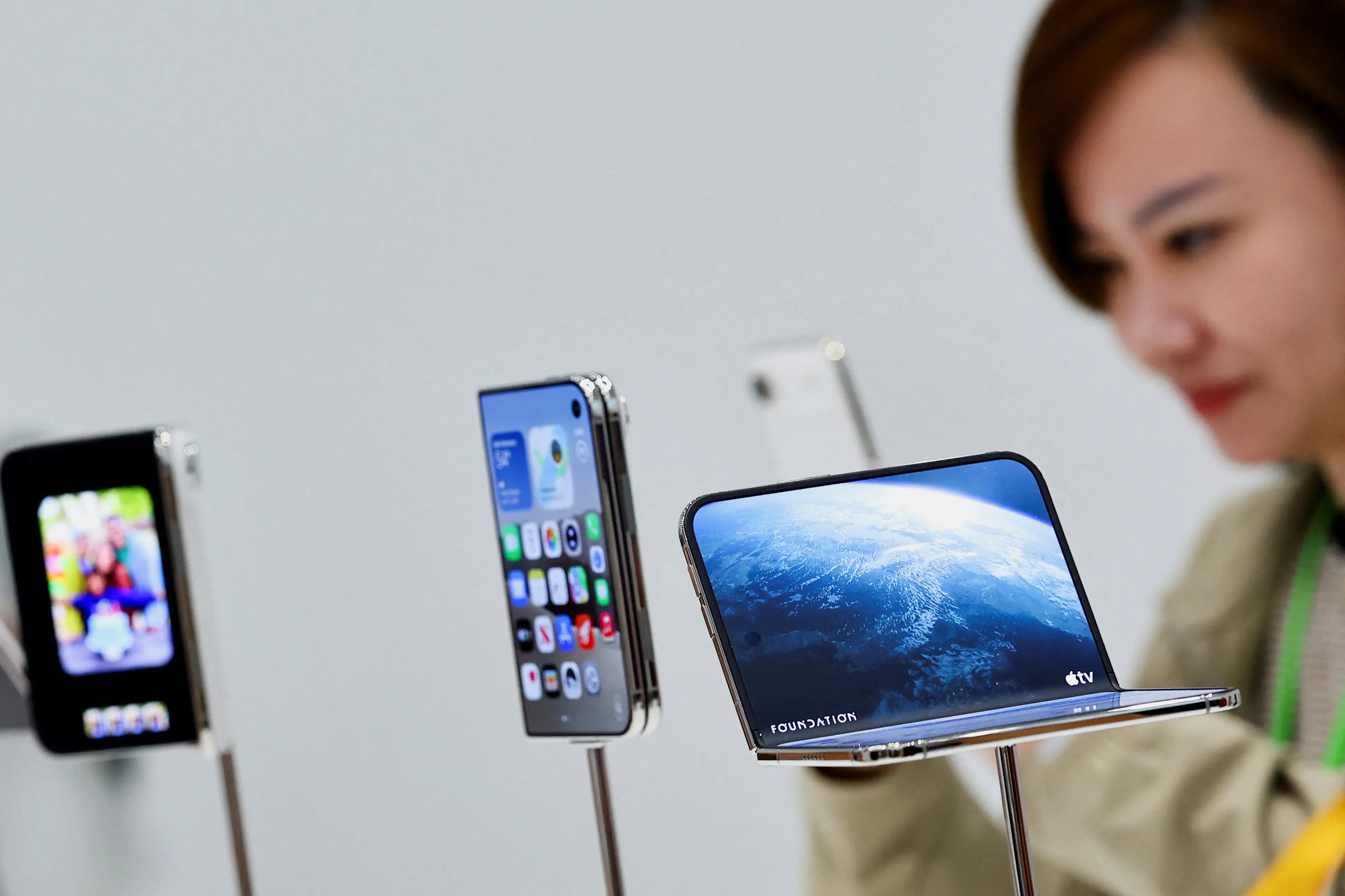
Apple has redefined its flagship smartphone with the launch of the Duo, a folding iPhone, betting its design and promises of data privacy will let it leap ahead of rivals who have been selling folding phones for years.
The Duo at $US1999 ($NZ3400) could shake up a category long dominated by Samsung and Chinese companies like Huawei, whose devices have struggled to move beyond a niche audience.
Analysts have long said Apple's entry could be the catalyst foldables need, helping bring the form factor into the mainstream much as the company did with smartwatches and wireless earbuds.
The Duo is sized and shaped like a passport, with rounded edges. It opens into a horizontal, 19cm-diagonal screen that also can be viewed vertically. There is a smaller single screen on the front, when the phone is folded.
When open, it is Apple's thinnest phone, the company said. However, it is thicker than folding phones offered by Chinese rivals.
New chief executive John Ternus led the event, for the most notable overhaul of Apple's flagship product since the iPhone X in 2017. The iPhone brought in $US209.6 billion, or just over half of Apple's sales, in its most recent fiscal year.
Ternus criticised existing foldables as awkward and poorly suited for common tasks such as scrolling and video viewing, saying the Duo was designed to deliver an iPad-like experience in a pocket-sized device through a custom hinge, dual displays with a consistent aspect ratio, and a new titanium body.
"It's entirely new and at the same time remarkably familiar. A similar size to your passport, it feels familiar to hold and comfortable to use with one hand," Ternus said.
Other tech companies made light of the launch. Duolingo, the foreign-language learning app with a green owl mascot named Duo, messaged on X, "We infringed upon," with laughing-crying emojis.
That drew a message of "solidarity" from foldable phone company Samsung Mobile US, which added, "They copied us, too."
ANALYSTS PREDICT STRONG MARKET SHARE
It will fall to Ternus, the previously low-profile hardware chief, to persuade Apple's customers that they need a foldable device costing about $US2000, a new high for a global brand that has defined mass luxury. Analyst firms such as International Data Corporation expect Apple will sell every foldable iPhone it can produce and secure a 40% share of the lucrative niche by the end of next year.
Apple positioned the iPhone Duo as a business productivity device, showing how it would manage Zoom calls with multiple participants and a broader view of the Slack messaging app. The Duo's larger screen will support multiple app windows at once, a move aimed at productivity that Apple has made with some of its iPads.
Apple said the iPhone Duo, available from October 23, will feature the A20 Pro chip to drive its displays and also a new C2 modem chip designed by Apple, part of its move away from Qualcomm's QCOM.O wireless data chips. Its battery supports 24 hours of mixed dual-screen use and can charge to 50% in about 20 minutes.
"Apple showed up years after everyone else, yet it walks in and sets the rules. Apple entered the foldable market and, in one keynote, set the price and the standard every rival will now be measured against," said Francisco Jeronimo, vice president for Data and Analytics, Devices, at IDC EMEA.
"The real fight is China, where Huawei owns nearly 80% of foldables. Apple has just given Chinese buyers a reason to look up. Huawei owns China's foldable market today. Apple has just handed Chinese buyers their first genuinely compelling reason to reconsider."
Apple shares closed down 0.3% at $315.34 on Wednesday, following the presentation.
NEW CEO TERNUS HIGHLIGHTS PRIVACY IN AI
Former chief executive Tim Cook handed off to Ternus at the start of the presentation with a video of a joking debate about how to begin the event. The video closed with a close-up of Cook, who said, "Not me. That's your guy," pointing back toward the new CEO.
Ternus described the iPhone platform as a personal AI hub that focused on privacy, saying that others wanted to collect and store personal data. "Honestly, trust only goes so far when your data is no longer yours to control," he said. "That's why Apple Intelligence runs on device whenever it can."
Apple's Lilian Rincon, who oversees AI products for the iPhone maker and was recruited from Google earlier this year, described an updated Siri assistant.
Executives also showed off the iPhone 18 Pro and the 18 Pro Max handsets that are the latest versions of Apple's well-known line, which do not fold. Pricing for the iPhone 18 Pro and Pro Max starts at $US1199 ($NZ2050) and $US1299 ($NZ2260), up $US100 from the starting prices of the iPhone 17 Pro and Pro Max.
AIRPODS AND APPLE WATCH UPDATES
Apple also unveiled a feature aimed at addressing growing concerns over AI-generated and manipulated images. It introduced a new standard it calls "Apple Reference Image" to prove the authenticity of the images taken with the new iPhone 18 Pro cameras and said it will also support the emerging SynthID standard for identifying images that have been created or edited with AI. The Apple Reference Image feature will not be available in the European Union or China.
The iPhone 18 Pro also will include the new A20 Pro chip, which brings improvements to help advanced AI models run directly on iPhones.
The company also said a new version of AirPods would start at $US129 with noise cancellation, a first for its budget line of earbuds. Apple also unveiled the Apple Watch Series 12 and Apple Watch Ultra 4, positioned as major health-focused upgrades with new features that gauge recovery and fitness, as well as improved heart-rate tracking.
Micron CEO Sanjay Mehrotra attended the launch, notable because Apple rarely gives suppliers a prominent role at such events. As Apple adds more AI features to iPhones and other products, demand for high-performance memory has increased, elevating the strategic role of suppliers such as Micron, especially amid a global shortage of memory chips.