
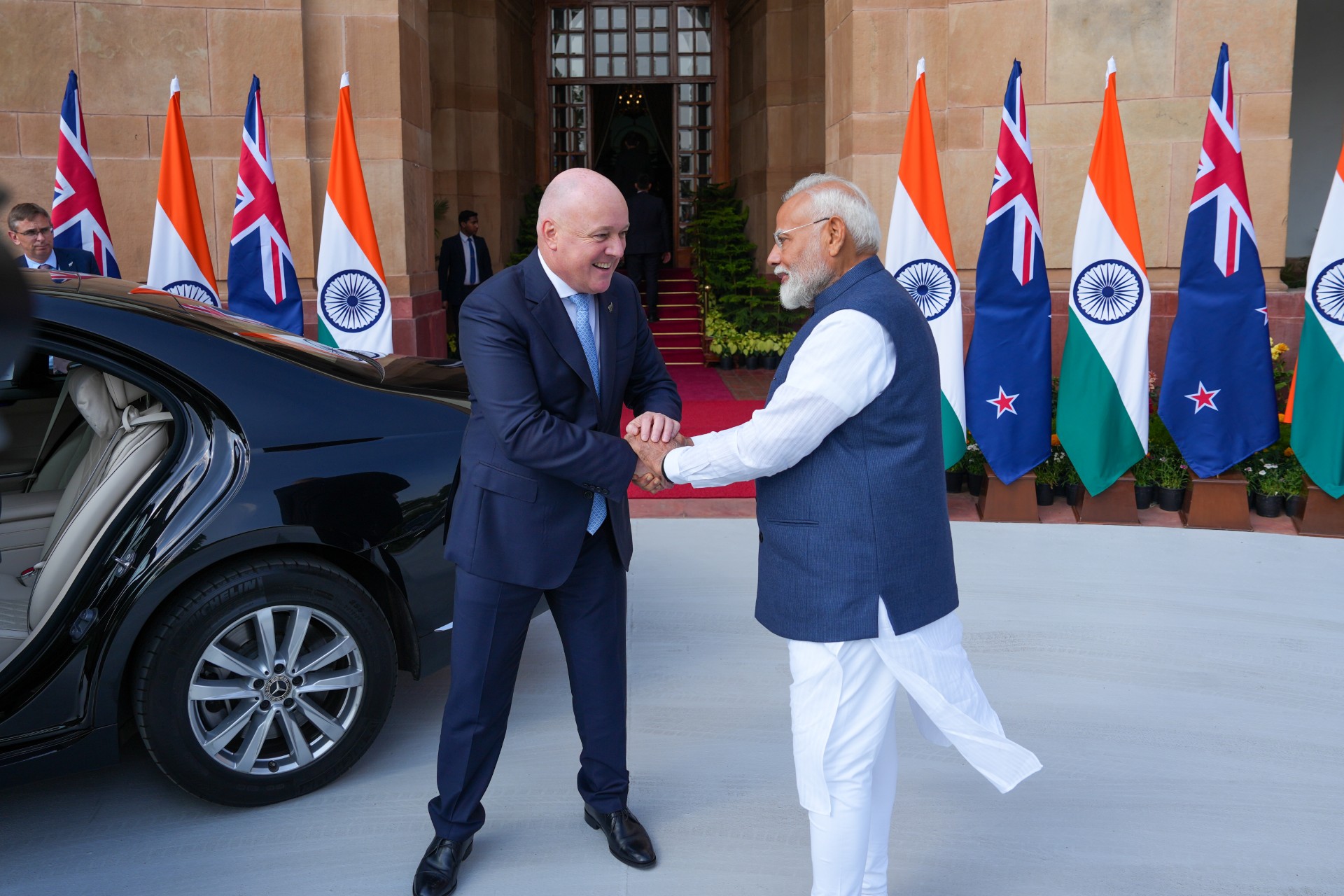
It's an economy forecast to be worth $NZ12 trillion by 2030.
But coalition partner NZ First won't support the deal, saying it "gives too much away".
The agreement eliminates or reduces tariffs on 95% of New Zealand's exports to India with more than half of products to be duty free on day one of the pact, improving access to India's rapidly expanding middle class, the New Zealand Government said today.
New Zealand would offer some 1667 temporary work visas a year for people in areas where it has skills shortages, including doctors, nurses, teachers, technology professionals and engineers, and another 1000 places a year in its working holiday visa programme, matching Australia's free trade pact with India.
"The gains are wide-ranging and significant," New Zealand Prime Minister Christopher Luxon said.
"India is the world's most populous country and is the fastest-growing big economy, and that creates opportunities for jobs for Kiwis, exports and growth."
The countries expect to sign the agreement in the first half of 2026, the New Zealand Government said.
Trade Minister Todd McClay said the deal put the country on an equal or better footing than other countries which traded with India and "will deliver thousands of jobs and billions in additional exports".
The Indian government confirmed the pact without giving further detail. India's trade minister was scheduled to speak with reporters later on Monday.
NZ First to vote against deal
The deal makes good on a 2022 election promise from governing National Party that, if elected, it would finalise a New Zealand-India free trade agreement in its first term.
But parliamentary approval was not immediately assured. Coalition partner New Zealand First, which holds eight of the 123 seats, would vote against the deal.
Leader Winston Peters said today the deal "gives too much away, especially on immigration, and does not get enough in return for New Zealanders, including on dairy".
It is now in the hands of opposition parties as to whether it passes or not, RNZ reports.
In a statement released just before the agreement was announced, Peters described it as a "low-quality deal".
NZ First exercised the agree to disagree provision of its coalition arrangements when Cabinet approval for the deal was sought last week, and made it clear that it would vote against enabling legislation if and when it was introduced to Parliament.
"While New Zealand is completely opening its market to Indian products under this deal, India is not reducing the significant tariff barriers currently facing our major dairy products," Peters said.
The party also expressed concerns about the proposed changes on migration. The trade deal creates a new employment visa for Indian citizens, and according to the party will likely generate greater interest in Indian migration to New Zealand during a tight labour market.
Peters said his party's approach to trade deals has been consistent, longstanding and principled.
"New Zealand First's longstanding approach has been to support those FTAs that deliver a good deal for New Zealanders and to oppose those that do not."
Limited gains for dairy
Only limited gains were secured for dairy, with duty-free access for re-exports, bulk infant formula and a 50% tariff cut for high-value milk albumins under a quota.
Dairy access to Indian markets was always going to be the holy grail for a free trade agreement with India - highly valuable but difficult to obtain, RNZ reports.
McClay said dairy access would be future-proofed with a clause automatically triggering consultation for renegotiation of dairy access if India negotiated better terms with other comparable countries.
The deal would also be reviewed one year after it comes into force.
McClay highlighted a kiwifruit quota nearly four times current exports, with a 50% tariff applying once the quota is reached; agreement for preferential market access for apples and mānuka honey; and geographical indication rules for specialist and iconic New Zealand product names.
The agreement would also include a Treaty of Waitangi clause.
Two-way trade between the two countries totalled $NZ3.14 billion in 2024, dominated by pharmaceuticals from India and forestry and agricultural products from New Zealand, including wool, logs and apples.
India FTA key details
- Duty-free access on almost 57% of NZ exports from day one, increasing to 82% when fully implemented, with the remaining 13% being subject to sharp tariff cuts
- Immediate tariff elimination on sheep meat, wool, coal and over 95% of forestry and wood exports
- Duty-free access on most seafood exports, including mussels and salmon, over seven years
- Duty-free access on most iron, steel and scrap aluminium, over 10 years or less
- Duty-free access for most industrial products, over five to 10 years
- 50% tariff cut for large quota of apples - nearly double recent average exports
- Duty-free access for kiwifruit within a quota almost four times our recent average exports, and tariff halved for exports outside of quota
- Duty-free access for cherries, avocados, persimmons and blueberries, over 10 years
- Tariffs on wine reduced from 150% to either 25% or 50% (depending on the value of the wine) over 10 years, plus a "Most Favoured Nations (MFN)" commitment
- Tariffs on mānuka honey cut from 66% to 16.5% over five years
- MFN status and liberalisation across services exports
- Duty-free access for dairy and other food ingredients for re-export from day one
- Duty-free access for bulk infant formula and other high-value dairy preparations over seven years
- 50% tariff cut for high-value milk albumins within a NZ-specific quota equal to current export volumes
The deal also includes chapters on Customs Facilitation and Clearance, Technical Barriers to Trade, Sanitary and Phyto-Sanitary Standards, Culture, Trade and Traditional Knowledge, Economic Cooperation, Trade and Sustainable Development.
- Reuters and RNZ


