

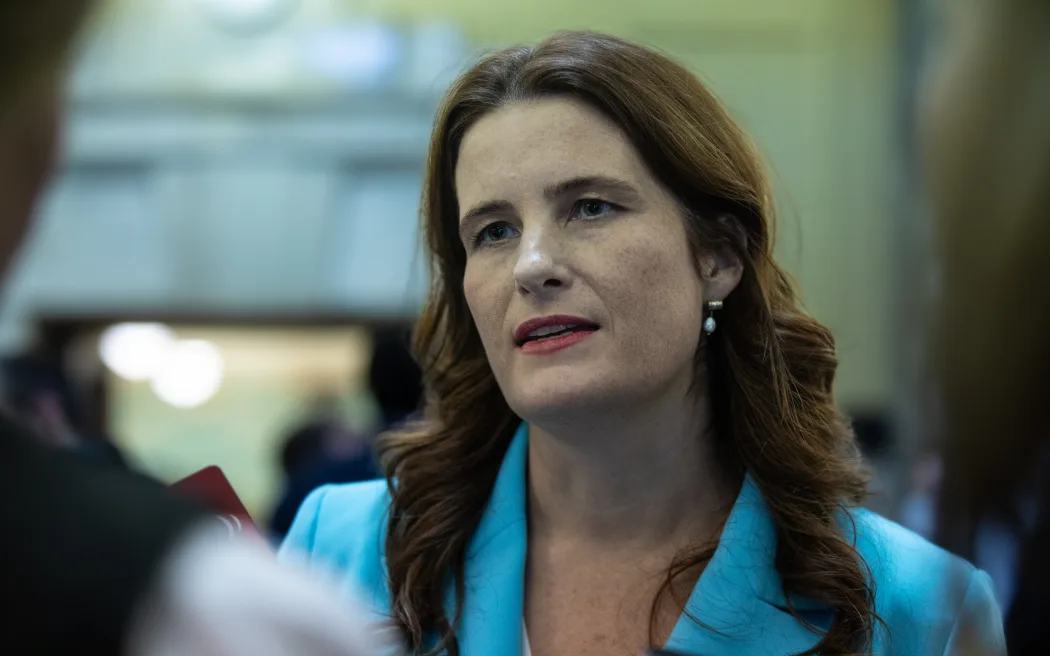
Finance Minister Nicola Willis is pinning the blame for the economy's slump on "international turmoil and uncertainty" driven by the United States' tariff roll-out.
But Labour says other countries - like Australia - have fared the storm better, accusing the coalition of taking New Zealand backwards.
New data released on Thursday showed a sharp drop in GDP for the June quarter - down 0.9% - much worse than had been expected.
In a statement, Willis said the US announcement - right at the start of the second quarter - had caused firms and households to put off spending decisions.
"The economy had been growing strongly in the previous six months, but suddenly had the stuffing knocked out of it," Willis said.
"I feel for people and businesses who have been affected."
Willis stressed that the data was "backwards-looking" and there were signs the economy was growing again as interest rates fell.
"Lower interest rates are filtering through the economy. There is evidence of increased mortgage lending. And the impact of tariffs has not been as disruptive as initially feared. The outlook for most export sectors remains positive.
"All forecasters are expecting economic growth to strengthen from now on as uncertainty about the impact of increased tariffs eases."
Labour's finance spokesperson Barbara Edmonds said the latest figures proved the damage being caused by National's "economic mismanagement" - a phrase often thrown at Labour by Prime Minister Christopher Luxon.
"Christopher Luxon stood in front of New Zealanders in 2023 and said his business experience would fix cost of living and the economy. Instead, he has failed dramatically," Edmonds said in a statement.
Edmonds said the government would blame "everyone else" for the poor numbers, but the country was clearly headed in the wrong direction.
"Australia's economy grew by 0.6% in the last quarter, which only highlights the failure of Christopher Luxon and Nicola Willis.
"Thousands of jobs are being lost, businesses are struggling to stay afloat, and record numbers of New Zealanders are leaving to find work overseas.
"New Zealand cannot afford another three years of National."
Calls for resignation
Former Finance Minister Roger Douglas is calling for Finance Minister Nicola Willis to resign.
He and University of Auckland Matthew Abel chair of macroeconomics Robert MacCulloch said the contraction in GDP revealed by Stats NZ on Thursday was because Willis was "sending New Zealand bankrupt by failing to get to grips with our ballooning fiscal deficits and public debt".
"Her own Treasury contradicts her claim that NZ is on a path to surplus. It is not. Treasury's long-term fiscal forecasts show out-of-control deficits due to pensions and health-care spending from an ageing population," they said in a statement.
"Willis is not up to the job and is not levelling with the New Zealand public."
Willis' office would not comment on the statement.
MacCulloch said Willis kept saying the country was returning to surplus.
"The books are not improving. And this surplus she talked about today, that's a creative accounting trick. She changed the way the accounts were being measured... she keeps saying they're getting better, it's not true."
Economists agreed that the outlook for the third quarter was better, but said given the sharp contraction, activity was still lower than had previously been expected.
MacCulloch said it was disingenuous to blame the global picture.
"She mentioned the tariffs hitting much harder here - that makes no sense at all. In fact, most countries overseas had far higher tariff uncertainty than New Zealand."
Labour's deputy Carmel Sepuloni said Australia's economy grew 0.6% over the same period.
"Where to next, you know? Is it the fault of the butcher, the baker, the candlestick maker, but not Nicola Willis? It's her responsibility - she's the minister for finance."
'Worst is now behind us'
ASB economist Wesley Tanuvasa said the contraction was "sizeably weaker than expectations".
"The slowdown is characterised by material weakness in goods production and a variety of statistical adjustments," Tanuvasa said.
"Manufacturing declines were broad-based and coincide with a deceleration in goods exports," Tanuvasa said. "Construction continued to retrace from stimulus-driven highs."
The weak services exports reflected "stagnating tourism", ASB said.
"Our hope is that the worst is now behind us," Tanuvasa said.
Further OCR cuts likely
"Today's data certainly validates the RBNZ's dovish pivot at the August MPS [monetary policy statement]," ANZ senior economist Matthew Galt said.
ANZ continued to forecast two Official Cash Rate (OCR) cuts of 25 basis points each in October and November, taking the rate to 2.5%.
Galt said the sharp fall in GDP would spark market discussion about whether the OCR would need to go lower than 2.5%, and whether the RBNZ would cut the OCR by 50 basis points.
"Never say never, given two members voted for a 50bp cut last month, and this is a pretty chunky downside starting point surprise," he said.


