
PHOTO
The Opuha Dam’s ability to protect South Canterbury communities from major flooding has taken a major step forward, with Opuha Water Limited (OWL) successfully commissioning a new outlet valve capable of releasing record volumes of water from the dam in advance of a weather event.
By enabling larger controlled releases before a storm arrives, the new outlet allows OWL to build additional flood buffer within Lake Opuha while downstream rivers are still operating at normal levels. This increases the dam’s ability to temporarily store floodwaters and can help reduce peak flood impacts further downstream.
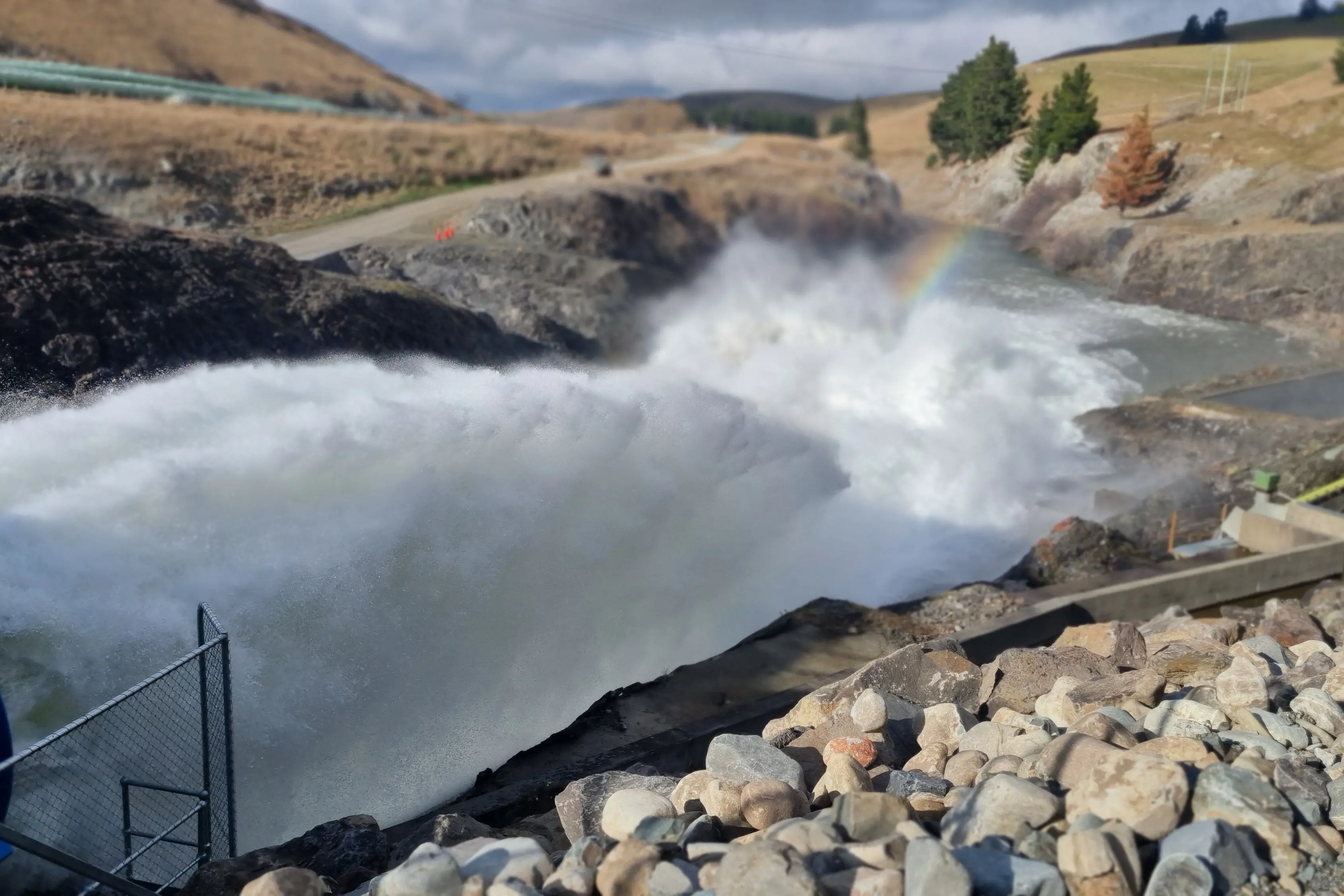
The new low-level outlet valve, commissioned on August 11 and 12, marks one of the most significant safety upgrades undertaken since the dam was built. During testing, it delivered a historic first for Opuha Dam, with total discharge flows through the penstock of about 52 cubic metres per second. That equates to about 187,000cu m of water — enough to empty around 75 Olympic-sized swimming pools — every hour.
The upgraded outlet features a new 1.8m diameter fixed cone discharge (FCD) valve. It utilises a branch of the penstock used during construction of the dam, which has been buried inside the dam structure until now.
The project has been designed to significantly increase the dam’s ability to safely release water before and during major weather events, giving OWL a powerful new flood management tool.
The new outlet can reduce Lake Opuha’s water level by up to about 6.5% a day ahead of a predicted significant high rainfall event. Depending on inflow volume, this would equate to 27%-32% of the lake volume across a five-day period. As well as reducing reliance on the dam’s spillways, advance dewatering protects downstream stopbanks, with the dam acting as a buffer for flood waters.
The $8 million project is one component of the wider Opuha Dam and Irrigation Scheme upgrade, which is being supported by a government loan of up to $20.8m through the Regional Infrastructure Fund, administered by Kānoa — Regional Economic Development & Investment Unit.
Opuha Water chief executive Bjorn Triplow said the achievement represented an important investment in the safety of the dam itself, but also the long-term safety and resilience of South Canterbury roads, rail, bridges, stopbanks, productive land and local townships.
“This is a landmark achievement for Opuha Water, our farmer shareholders and the community,” Mr Triplow said.
“The successful commissioning confirms that the new outlet is performing as intended and provides a significant increase in our ability to safely manage water levels ahead of and during major flood events.
“While Opuha Water’s farmer shareholders have funded this investment, the benefits extend well beyond the scheme itself. Increased flood management capability enhances the resilience of critical downstream infrastructure, rural communities and productive land throughout the catchment.”
Commissioning included operation of the FCD valve alongside the hydroelectric generation plant. Together, the two systems achieved total discharge flows of about 52cu m per second, the highest controlled-release capacity through the dam’s penstock since it was built.
“This project demonstrates the commitment of Opuha Water and its farmer shareholders to invest in infrastructure that not only supports irrigation and renewable energy generation, but also delivers lasting benefits for the wider region. It is an investment in community resilience and the long-term security of one of South Canterbury’s most important strategic assets,” Mr Triplow said, adding that while the valve represented a step forward in flood control, further work was needed to increase spillway capacity.
“This would, however, be a significantly more expensive undertaking. Given that the primary beneficiary of increased spillway capacity would be publicly owned river infrastructure, OWL is keen to work with the wider community to explore how this could be progressed.” — Allied Media