
PHOTO
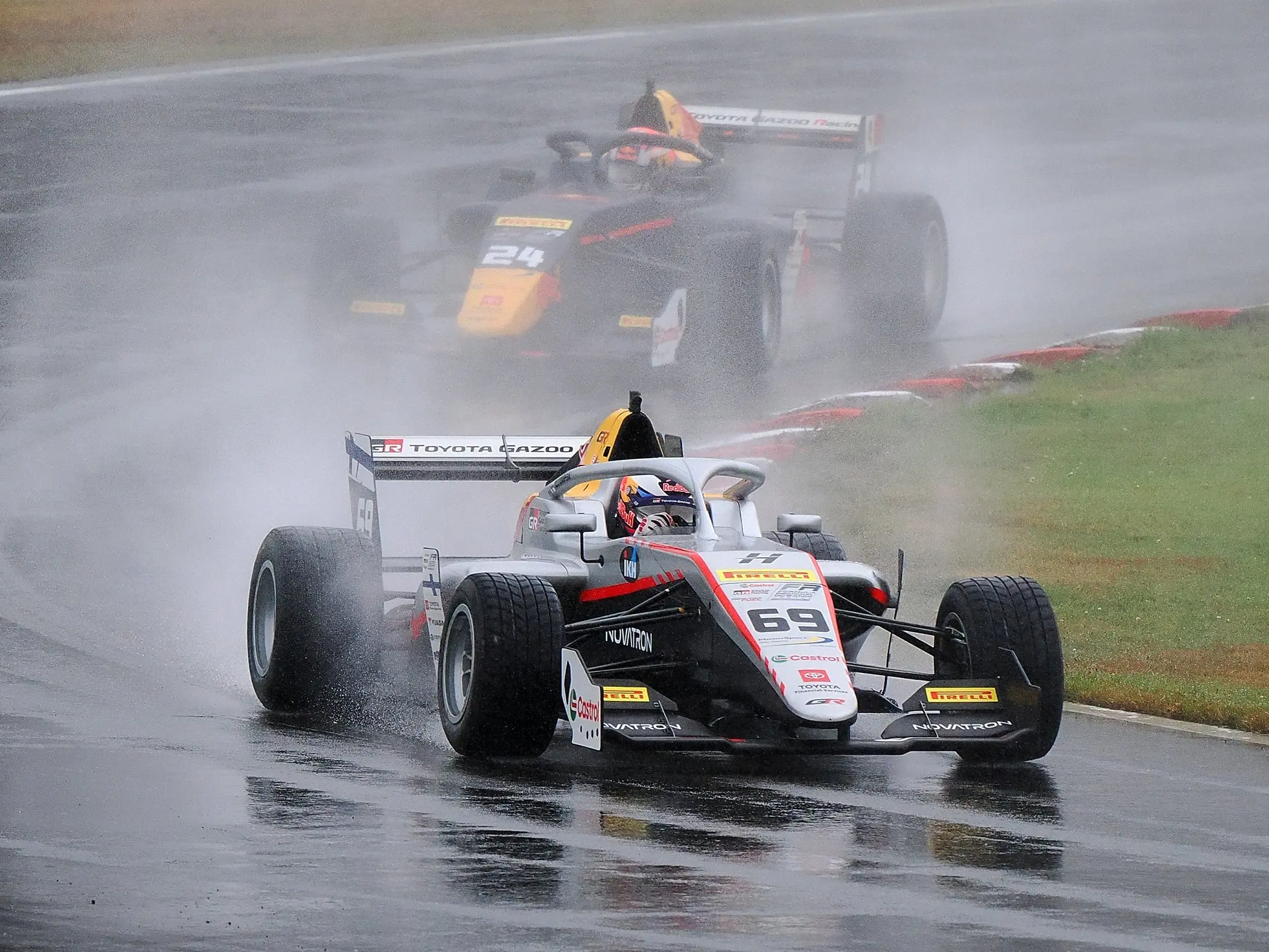
After languishing towards the back in the opening two rounds of the 2026 Castrol Toyota Formula Regional Oceania Championship, Kalle Rovanpera finally came to the fore at last weekend’s third round, held at Teretonga Raceway, Invercargill.
I am sure I wasn’t the only follower of the former world rally champion to be delighted at his performance, which comprised third, fifth and seventh placings. While the third placing scored in the opening race was the Finn’s best result (and his first podium of the series), it was his tigerish drive to fifth in a treacherously wet race two that stood out, showcasing to the full the car control that comes with all that WRC experience.
As Rovanpera gave a first glimpse of what he might be capable of in a single-seater once he gains more circuit racing experience, the Teretonga meet also saw some fascinating championship developments ahead of this weekend’s series finale, the New Zealand Grand Prix meeting at Highlands Park.
Notching up his third race win of the series at Teretonga, New Yorker Ugo Ugochukwu continues to head the series’ points table, but wins for Freddie Slater in the other two races at the track have catapulted the English racer into title contention. Heading to Highlands, and with four races to run at the Cromwell circuit, Slater trails Ugochukwu by just 22 points. A race win is worth 35 points, so while Ugochukwu remains the most likely champion, and has been super-consistent as well as quick, a slip-up is something he cannot afford.
Teretonga was not as kind to the series fortunes of Japan’s Jin Nakamura and Kiwis Louis Sharp and Ryan Wood, although all three remain title contenders.
This weekend the leading drivers have to focus not only on the championship, but also the New Zealand Grand Prix itself, which will be the final race of the series tomorrow afternoon.
This will be the 70th running of the Grand Prix, and it is an illustrious prize, with the names engraved on the trophy including no fewer than seven F1 world champions. The latest of these is reigning world champion Llando Norris, who won the New Zealand Grand Prix in 2016. The others are Keke Rosberg (NZ GP winner in 1977 and 1978), Jackie Stewart (1967), Graham Hill (1965 and 1966), John Surtees (1963), Stirling Moss (1962, 1959 and 1956), and Jack Brabham (1961, 1960 and 1958).
Before the GP itself — a 27-lap race scheduled to run at 4.33pm tomorrow — there will have been three championship races. The first, scheduled for yesterday afternoon, was a rescheduled running of race three at Teretonga that was canned due to the weather. That catch-up dash will be followed by further races for the Toyota single-seaters this afternoon and tomorrow morning.
Supporting categories at Highlands this weekend include the Bridgestone GR86 Championship, Summerset GT New Zealand, the TA2 Championship, and historic Formula Atlantic single-seaters. The gates open at 8am both days, with on-track action through to late afternoon.
It did occur to me that while he was slip-sliding around Teretonga in the wet last weekend, Rovanpera might have reflected on the fact that the conditions there were still far easier than those facing his erstwhile WRC rivals on the Monte Carlo Rally.
Monte Carlo Rally
A challenging mix of dry, damp, icy and snowy roads is a staple of the Monte, but this year’s event was next-level, with some of the most treacherously unpredictable conditions I have seen footage of.
Pretty much every top driver this year survived either a major near miss or an off-road excursion at some point. Even rally winner Oliver Solberg slid off and into a snowy field, but with great presence of mind, and an ounce or two of luck, regained the road with little more than 20 seconds lost.
These were horrible conditions for Hayden Paddon and John Kennard to return to the WRC. I felt the Kiwi duo acquitted themselves well given past experiences on the event, not to mention an absence of any meaningful pre-rally seat time in the latest Hyundai i20 WRC car.
As far as their final result went, it was unfortunate that their "off", which came at slow speed on an icy bend, landed them in a spot from which it took spectators four minutes of pushing and shoving to effect a recovery.
Before then, Paddon and Kennard had been placed seventh, but with Toyota’s Takamoto Katsuta catching them fast after early dramas of his own. So, in all probability, without those four minutes of drama, the Kiwis would have finished eighth; with it, they came home 11th.
Paddon’s own reflection on the event was revealing in every sense.
"This whole experience has been one of the toughest of my life, both mentally and professionally," he said.
"To back yourself, to not run away from the ultimate challenge and to step back into conditions as demanding as these while learning a new car from scratch has been humbling in every sense. We had our setbacks over the weekend, but our clear objective was to get to the end — and we achieved that."
It has yet to be confirmed what the second rally will be in Paddon and Kennard’s part-time 2026 WRC campaign, but most speculation points to Rally Croatia in April.
Otago Rally
While on the subject of rallying in April, there’s been further exciting news for the Otago Rally this week, with Australian Toby Price confirmed as a starter.
While not so well known on four wheels, Price is a two-time winner of the gruelling Dakar Rally in the motorcycle category and has scored many other successes in desert racing events.
In the past couple of years Price turned to four wheels, contesting last year’s Australian Rally Championship and finishing eighth on this year’s Dakar event in a Toyota Hilux. At Otago he will drive a Toyota GR Yaris, previewing a new one-make class for the car that will be part of the NZ rally scene from 2027.
He joins triple Otago classic rally winner Pasi Hagstrom (Finland) and ex-WRC stars and past classic winners Kris Meeke (Ireland) and Mads Ostberg (Norway) in a growing list of high-profile entries for what will be the 50th anniversary event.