
PHOTO
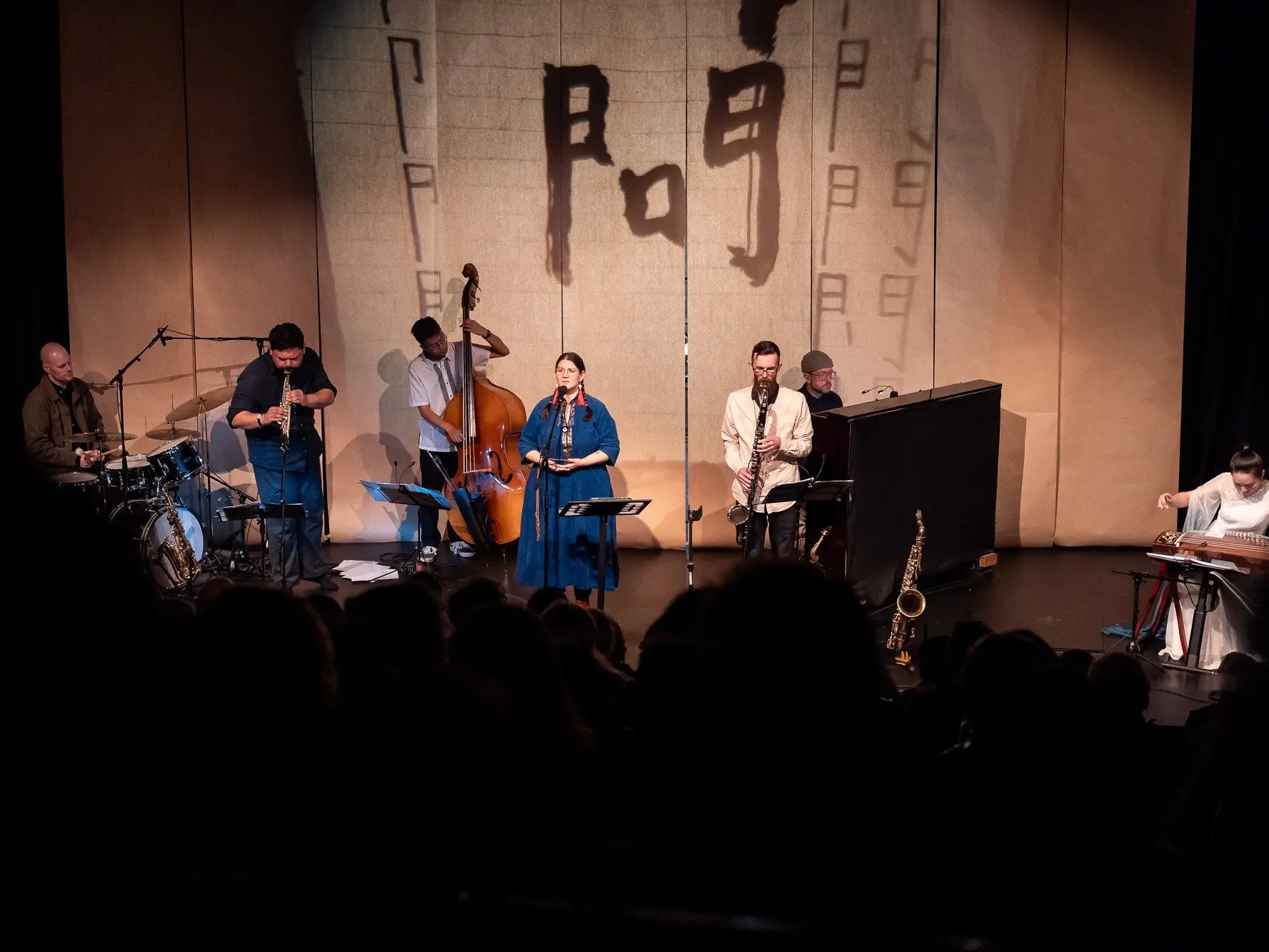
‘‘Not doing, the wise soul doesn’t do it wrong, and not holding on, doesn’t lose it,’’ sings Chelsea Prastiti in the most mellifluous tones possible before scatting smoothly off into further and higher registers.
She’s quoting from American author Ursula K. Le Guin’s English-language translations of Lao Tzu’s Tao Te Ching, which she does with a poise appropriate to the lyrical philosophy throughout Waypeople, Wellington-based jazz musician and composer Jake Baxendale’s new album.
Elsewhere she sings the question ‘‘can you keep the soul in its body?’’ and cheerily suggests ‘‘whatever you lost, you won’’, the pearls of ancient Chinese wisdom embroidering the music — which brings China with it, Baxendale’s saxophone playing off Jia Ling’s guzheng to weave exotic new silks.
There’s a lot going on, as you’d expect when East meets West, but it turns out they can get on just fine. Better than fine.
The genesis of Waypeople involved a convergence of all sorts of things that were happening in Baxendale’s life, as if preordained. But at the same time — perhaps consistent with the whole Taoist duality vibe — was also something of a happy accident.
He and his partner were both fans of Le Guin, he says, but didn’t know of her Tao Te Ching translation, until his partner came across a copy.
‘‘She sort of picked it up, kind of idly, off the shelf for me. It turned out to be a very profound acquisition.’’
He was soon picking out verses ‘‘at random’’ and reading them aloud to her.
It played into Baxendale’s pre-existing interest in philosophy and other cultures, and a nascent interest in poetry.
‘‘And I had a newfound interest in song because I had a young baby at the time, and so I was singing to her a lot,’’ he says.
‘‘It was a lot of old and new interests coming together at exactly the right time, I think, is basically what it is. And then because they’re such musical versions of these poems, I just felt compelled to start writing.
‘‘It was kind of falling off the page, so to speak.’’

As work began, the firsts were racking up, the first time Baxendale had set poetry to music, the first time he’d written for voice, the first time he’d heard a guzheng in person — the traditional Chinese zither that is the third leading voice on the album, beside Baxendale and Prastiti.
As part of the composition process, Baxendale even sang himself, at least on demos for the rest of the band — test driving the lyrics.
‘‘Because, obviously, I’m an untrained singer and a very unpracticed one, I felt like if I could more or less confidently sing them, then a really good singer was going to be able to work wonders with it,’’ he says.
Waypeople was initially commissioned for the Wellington Jazz Festival and has had further outings since, but was last month released on record and next week arrives live in the South, for shows in Ōamaru and Ōtepoti. Baxendale will be joined again by Jia Ling (aka Jessie) on the guzheng and Prastiti, as part of the concert line-up.
Because of the nature of the music, both were closely involved in the music’s creation as Baxendale approached the work of composing in a new way.
‘‘It was a lot more back and forth between myself and the singer, checking that keys and ranges were appropriate and phrasing things, and with the guzheng player as well, making sure that the parts were playable and that they sort of made sense on the instrument or, if it was something new to her, that we were getting together and demonstrating the concepts and the sound of it.
‘‘I had to get a lot of lessons from her as well as to how the instrument works and what it was capable of and so on.’’
In the event, that meant Baxendale wasn’t required to take the deepest dive into Chinese musical theory, that might otherwise have been necessary.
‘‘I might have had to have done a lot more of that if Jessie wasn’t such a willing participant. She’d learned a lot and developed her practice really rapidly to be able to play this music.
‘‘But, yeah, in the end, it was more about developing and deepening relationships between Jessie and I more than it was between me and that music. Because she really embraced the project wholeheartedly and so it just became a case of, like, how can I write even better music for you to play and then in return, how could she interpret it and embody it even better?’’
Which isn’t to say Ling alone is expected to bring The Orient, as the sax on Waypeople often blows in from the East itself.
The interactions were also designed to draw an emotional response from his collaborators, Baxendale leaving certain sections of the music unnotated and instead providing imagery from which the players might draw, to use in filling the space he’d left.
‘‘I wanted to be able to access people’s improvisation or potential without always having to speak specifically to a jazz aesthetic.’’
Naturally enough, the philosophy of the book spilt over into the music in other ways, drawing on the Taoist principle of wu-wei, ‘‘doing by not doing’’ and its encouragement to resist excess and to value simplicity, nature and humility.
That said, Lao Tzu’s advice didn’t necessarily flow effortlessly on to Baxendale’s charts.
‘‘I’ve got some maximalist tendencies, I think, when it comes to music,’’ he confesses.
A more is more default setting.
‘‘So, yeah, that was a good challenge — to find a kind of useful reserve in the writing and the performance of this music.
‘‘The whole album is just a reflection of the text,’’ Baxendale says, ‘‘which itself is full of paradox and juxtaposition and contrast, yin and yang. It’s all part of the book and that works its way into the music naturally.’’
The profound and mystical sits next to consideration of small, practical, everyday things, as the music swings from slowly contemplative to breezily upbeat — and, on Against War, to downright belligerent.
‘‘Weapons are unhappy tools, not chosen by thoughtful people,’’ Prastiti hectors.
Baxendale enjoyed the opportunity to engage with such an ancient text, millennia old, and to find so much that resonated in our current moment.
‘‘I think it just struck me when I was reading the book just how urgent and relevant all the messaging was. I think in some ways it’s kind of depressing but I mostly find it really reassuring that as bad as we behave to one another and the planet, there’s always been alternative ideas. This book is nearly two and a-half thousand years old. And it has some of the same ideas. They had some of the same ideas about progress and the accumulation of wealth and violence and the messy use of power that we are still grappling with now. So, I guess that’s useful to me somehow.
‘‘It’s reassuring. The good ideas stay relevant. The bad ideas are still really bad — and should be confronted as much as possible.’’
‘‘It’s also really nice to have, I think, a text, a philosophical text that sits really easily with discomfort and confusion and ambiguity. To be reassured that it’s OK to just not know or to not do or to not act.
‘‘This kind of reaching constantly towards certainty in something or the acquisition or knowledge of something, to master things. I don’t know. It’s great to just be like, hey, you know what? Confusion is all part of it.’’