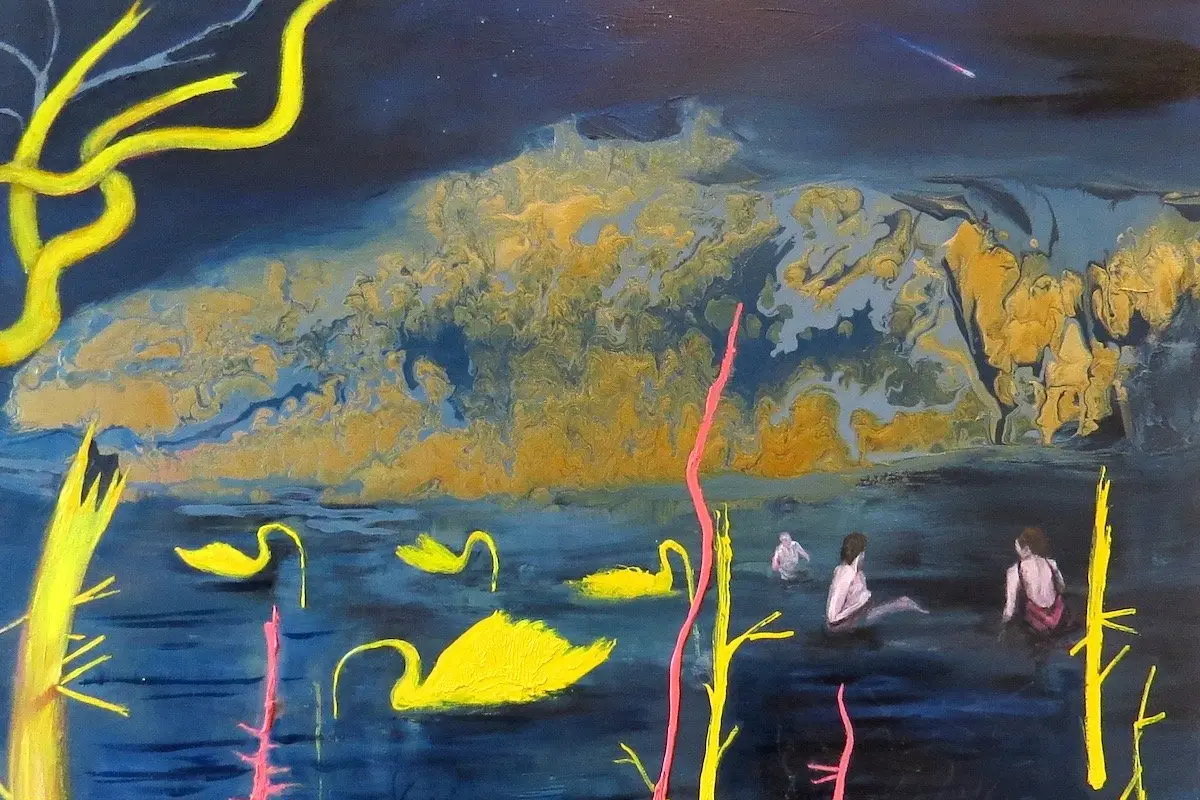
“Microcosmos”, Joanna Margaret Paul (Brett McDowell Gallery) “Microcosmos” is a collection of softer pencil, ink and watercolour works by the late Joanna Margaret Paul. The works range from 1970 to the time of her death in the early 2000s and feature a dozen pieces ranging from intense studies to zen-like scenes delineated by a few deft strokes. The latter pieces give some indication of the artist’s abilities; in scenes like Rain, an entire story is told with a few well-placed graphite lines and a single word. Several of the works have the air of sketches for planned paintings, though they are complete in and of their own right. Images such as @ the Red Eye Cafe and Untitled (Moana Pool) capture both the scene and a narrative element simply and effectively and the two sunset pieces rely very largely on washes of colour. The exhibition title comes from a small series of “Microcosmos” works, still lifes of shells, leaves and driftwood which in their detail seem to encompass miniature universes. The strongest work in terms of the boldness of line is a conte and graphite portrait of the artist’s then-husband, Jeffrey Harris, at their Dunedin home. Paul has managed to nicely capture her spouse’s personality in the two-tone work, providing us with an impressive intimate portrait of the artist. “Anxiety Melts Despair: Drawings and Paintings 1992-2022”, Michael Morley (Olga) A similar overview of 30 years of work is present in Michael Morley’s exhibition at Olga. Morley is insistent, however, that the exhibition is not a retrospective, but rather “the lucky few [works] the floods, landslides, and plagues of the last three decades”. The artist’s work ranges from colour field abstraction though to a brutal expressionism, bold, bright and full of life. In some of the pieces, the artist’s long-standing connection with the music scene comes to the fore, most obviously in titles such as Desolation Row and Boogie Wonderland. In other pieces, an implied humorous narrative is formed by the juxtaposition of image and title, as is the case with Pineapple Disaster. It is a series of softer, music-related works which are the most poignant, formed in the image of that long forgotten item, the seven-inch single sleeve. Each record label had its own design for sleeve art for these 45rpm records, based on its logo (although some companies simply went with a plain white sleeve). Morley presents us with six watercolours, each gently depicting the sleeve from a different label, some of which are themselves no longer around. The works provide a warm nostalgia for anyone who has spun vinyl by Polydor, RCA or Fontana. The paintings flowing and blurring back into memory. “Strange Shores”, Sharon Singer (Hutch) There is an unnerving gothic undercurrent in much of the art of Sharon Singer. Although many of the artist’s mixed media images are open to interpretation and reinterpretation, there is a pervasive influence of the more dystopian side of modern society lurking beneath the surface of many of the artist’s paintings. This is not darkness for the sake of darkness, nor is it a headlong dive into despair. These are works that suggest that change is often just a protest away, but their oracular messages are couched in ambiguity such that viewers must draw their own conclusions. On the surface, there is an unnatural calm to many of the images. The still seas are dark, the trees and animals are at peace but glowing in unfamiliar colours. The peaceful nature lures us in, which is the artist’s intention. For this is not a world in balance. Animals and people bathe in the warm coolant water from a nuclear reactor in The Last Resort. The sea burns in Collector of Warm Shadows. And the Snake Island images are an allegory of that most notorious of recent news islands, that belonging to Jeffrey Epstein. Singer depicts a planet haunted by our sins, but one capable of redemption.