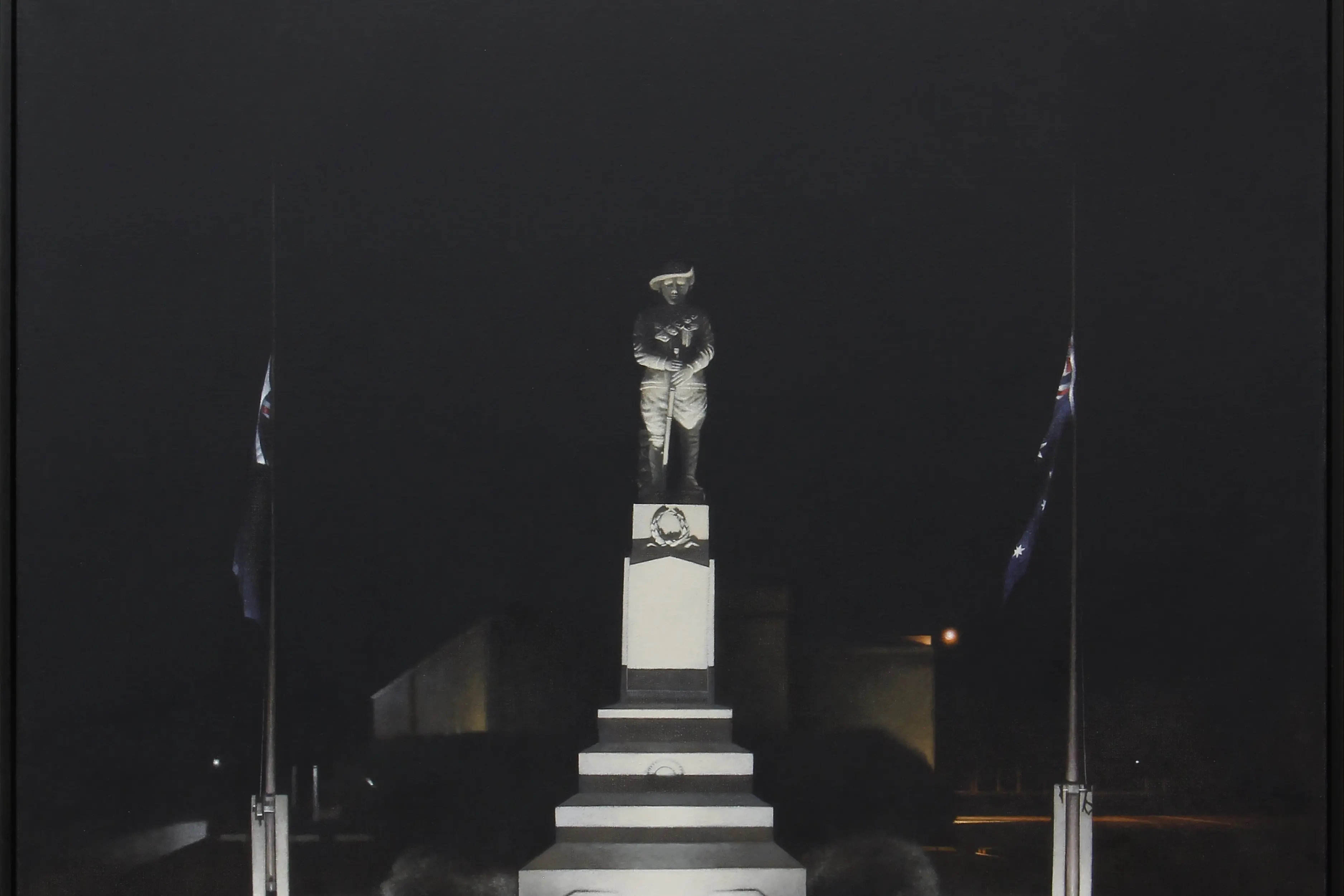
Grahame Sydney: “Close to Home” Milford Galleries, Queenstown Under a pink-tinged sky, the branches of a lone, dying tree stretch outwards like the limbs of a ballerina, lost in silent music. On a wire fence, an abandoned doll clings to the rusted metal, its face in shadow, its position dire, tragedy entwined with a flickering thread of resilience and courage. In the darkness, an eerie glow shines on a war memorial — Lest We Forget, yet standing alone in the dark, deserted, perhaps an indictment on humanity’s tendency to repeat our mistakes, over and over again. Every work in the highly anticipated “Close to Home”, Grahame Sydney’s first exhibition in fifteen years, is exquisitely detailed and skillful, crafted with intention and feeling — whether that’s anger and helplessness as the world falls into violence and conflict yet again, grief and respect for a lost friend, or a loving appreciation for pure beauty. The works trace through more than three decades in the artist’s life, often revisiting the Central Otago landscape, capturing the fall and transformation of light in the way that’s so unique to the eye and brush of Sydney, then moving indoors to immortalise moments of connection and intimacy. In a series of portraits of the artist’s wife, Fiona, her face remains turned away from the viewer, lost in her own thoughts, while in the self-portrait Myself at 76, Sydney stares out of the frame, positioned slightly off-centre, as if pausing to look through a window, a reflection on what’s past and what’s still to come. Deborah Moss: “Hum”, Belinda Griffiths: “Incline”, and Eliza Glyn: “Eliza Glyn” Gallery Thirty Three, Wānaka It’s a treasure trove at Wānaka’s Gallery Thirty Three this month, with three fascinating new exhibitions. Deborah Moss’s “Hum” focuses on the general feel of the space around her, the underlying hum and rhythm of life, the voices and sounds that are worth hearing beneath the surface noise. In her abstract works, the imagery emerges from a cloudy background, clustering together, feeling very much like the way thoughts and memories coalesce in the mind, but the artist still finds space for stillness and silence, letting the light through. Belinda Griffiths’s “Incline” blends abstraction with hints of intensely affecting detail, in a series of monotype prints that explore connection and communication through the physicality of a single figure. Each brushstroke conjures the curves and flex of tendons and muscle, as the head and neck of an anonymous figure lean inwards, inclining to hear a silent voice. Her face is largely hidden or turned away from our view, but in Inclined 3, we see a fleeting suggestion of her features and feelings. Eliza Glyn’s work is a delicious dichotomy of the internal and external, the wide expanse of the world outside and the intimate, chaotic clutter of life indoors. Her different styles are juxtaposed through her incredibly smooth, minimalistic oil landscapes, where the hills roll out into seemingly infinite space and clarity, and her gorgeous gouache still life works, crowded with detail and quirky snippets of personality — the different facets of life and our environment. [Missing Credit]"Dandelion" (detail), by Sculptures by Justin. Photo: L Elliott Group Show: “New Works” (Artē Collective, Luggate) Outside the Artē Collective gallery in Luggate, a supersized dandelion moves gently in the breeze, framed against a crisp blue sky, the metallic pappus twinkling in the sunlight. With some of the fluffy seed heads displaced, seeming to dance away into the wind, it’s as if someone has just made a wish and blown on the large-scale sculpture. The beautiful work is a new piece from Wānaka artist Justin Klar at Sculptures by Justin, combining the industrial and the whimsical — a theme that continues inside the gallery, with Andi Regan’s intricate cable-tie Succulents and her hand-cut nylon Contour Keas taking flight across the walls. The latter are patterned with swirls against a blue and green background, evocative of aerial patterns across the land and lakes, a literal bird’s eye view. The swirls seem to move organically into Briar Hardy-Hesson’s nearby Nymphaea painting, as water moves and ripples around the colourful titular waterlilies, and Sophie Melville’s Out of the Darkness and Into the Light, which captures perfectly the sense of standing in the wind, feeling it blow away troubles, washing away the darkness. Nearby, Jenny Chisholm’s Between Storm and Stillness and Mountain Breath are small windows on to a quiet, pensive world, the blending of paint creating an almost velvety texture, with light peeking through cloud and shadow. Amongst a small collection of paintings by the late artist Lizzie Carruthers, her characteristic anthropomorphic animals peek out of their frames, silently sharing their stories.