
PHOTO
In 1999, two metal detectorists, Henry Westphal and Mario Renner, clambered up to a prehistoric site on the Mittelberg near Nebra in Germany and illegally set to work. When their detector scored a hit, they took to their shovels and unearthed a quite stunning find.
It was the Nebra sky disc, which lay in this once sacred site along with two bronze daggers and some axes. They sold their loot for $NZ32,000, and it changed hands further until the German authorities caught up with it in Switzerland, and arrested the thieves. The sky disc ended up in Germany’s Halle museum and the robbers in jail.
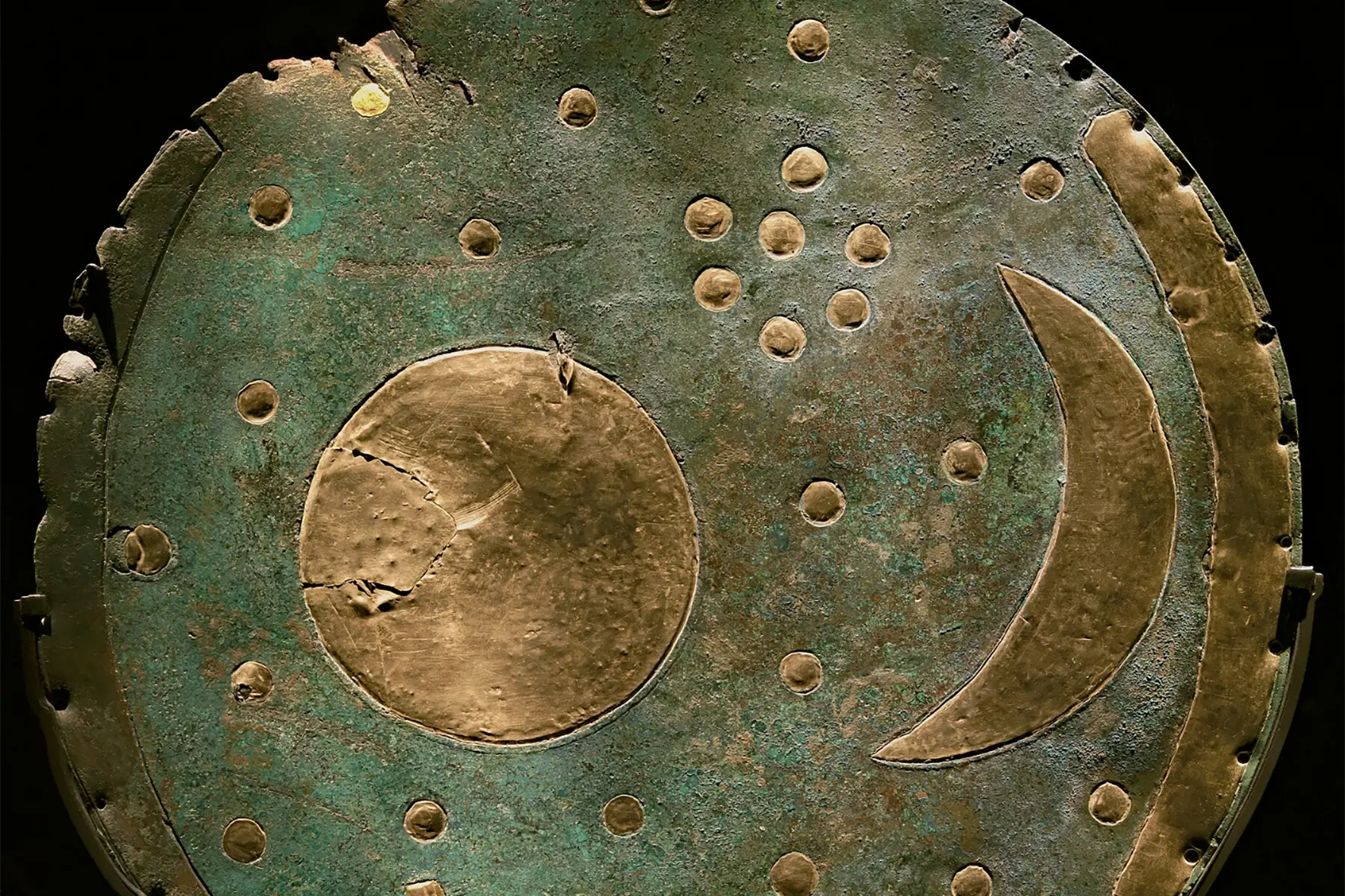
The sky disc is 30cm across and made of bronze inlaid with golden depictions of the sun, moon and stars. A cluster of seven stars has been interpreted as the Pleiades. On the right-hand side there is a gold strip; a corresponding strip to the left is missing. A striated third strip at the base has been interpreted as a solar boat that carried the sun on its daily journey across the prehistoric heavens.
Archaeologists and astronomers have pored over the sky disc ever since its discovery. It dates to about 1800BC, a time when the region was dominated by a warrior aristocracy seen in the nearby Bornhock princely burial mound. Astronomers have described it as “the oldest concrete depiction of cosmic phenomena worldwide”.
So what does it signify? The answer lies in the two golden crescents that flank the sun and moon. If you draw lines from the top right of one to the lower left of the other, the resulting angle is exactly 82.7°, and that corresponds to the passage of time recorded by the summer and winter solstice, when the sun momentarily stands still before reversing course. When, at 51°N latitude, you look northwest from the Mittelberg, you will find that the sun sets behind the topmost peak of the Harz mountains 80km away. Does this remind you of the summer solstice at Stonehenge, when the sun rises directly above the so-called heel stone beyond the main Sarsen ring? Let us acknowledge the remarkable sacred knowledge of the heavens that existed across the European Bronze Age and marvel at how they recorded celestial events.
However, there is now more information to hand. The sky disc is made of tin bronze, and embellished with gold. Where did these metals come from? Archaeologists have deployed trace element and isotopic analyses recently and pinpointed alluvial gold deposits along the course of the river Carnon in Cornwall as the source. The rich deposits of tin ore from Cornwall were also tapped. This means that the metal travelled 1250km to the warrior princes of Germany before craft specialists set to work on a disc now described as one of the most important archaeological finds of the 20th century.