

PHOTO
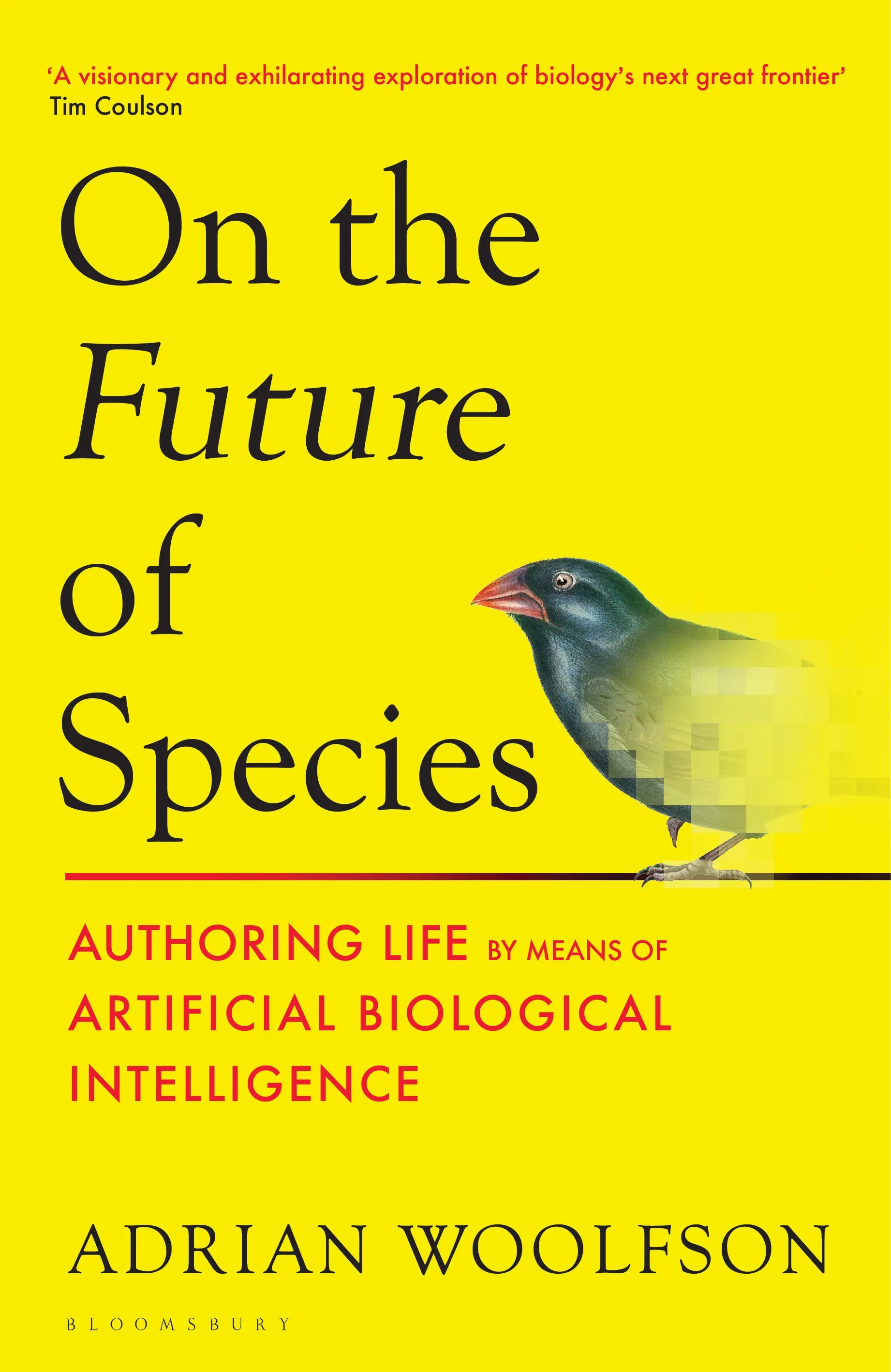
On the Future of Species: Authoring Life by Means of Artificial Biological Intelligence
By Adrian Woolfson
Bloomsbury
Reviewed by Clive Trotman
In case the allusion of this book’s title to that of Charles Darwin’s great work On the Origin of Species is lost on any reader, the picture of a finch on the cover should jolt them into higher consciousness.
Against Darwin’s subtitle “by Means of Natural Selection”, Adrian Woolfson’s contrasting subtitle invites us to contemplate a diametrically different and potentially frightening future.
We face arguably the greatest revolution in the billions of years of life’s history, the point where life has itself achieved the human species, uniquely equipped with the ability to alter its own destiny, and that of every other species, for better or worse.
The style of Woolfson’s rich narrative features much entertaining detail about the personalities and interactions involved in the great biological discoveries.
All scientific advances build on prior discoveries, but if genetic manipulation had a starting point, it was surely the unravelling of DNA structure in 1953.
It is great to see full recognition given to the hapless Rosalind Franklin, persevering in an era when the university did not even allow females and males to have lunch together.
Nevertheless, Franklin’s brilliant X-ray crystallography images were instrumental in enabling James Watson, Francis Crick and Maurice Wilkins to deduce the chemistry of DNA and win the Nobel Prize. (Franklin had died.)
Progress since has been exponential.
The Human Genome Project, to obtain the first sequence of all the genes (the genome) of a random human, cost nearly US$3 billion and took 13 years.
Technological advances have reduced the cost to a few hundred dollars per person.
With the ability now to compare the genomes of hundreds of thousands of people line by line, genetically inherited problems can be tracked to specific gene differences.
Medical science is learning how to repair these differences by harnessing specially equipped viruses to insert the correct DNA, a massive technology in itself.
As Woolfson explains, the genome is not merely a structural blueprint, but a set of instructions needing to be performed in the correct order to assemble viable three-dimensional life, even as simple as a bacterium.
Only AI can come close to marshalling the trillions of DNA data points necessary to deduce the higher language, or generative grammar, of how this happens.
With that knowledge comes the prospect, if distant, of “improving” on natural life — of changing physiological efficiency, longevity, anatomy.
Notionally, science could devise new subspecies of humans, disease resistant people and improved forms of animals or plants, or could recreate extinct species or even devise completely new ones.
Sadly, history demonstrates that scientific advances achieved with the best of intentions are always at risk of becoming subverted for nefarious purposes.
The construction of aggressive breeds of animals, or super-infectious bacteria and viruses, are about to become a lot easier.
Woolfson’s repeated exhortations to ethical constraints may unfortunately fall on deaf ears.
Clive Trotman is a Dunedin scientist and arbitrator.