

PHOTO
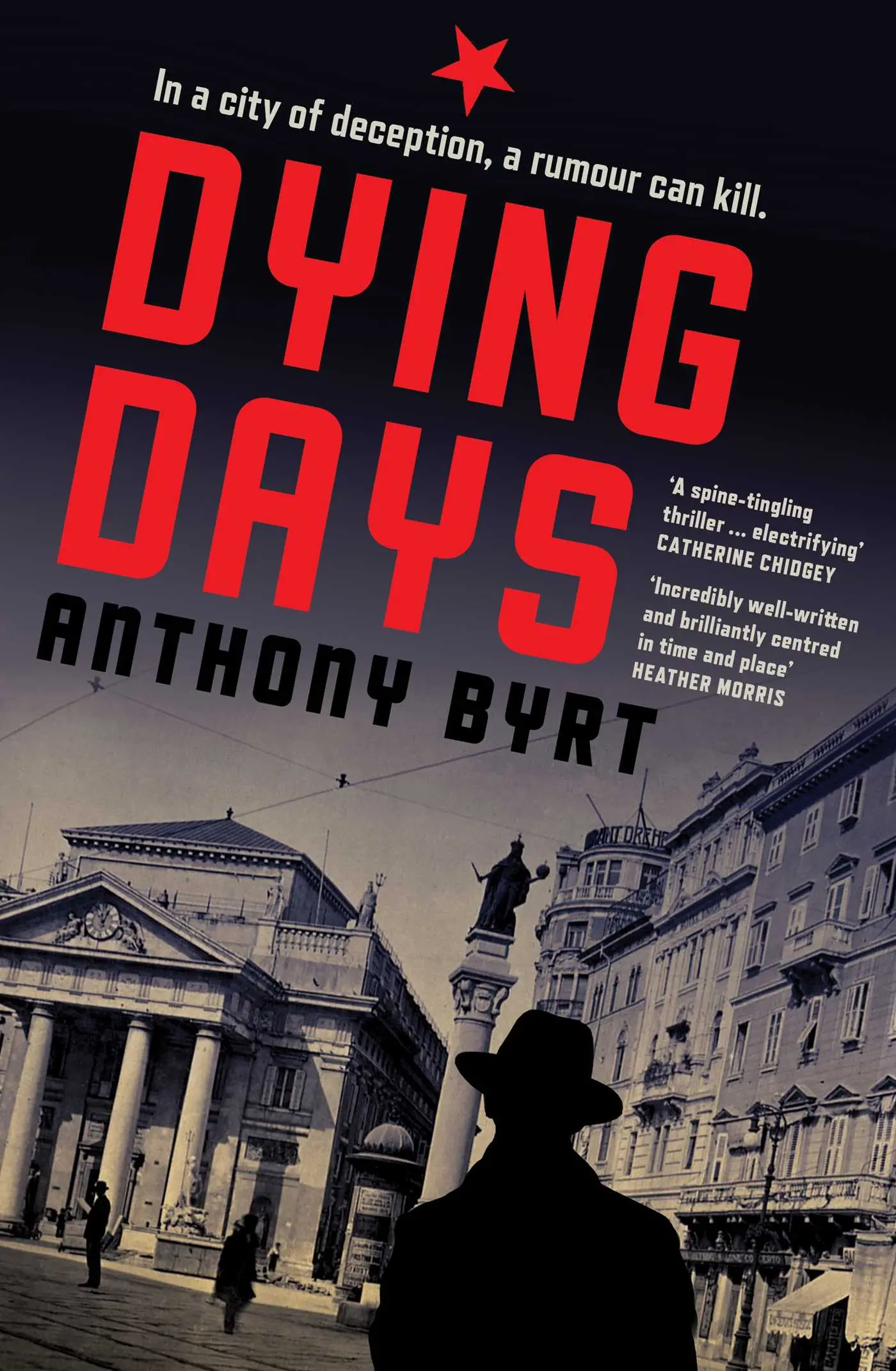
Dying Days
Anthony Byrt
Affirm Press
Reviewed by Jim Sullivan
That an infrequent reader of fiction should be reviewing a novel is because Dying Days is set amidst real events which have always intrigued me — the so-called “40 Days of Trieste” in mid-1945 during which a stand-off between New Zealand troops and Yugoslav forces was the backdrop to intrigue that also involved Italian partisans and the remnants of the defeated Germans and some of their hangers-on.
Naturally, when Dying Days arrived I turned first to the back pages where Anthony Byrt revealed his sources and it confirmed that he has probably read as widely on the topic as anyone.
As a consequence, while interweaving the energetic dialogue and plot twists which are apparently compulsory in a thriller, he succeeds in providing a pretty accurate portrayal of the events of those weeks, a time Winston Churchill included in his famous “Iron Curtain” speech: “From Stettin in the Baltic to Trieste in the Adriatic, an iron curtain has descended across the Continent.”
The Australian publishers, with an eye for local sales, are presenting Dying Days as an ANZAC story.
It is, of course, nothing of the sort.
New Zealand readers will enjoy a narrative in which their own troops, often real people in peripheral roles (General Bernard Freyberg, Geoffrey Cox and other senior officers) are featured and given Kiwi dialogue which rings true, although I’m not convinced “Sir” was a form of address used quite as often as Dying Days suggests.
While the main protagonist is a British intelligence officer with a touch of James Bond about him, the subsidiary hero is a well-drawn New Zealand officer, Captain Mark Donnelly.
That New Zealand cricketer Major Martin Donnelly was in Trieste during the forty days may be just a coincidence.
The plot revolves around the disappearance of four New Zealand soldiers, and while there were strong rumours in Trieste that some New Zealanders had met mysterious ends, no proof of this ever emerged.
As a novelist, Anthony Byrt is able to present a scenario in which the New Zealanders did go missing but to reveal their fate is not part of a reviewer’s remit.
That one of them was a closet Nazi supporter may be stretching credulity a bit but that, no doubt, is part of the thriller repertoire.
Byrt turns in some top-rate descriptive passages.
The Italian summer heat and the threatening weirdness of the surrounding countryside are real enough.
Moments of physical violence, another thriller essential, are handled with restraint and are all the more realistic because of it.
I ploughed on through early pages which had me confused but soon began to enjoy Dying Days, wanting to know what happened next which is, after all, the job of a good thriller.
In the end, I was still a trifle confused but regular spy/thriller readers won’t have that problem.
I am now encouraged to re-read the classic historical account of the events in the novel, Geoffrey Cox’s The Road to Trieste.
Dying Days has shown that a novel based on solid research into historical events can be a damn good read.
That is some achievement for a confirmed non-fictionist.
Jim Sullivan is a Patearoa writer