

PHOTO
If we care about the environment, we have to get amongst it, a trio of young scientists tell Tom McKinlay.
Rain had been falling for some time and the Leith was rising.
It was cold. Dunedin was recording its warmest June on record, but it was still the middle of winter.
The midday high of less than 10°C had dropped away further, plummeting through the single figures.
Of course, the water in the Leith had started cold and remained that way, it wouldn’t break 7°C.
However, they had been waiting some time for this opportunity and needed to take it.
They couldn’t be sure when conditions would again be in their favour. It had been an unusually dry month — Dunedin the driest of the main centres, seeing less than two-thirds of its usual monthly precipitation — but the rain had finally arrived, just enough of it for their purposes.
‘‘We hoped and prayed for rain and then it came,’’ says Ava Wilson.
The ‘‘we’’ here is Ava herself, Zoe MacKenzie and Emily Berry, and there they were, at the Leith, as the evening darkened to night — the sun had set, in as much as you could tell, at 5pm — fishing samples of water out of Dunedin’s urban waterway, Ōwheo, the Water of Leith.
In between curling, dance and other after-school activities, they’d taken it in turns, or together, to return to the stream’s true right bank below the University of Otago clocktower to scoop samples in repurposed, clean milk bottles through the later afternoon and into the evening, as the flow doubled and then increased again.
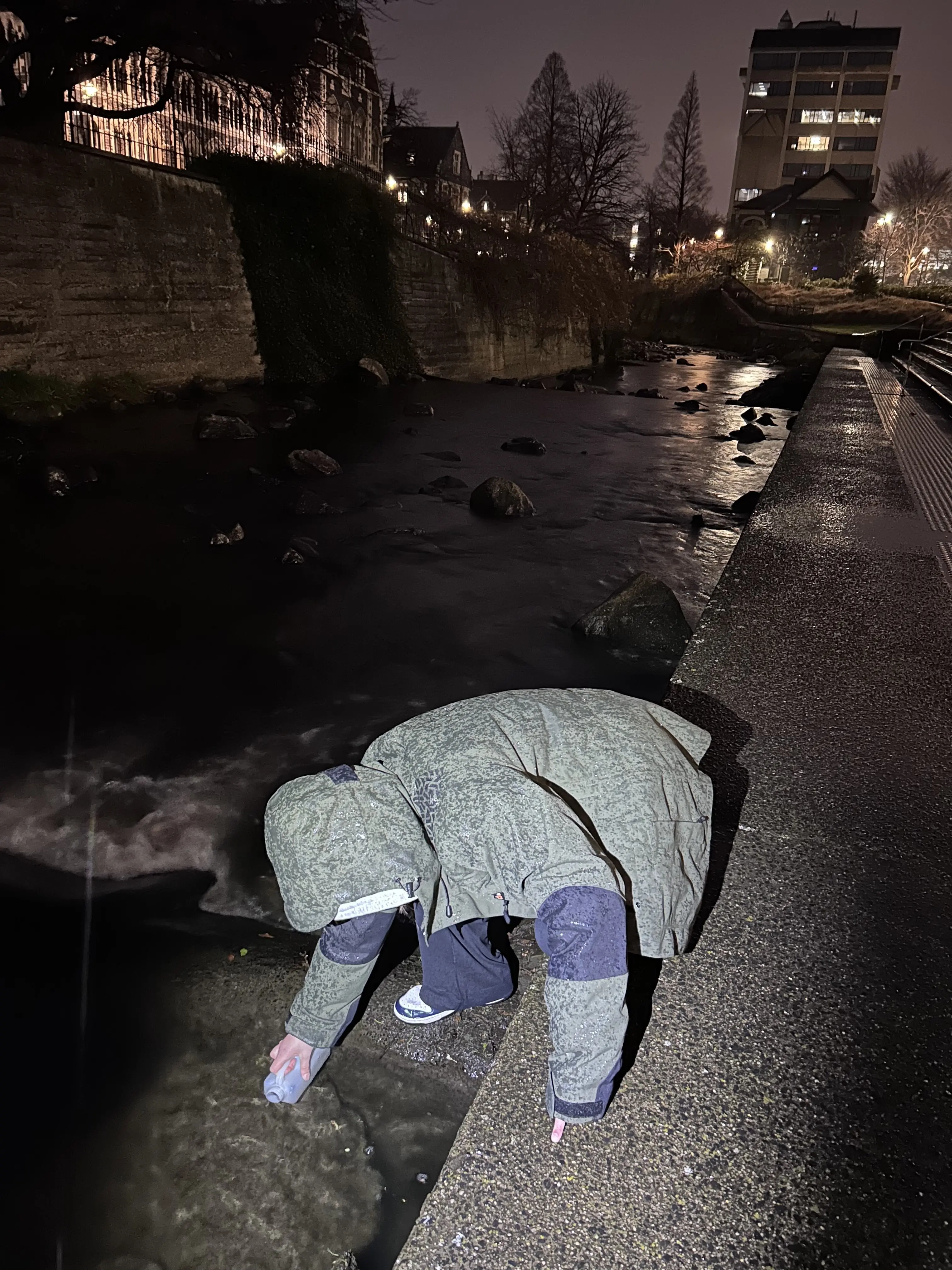
‘‘As the night progressed, it became a bit more difficult because the ground was a bit more slippery and it was just colder, wet and hard to see,’’ Zoe recalls.
Still, at the end of it, the Columba College students had the samples they needed — stream water collected during a storm event that would tell them whether pollutants did indeed spike in the waterway at those times.
This was their hypothesis: ‘‘The concentrations of phosphate and nitrate in the Water of Leith Ōwheo will increase during a heavy rainfall event as stormwater run-off transports nutrients, fertilisers, microplastics, motor oil, animal excretions, waste and other pollutants. Concentrations are expected to reach a peak shortly after rainfall starts before gradually decreasing as the nutrients begin to be washed downstream.’’
Beyond challenging themselves to follow sound scientific processes to test their theory, there was an extra layer of pressure: the trio hoped to enter their experiment in the Otago Science and Technology Fair at Tūhura Otago Museum.
They could be fairly certain they’d find the pollutants they were most interested in — phosphate and nitrate — as the multi-agency environmental data sharing outfit Land Air Water Aotearoa records both as permanent features of the stream’s flow. The trend over the past five years is ‘‘indeterminate’’ or ‘‘likely degrading’’, its website reports.
Ava, Zoe and Emily’s science fair project had not been chosen at random, rather it had spun-off of a larger scientific enterprise that’s been quietly monitoring the health of one of Ōtepoti’s most important natural resources for some years now.
The high-schoolers are all involved in Healthy Harbour Watchers, a project running since 2006 to investigate, as its name suggests, the ecosystem health of the city’s harbour.
It was originally established by former John McGlashan College science teacher Andrew Innes as both a community-based citizen science project and a way to transfer chemistry skills to a new generation — specifically in that marine environment setting. To date, it has worked with hundreds of high school students and volunteers to collect and analyse water samples from various sites around Dunedin.
By doing so, Healthy Harbour Watchers contributes to a fuller understanding of ecosystem health. The local authority with statutory responsibility for water quality — the Otago Regional Council — can do only so much. It monitors the Leith, but not necessarily during storm flushes, and that’s about it for waterways that flow into the harbour. The Dunedin City Council monitors E. coli at popular swimming spot Macandrew Bay.
‘‘The reason we started was there was no information,’’ Innes explains.
‘‘The database we’re trying to add to now is still trying to answer the question of what’s happening in the harbour.
‘‘If you want to understand what’s happening in your backyard you have to do some testing.’’
Together with students from several Dunedin high schools, Healthy Harbour Watchers takes samples from both waterways that flow into the harbour, and from the receiving waters of the harbour itself, testing for phosphorus and nitrogen, among other indicators. There are a lot of pipes and streams funnelling stormwater into the harbour.
‘‘We counted pipes between Anderson’s Bay out to Portobello and it was something between 50 and 60 small discharge pipes that would have lots of stormwater going into the harbour when it rained,’’ Innes says.
So, the task is to answer the question, what’s the impact on the harbour?
‘‘That is the big plan and until we gather more data we probably won’t have any nice concise answers.’’
What they do know, the results of testing so far, will soon be easier to access, as a new website is under construction — courtesy of one of their school teacher allies.
Otago Harbour is not alone in terms of a paucity of data concerning the state of the water, Innes says.
If you are interested in the water quality of our freshwater rivers, there are well established parameters accepted throughout the country, he says. So, around Ōtepoti, there’s information on the Leith and Silver Stream, for example.
‘‘But in harbours and things like that, or marine places, there’s no established research that’s been done that would say this is bad and that is bad.’’
And there is potential for bad. Just over the hill from the harbour, Tomahawk Lagoon has regularly suffered from toxic algal blooms and scientists have warned that the combination of warming seas, nutrient run-off from land and seeping sewage could cause an algal bloom in the harbour fatal to marine life. Ship ballast can also introduce new foreign algae into a harbour environment — loading the dice.
Last year, there was a bloom in Lyttelton Harbour caused by toxin-producing Karenia algae.
A recent massive bloom along South Australia’s coast, also involving Karenia algae, is thought to have killed fish, dolphins, sea lions, penguins and sharks.
Warmer seas were a likely factor there. This year’s El Nino is regarded as a risk factor for algal blooms.
If it did all add up to a problem for Otago Harbour, it would quickly impact the lives of locals.
‘‘If you were thinking you’d love some cockles from the cockle beds near Port Chalmers, then algal toxins would accumulate in the shellfish — so it would be unwise to eat the fish and eat the shellfish,’’ Innes says.
So, Healthy Harbour Watchers take their samples and head back to HQ at the Tomahawk Domain Hall to do the analysis.
At present, St Hilda’s Collegiate pupils are involved at Sawyers Bay Stream and Mussel Bay, Logan Park pupils do regular testing at Ōwheo-Water of Leith and the boat harbour where it emerges, Trinity Catholic College looks after Somerville Stream and Andersons Bay inlet, and Columba College — outside science fair projects — monitors Macandrew Bay’s stream and harbour water.
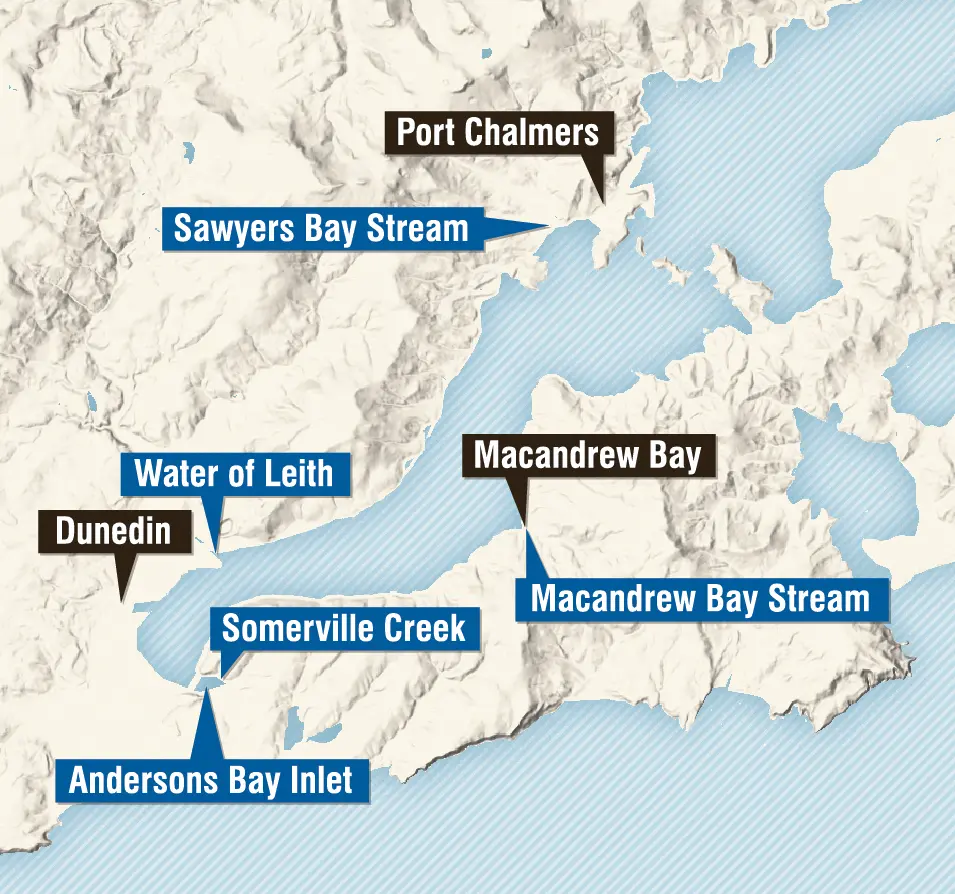
Innes notes that the last time they measured Somerville Creek it was loaded with nitrogen and phosphorus. He describes the water in Sawyers Bay Stream as ‘‘not very nice’’.
On the upside, the absence of disease outbreaks among people swimming in the harbour is a good sign, he says — an indication things aren’t too bad.
The second former science teacher behind Healthy Harbour Watchers, Dr Murray Vickers, who did his teaching at Columba, emphasises the opportunity the initiative provides secondary school students to get hands-on with their environment.
‘‘Being a scientist, I’m interested in getting kids into science,’’ he says. ‘‘And if they can do experimental work in the weekend — we go on Saturday mornings — that’s getting them involved in some real science.’’
They get to do some more sophisticated things than what they would do at school, and learn about why it’s important, he says.
Shout out to the school teachers, Innes adds. Without them, those Saturday mornings don’t happen.
‘‘You’ve got to find a teacher who wants to do it or is passionate about things and if that happens then you’re in business.’’
Together they’re equipping the next generation for the challenges they’ll face.
‘‘If they know how to collect data properly and know that it’s got a bit of rigour, they can have an intelligent conversation with someone about it,’’ Innes says.
‘‘I hate the term ‘warriors’,’’ he says, but he’d like to think the pupils will become advocates for Otago Harbour.
Which was pretty much what Ava, Zoe and Emily had set out to achieve.
The Water of Leith was chosen for their science fair project because it is monitored for flow rates — the stream has form when it comes to flooding. And if you want to know how much nitrogen and phosphorus is flowing into the harbour — and they did — you need to know the flow rate.
This was the question they set out to answer: ‘‘How do heavy rainfall events affect the phosphate and nitrate concentrations in the Water of Leith (Ōwheo) and what implications do these changes have for the water quality and the health of the surrounding aquatic ecosystem(s).’’
For several days before the June 24 rainfall event, Dunedin’s streets and backyards had been fairly dry, so those pollutants would be building up, waiting to be flushed away into the harbour, Emily says.
Unlike waste water, stormwater generally receives little to no treatment before entering natural waterways, the girls knew, so the runoff from the city’s hard surfaces — its roofs, roads and footpaths — would carry its contaminant load of rubbish, debris, oil and chemicals at pace, via the stormwater system, directly into the Leith.
Both of the chemical compounds they were particularly interested in — phosphate, or dissolved reactive phosphorus, and nitrate nitrogen — are naturally present in water, and essential for plant growth, but only at low levels.
The problem arises when the concentrations get too high, causing a chain reaction of weed and algal growth, some of it toxic, potentially leading to eutrophication, in which oxygen levels decline to the point where other life can’t survive.
Before the rain, the Columba students’ testing showed phosphate at 0.087 parts per million in the Leith at Woodhaugh, and given the flow rate at that time, the stream was transporting phosphate at a rate of 15.45mg per second. The equivalent numbers for nitrate before the rain was 3.431ppm and 607.29mg/s.
Both measurements surged once the clouds opened.
Phosphate jumped to 0.11ppm and increased fivefold in the flow to 78.83mg/s at its peak. Nitrogen was up at 4.456ppm and 3105.83mg/s.
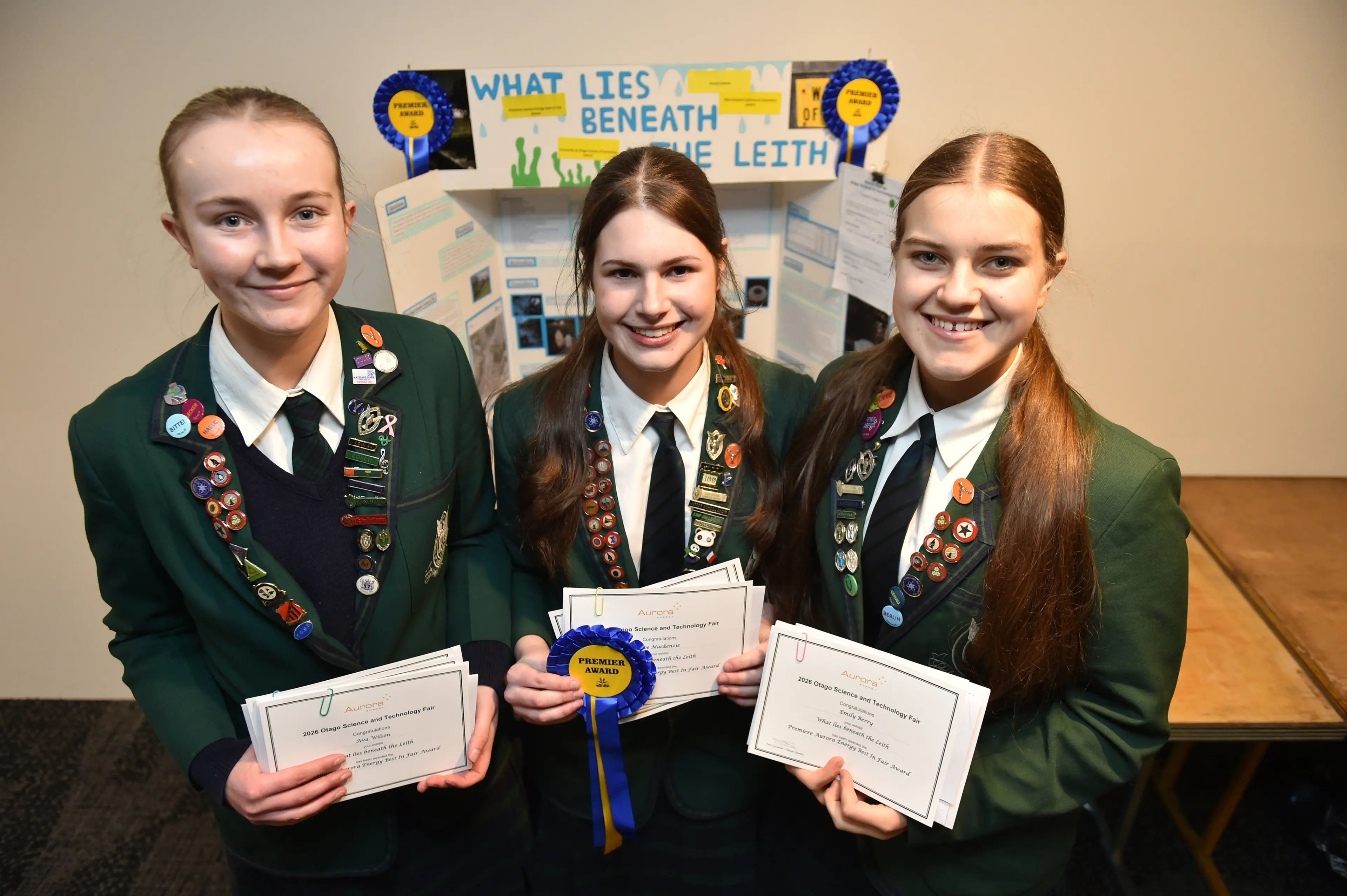
‘‘Overall, this investigation supported our hypothesis that storm events negatively affect the water quality of the Water of Leith/Ōwheo,’’ the trio wrote in their science fair report.
‘‘As shown in our investigation, even in a small rain event (approximately 3mm) notable changes in the phosphate and nitrate concentrations increase and the turbidity levels fluctuate alongside the flow rate of the river. Which demonstrates that even modest rainfall can transport pollutants from the surrounding urban catchment into the river.
‘‘These findings are particularly important because the Water of Leith-Ōwheo ultimately flows into Otago Harbour, meaning contaminants transported during storm events may affect not only the river itself but also downstream estuarine and marine environments.’’
The big takeaway, Zoe says, is that we need to be monitoring our waterways during storm events, so we know more about their impact on pollution.
The ORC’s regular testing in the likes of the Leith provides part of the picture but without catching those weather events, there is data missing, Ava adds.
They are important insights and were recognised as such at the science fair, where the Columba trio picked up the top prize.
However, they are quick to pay tribute to mentors Murray Vickers and Andrew Innes and their work in the modest Tomahawk Domain Hall.
It is such an important place, Emily says, providing a unique experience.